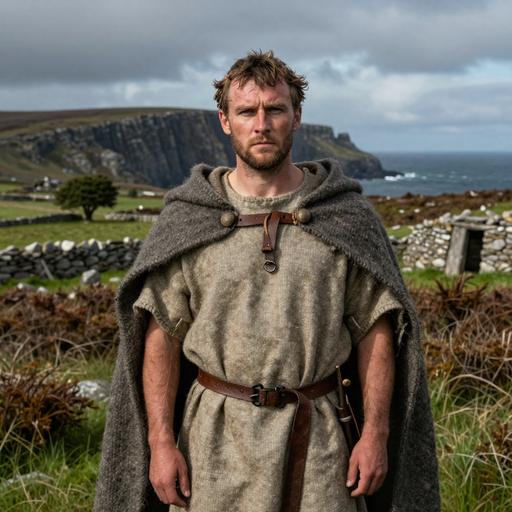
A man buried in Ireland in the Copper Age to Early Bronze Age era

Download PDF creates a visual, rasterized copy. Use Print for selectable text and better assistive-technology support.

Loading Report

Preparing your ancestry journey

Preparing the available report content...

Your report will open automatically.

Skip to main content
Reference library / Sample profile

A man buried in Ireland in the Copper Age to Early Bronze Age era

Explore the recorded context, genetic comparisons and research behind this reference sample.

IrelandIreland EBA

A reference profile describes this sample. It does not establish a personal or family relationship.

AI portrait reconstruction for A man buried in Ireland in the Copper Age to Early Bronze Age era
AI-generated artistic reconstruction, not a photograph of the individual.
Record

Sample details

Recorded details and available lineage markers.

Individual

Celtic individual, Ireland

Sample ID: rath3

Date Range

1736 BCE - 1539 BCE

Cultural Period

Ireland EBA

Biological Sex

Male

mtDNA Haplogroup

J2b1a

Y-DNA Haplogroup

R1b1a1b1a1a2c1

Social Role

Farmer (AI estimate, era-typical)

Geography

Location

Where this individual was discovered

Country Ireland
Locality Rathlin Island. County Antrim
Coordinates 55.2921, -6.1917
Chronology

Date range

When this individual lived in the broader context of human history

Celtic individual, Ireland 1736 BCE - 1539 BCE
Context

Historical context

Background information associated with the reference record.

Region & Environment

Early Bronze Age Ireland occupied a humid Atlantic climate with productive zones in river valleys and flatter coastal areas, while uplands and bogs shaped settlement choices and travel routes. The landscape offered workable soils, timber, and access to raw materials needed for metalworking, though significant exchange would have been required to obtain copper and tin.

Historical Context

Between roughly the mid–3rd and early 2nd millennia BCE, Ireland saw the spread of bronze technology and new styles of metalwork. These changes occurred within local communities rather than clear evidence of large-scale displacement. The period is best understood as a time of gradual technological adoption and evolving social networks.

Populations & Lifeways

People lived in small to medium settlements and in dispersed farmsteads, practicing mixed farming and herding alongside hunting and gathering where appropriate. Daily life relied on timber, stone, and perishable materials, with craft work tied to households and community specialists. Social organization likely emphasized kin-based cooperation, as well as local leaders whose authority could be expressed through conspicuous consumption and ritual activity.

Archaeology & Material Culture

Archaeological signatures include metal items made in bronze and associated artifacts that suggest regional stylistic affinities. Everyday tools and domestic equipment continued to be fashioned from stone, bone, and wood, with metal likely used selectively for items that conveyed status or had specific roles. Settlement archaeology and burial evidence (where present) help show changes in how communities marked memory and authority.

Culture & Society

Bronze work and the display of metal objects provided new avenues for social signaling. Differences in grave goods or crafted items (where securely dated) point to unequal access to imported materials, skills, or exchange partners. Ritual practice remained important, and the maintenance of ceremonial landscapes would have reinforced community identity.

Legacy & Transition

The Early Bronze Age laid groundwork for later phases of the Bronze Age by embedding metallurgy into regional lifeways and strengthening long-distance contacts. Subsequent developments would further diversify settlement patterns, material styles, and forms of display, setting the stage for later Bronze Age cultural expressions.

Analysis

Genetic comparisons

These comparisons show genetic similarity, not identity or origin. The populations listed are those whose genomes show statistical alignment to this ancient individual.

Similarity reflects shared history, not shared identity. These are analytical comparisons, not claims about who this person was.

Modern Genetic Admixture

This analysis compares the DNA profile with present-day reference populations, showing statistical similarity to modern reference populations from different regions. The excavation site records where this individual was found, not a fixed modern genetic identity.

Europe 96.4%
Northwestern European 73.5%
English 52.6%
Northwestern European 9.3%
Scandinavian 7.9%
Finnish 3.9%
Eastern European 12.9%
Southern European 10.0%
Iberian 7.7%
Italian 1.8%
Sardinian 0.5%
Asia 3.3%
Central Asian, Northern Indian & Pakistani 2.3%
Indian 2.3%
Northern West Asian 1.0%
Cypriot 1.0%

Closest Modern Populations

These are the modern populations showing the closest statistical alignment to A man buried in Ireland in the Copper Age to Early Bronze Age era, ranked by genetic distance. Lower distance values indicate closer statistical similarity. Cross-region similarity can reflect shared ancestry, population movement, continuity, or later admixture.

1
Norwegian
1.9896
2
Icelandic
2.1052
3
Orcadian
2.1488
4
Danish
2.1497
5
Swedish
2.2270
6
Scottish
2.2567
7
Shetlandic
2.3171
8
Dutch
2.4111
9
German Hamburg
2.4567
10
Irish
2.4680
Context

Related Samples

This individual exists within a broader network of ancient samples. No ancient genome stands alone.

Individual Culture/Period Date Location Action
Celtic individual, Ireland Early Bronze Age Ireland 2031 BCE Rathlin Island. County Antrim, Ireland View
Celtic individual, Ireland Neolithic Ireland 3346 BCE Ballynahatty. County Down, Ireland View
Celtic individual, Ireland Early Bronze Age Ireland 2026 BCE Rathlin Island. County Antrim, Ireland View
Celtic individual, Ireland Early Bronze Age Ireland 1736 BCE Rathlin Island. County Antrim, Ireland View
Britain N individual, Ireland 3346 BCE Ballynahatty. County Down, Ireland View
Britain Ca Eba individual, Ireland 2031 BCE Rathlin Island. County Antrim, Ireland View
Britain Ca Eba individual, Ireland 2026 BCE Rathlin Island. County Antrim, Ireland View
Britain Ca Eba individual, Ireland 1736 BCE Rathlin Island. County Antrim, Ireland View
Page 1
Individual Culture/Period Date Location Action
Celtic individual, Ireland Early Bronze Age Ireland 2031 BCE Rathlin Island. County Antrim, Ireland View
Celtic individual, Ireland Early Bronze Age Ireland 2026 BCE Rathlin Island. County Antrim, Ireland View
Celtic individual, Ireland Early Bronze Age Ireland 1736 BCE Rathlin Island. County Antrim, Ireland View
Page 1
Sources

References

Scientific publications and genetic data that inform this profile.

G25 Coordinates

These coordinates represent a position in genetic space, a tool for comparison, not a conclusion. You can use these to perform custom admixture analysis in G25 Studio.

rath3,0.13289152,0.12294198,0.05782274,0.0563078,0.03897706,0.01915874,0.00332554,0.0064091,0.00398408,-0.0058732,-0.00847198,0.00557624,-0.0028283,-0.00820166,0.0162696,-0.00105634,-0.01302778,0.00150642,-0.00087702,-0.00011806,0.0048514,0.0036128,-0.00089062,0.01073286,-0.00205251
Continue in G25 Studio
Use code for 30% off • Expires Nov 16