Menu
Store
Blog
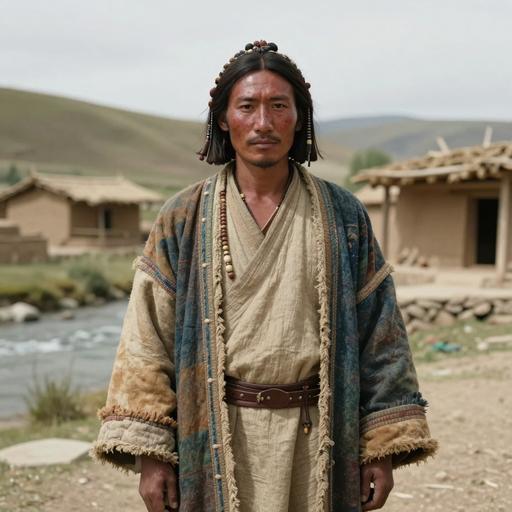
Portrait reconstruction of C1036
Ancient Individual

A man buried in China in the Bronze Age era

C1036
893 BCE - 787 BCE
Male
Xiaoenda Culture
China
Scroll to begin
Chapter I

Identity

The biological and cultural markers that define this ancient individual

Sample ID

C1036

Date Range

893 BCE - 787 BCE

Biological Sex

Male

mtDNA Haplogroup

Not available

Y-DNA Haplogroup

O-CTS2643

Cultural Period

Xiaoenda Culture

Chapter II

Place

Where this individual was discovered

Country China
Locality Xiaoenda (Chamdo)
Coordinates 31.6000, 97.1000
Chapter III

Time

When this individual lived in the broader context of human history

C1036 893 BCE - 787 BCE
Chapter IV

Story

The narrative of this ancient life

The term \Xiaoenda Culture" does not appear to be widely recognized or documented in academic or historical resources related to Chinese history or archaeology up to my last update in October 2023. It's possible that "Xiaoenda Culture" is a fictional or very obscure reference, as Chinese history indeed comprises numerous distinctive cultures and historical periods.

However, I can provide insights into early Chinese cultures and civilizations, specifically those that flourished during ancient times, like the Xia, Shang, and Zhou dynasties, as well as earlier prehistoric cultures like the Yangshao or Longshan cultures. Here’s an overview of the early foundations of Chinese civilization that are well-documented:

Yangshao Culture (c. 5000–3000 BCE)

  • Location: Primarily situated in the Yellow River Basin.
  • Economy and Lifestyle: The Yangshao were a Neolithic culture engaged in agriculture, with millet being a staple crop. The community was predominantly sedentary, consisting of small, agrarian villages.
  • Artifacts and Pottery: Noted for their red and brown painted pottery, often decorated with geometric designs and occasionally with images of animals or human faces.
  • Social Structure: Generally believed to be egalitarian with communal living structures, lacking significant social stratification.

Longshan Culture (c. 3000–1900 BCE)

  • Location: Spread through the central plains of China, following the Yellow River.
  • Technological Advancements: Known for their advanced pottery skills, the Longshan made black, egg-shell thin pottery, which suggests significant technological and artistic advancements.
  • Societal Changes: Evidence of social stratification begins to appear, seen in burial practices and varying house sizes.
  • Infrastructure: Marked by the development of walled settlements, indicating organized defense mechanisms and possibly the beginnings of city-states.

Xia Dynasty (c. 2070–1600 BCE)

  • Historical Context: Often regarded as the first dynasty in traditional Chinese historiography, though archaeological evidence remains sparse and debated.
  • Legend and Reality: Documented by ancient texts like the "Bamboo Annals," the Xia dynasty occupies a transitional phase from prehistory to recorded history.
  • Technological Progress: Known for bronze casting, which heralded a new era of tool and weapon production.

Shang Dynasty (c. 1600–1046 BCE)

  • Location: Centered in the Yellow River Valley, around modern-day Henan province.
  • Cultural Developments: First definite historical dynasty supported by archaeological evidence. Known for its advanced bronze casting techniques, oracle bone script (an early form of Chinese writing), and development of a centralized state.
  • Religion: Practiced ancestor worship, divination, and a form of proto-animism.
  • Urbanization: Cities were built with palatial buildings, religious sites, and comprehensive burial sites, indicating sophisticated urban planning and religious practices.

Zhou Dynasty (c. 1046–256 BCE)

  • Western Zhou (1046–771 BCE): Known for the Mandate of Heaven concept, which justified the rule of the king or emperor as divinely sanctioned.
  • Eastern Zhou (770–256 BCE): Marked by the Spring and Autumn and Warring States periods, leading to significant philosophical development, including Confucianism and Daoism.
  • Technological Innovations: Iron began to replace bronze for tools and weapons, leading to improved agricultural techniques and military capabilities.
  • Cultural Flourishing: The Zhou era saw the compilation of classical texts like the "I Ching" and the formation of Confucian and Daoist thought.

Conclusion

The early cultures of China laid the foundation for millennia of development and civilization. They were characterized by significant technological advancements, varied religious and social practices, and the gradual formation of stable political structures and ideologies. If "Xiaoenda Culture" is a term used in specific or niche contexts, further clarification and resources from contemporary sources may be necessary to identify its features accurately."

Chapter V

Context

Other ancient individuals connected to this sample

Use code for 30% off Expires Apr 04