Menu
Store
Blog
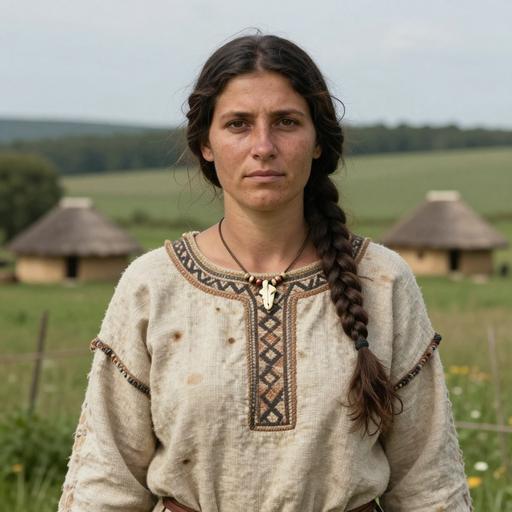
Portrait reconstruction of I2357
Ancient Individual

A woman buried in Hungary in the Middle Neolithic era

I2357
5300 BCE - 4900 BCE
Female
Middle Neolithic Alföld Linear Pottery Culture Szakálhát Group, Hungary
Hungary
Scroll to begin
Chapter I

Identity

The biological and cultural markers that define this ancient individual

Sample ID

I2357

Date Range

5300 BCE - 4900 BCE

Biological Sex

Female

mtDNA Haplogroup

H1e

Cultural Period

Middle Neolithic Alföld Linear Pottery Culture Szakálhát Group, Hungary

Chapter II

Place

Where this individual was discovered

Country Hungary
Locality Pusztataskony Ledence 1
Coordinates 47.4593, 20.5128
Chapter III

Time

When this individual lived in the broader context of human history

I2357 5300 BCE - 4900 BCE
Chapter IV

Story

The narrative of this ancient life

The Middle Neolithic Alföld Linear Pottery Culture (ALPC), specifically the Szakálhát group, represented a remarkable period in the prehistory of Hungary and the broader Carpathian Basin. This culture, flourishing from approximately 5300 to 4500 BC, played a crucial role in the neolithization of Central Europe, marked by significant developments in agriculture, settlement patterns, and material culture.

Geographic and Cultural Context

The Szakálhát group was situated primarily in the Great Hungarian Plain, also known as the Alföld, a fertile and expansive lowland area that provided an ideal environment for early agricultural societies. The Carpathian Basin's rivers and streams facilitated not only agriculture but also trade and communication, helping connect disparate Neolithic communities.

Settlement Patterns

Archaeological evidence shows that settlements of the Szakálhát group were typically located on slight elevations near water sources, such as rivers and streams, which prevented flooding and supported irrigation. These settlements often consisted of longhouses, which were rectangular, sometimes slightly curved, and made of timber and wattle-and-daub. These structures were multi-functional, serving as domestic spaces, storage, and sometimes even communal areas.

Economy and Subsistence

The economy of the Szakálhát group was fundamentally based on agriculture and animal husbandry. They cultivated various crops, including einkorn and emmer wheat, barley, and legumes like peas and lentils. These Neolithic farmers also practiced animal husbandry, raising cattle, pigs, sheep, and goats. The domestication of animals and cultivation of crops marked a significant shift from earlier hunter-gatherer lifeways to more sedentary and complex agricultural societies.

Fishing, hunting, and gathering wild resources supplemented their diet. The presence of wild animal bones in archaeological sites indicates that hunting of deer, boar, and other game continued to play a role in their subsistence strategies.

Pottery and Material Culture

The Alföld Linear Pottery Culture is well-known for its distinctive pottery, and the Szakálhát group was no exception. Their ceramics were characterized by intricately decorated, linear designs executed with incised or impressed techniques. Common vessel forms included bowls, storage jars, and cups. The motifs often included geometric patterns, which might have held symbolic meanings or represented communal identity.

Stone tools were another critical aspect of their material culture. Neolithic communities of this era created polished stone axes, sickle blades, and other tools primarily from local raw materials. Shell ornaments and personal adornments indicate the importance of aesthetic expression and possibly social status.

Social Organization and Cultural Practices

Social organization within the Szakálhát group was likely clan-based, with kinship ties playing a crucial role in community structure. Evidence suggests some level of social differentiation, which could have been reflected in the distribution of goods, burial practices, and possibly dwelling sizes.

Rituals and spiritual beliefs, while not fully understood, were certainly an integral part of life. The presence of figurines, altars, and specific burial rites suggests the existence of religious or spiritual practices, which might have involved ancestor worship or fertility rituals.

Interaction and Trade

The Szakálhát group, like many Neolithic communities, was not isolated. They engaged in long-distance trade and exchange networks that facilitated the spread of goods, ideas, and technologies. This exchange is evidenced by the presence of non-local goods, such as obsidian from the northeastern Carpathians and Balkan flint.

Conclusion

The Szakálhát group within the Alföld Linear Pottery Culture represents a dynamic and complex Neolithic society. Their advancements in agriculture, settlement construction, and material culture highlight their adaptability and innovation. Moreover, their interactions with neighboring cultures underscore the interconnectedness of Neolithic Europe, setting the foundation for the subsequent development of European prehistoric societies.

Chapter V

Genetics

The genetic ancestry of this ancient individual

Ancient Genetic Admixture

This analysis compares the DNA profile of I2357 with ancient reference populations, showing the genetic composition in terms of prehistoric ancestral groups.

Neolithic Farmers 69.1%
European Hunter-Gatherers 22.0%
Western Steppe Pastoralists 8.9%

Modern Genetic Admixture

This analysis compares the DNA profile with present-day reference populations, showing what percentage of genetic makeup resembles modern populations from different regions.

Europe 87.5%
Southern European 87.5%
Italian 48.1%
Sardinian 29.0%
Balkan 8.5%
Iberian 2.0%
Asia 8.1%
Northern West Asian 8.1%
Cypriot 8.1%
Africa 4.4%
North African 4.4%
North African 4.4%

Closest Modern Populations

These are the modern populations showing the closest statistical alignment to A woman buried in Hungary in the Middle Neolithic era, ranked by genetic distance. Lower distance values indicate closer statistical similarity.

1
Sardinian
3.2429
2
French Corsica
6.7948
3
Belmonte Jew
6.9155
4
Italian Lazio
7.8508
5
Italian Umbria
8.0938
6
Sicilian West
8.1538
7
Italian Lombardy
8.2615
8
Spanish Murcia
8.2778
9
Spanish Andalucia
8.3849
10
Spanish Canarias
8.4007
Chapter VI

Context

Other ancient individuals connected to this sample

Sources

References

Scientific publications and genetic data

Scientific Publication

Parallel palaeogenomic transects reveal complex genetic history of early European farmers

Authors Lipson M, Szécsényi-Nagy A, Mallick S
Abstract

Ancient DNA studies have established that Neolithic European populations were descended from Anatolian migrants who received a limited amount of admixture from resident hunter-gatherers. Many open questions remain, however, about the spatial and temporal dynamics of population interactions and admixture during the Neolithic period. Here we investigate the population dynamics of Neolithization across Europe using a high-resolution genome-wide ancient DNA dataset with a total of 180 samples, of which 130 are newly reported here, from the Neolithic and Chalcolithic periods of Hungary (6000-2900 bc, n = 100), Germany (5500-3000 bc, n = 42) and Spain (5500-2200 bc, n = 38). We find that genetic diversity was shaped predominantly by local processes, with varied sources and proportions of hunter-gatherer ancestry among the three regions and through time. Admixture between groups with different ancestry profiles was pervasive and resulted in observable population transformation across almost all cultural transitions. Our results shed new light on the ways in which gene flow reshaped European populations throughout the Neolithic period and demonstrate the potential of time-series-based sampling and modelling approaches to elucidate multiple dimensions of historical population interactions.

G25 Coordinates

The G25 coordinates for sample I2357 can be used for detailed admixture analysis in our G25 Studio tool.

I2357,0.10737046,0.16008848,0.01350772,-0.05631854,0.05228108,-0.02730054,-0.00375742,0.00458048,0.04265166,0.06810296,-0.0015652,0.01164942,-0.01955258,-0.01399524,-0.01232252,0.00577108,0.01364562,-0.0003927,-0.00098924,-0.00253556,-0.00059984,0.00358316,-0.01101276,-0.0184208,0.00385858
Analyze in G25 Studio
Use code for 40% off Expires Feb 27