Menu
Store
Blog
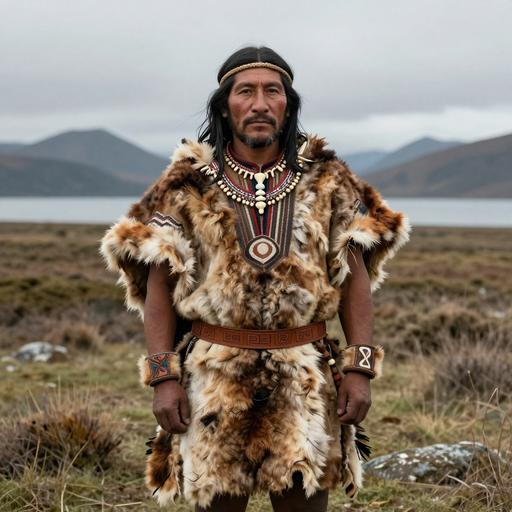
Portrait reconstruction of MA577
Ancient Individual

A man buried in Argentina in the Modern South America era

MA577
1800 CE - 1900 CE
Male
North Tierra del Fuego Selknam Culture 100 Years Ago
Argentina
Scroll to begin
Chapter I

Identity

The biological and cultural markers that define this ancient individual

Sample ID

MA577

Date Range

1800 CE - 1900 CE

Biological Sex

Male

mtDNA Haplogroup

D1g5

Y-DNA Haplogroup

Q-M902

Cultural Period

North Tierra del Fuego Selknam Culture 100 Years Ago

Chapter II

Place

Where this individual was discovered

Country Argentina
Locality Tierra del Fuego. Strait of Magellan
Chapter III

Time

When this individual lived in the broader context of human history

MA577 1800 CE - 1900 CE
Chapter IV

Story

The narrative of this ancient life

The Selknam, also known as the Ona, were an indigenous people who historically inhabited the northern regions of Tierra del Fuego, an archipelago located at the southernmost tip of South America. The description requested pertains to the Selknam culture approximately 100 years before present, offering a glimpse into their way of life, social structures, spiritual beliefs, and interactions with their environment before the full impact of European colonization was felt.

Geographic Setting and Environment

North Tierra del Fuego is characterized by its harsh and challenging environment, including subpolar oceanic climates, strong winds, and temperatures that rarely rise above 10°C (50°F). The landscape consists of rugged coastlines, open plains, and dense forests. Despite these challenging conditions, the Selknam adeptly adapted to their surroundings, which provided diverse resources that supported their nomadic lifestyle.

Lifestyle and Economy

The Selknam were traditionally a nomadic hunter-gatherer society, with hunting being central to their subsistence. Guanaco, a camelid native to the region, was a primary food source, providing meat, skins, and bones for various uses including clothing and tools. The Selknam also hunted other animals such as seals, birds, and smaller mammals, and gathered shellfish, berries, and plant roots when in season.

Social Structure and Community

Selknam social organization was familial and clan-based. Extended families traveled together across specific territories that they knew intimately, including all the water sources, safe campsites, and hunting grounds. Their social structure was relatively egalitarian, with roles divided to some extent by gender, though cooperation and community inclusion were highly valued.

Spiritual and Ritual Life

The Selknam were deeply spiritual, with a belief system that centered on shamanistic practices and the presence of supernatural beings. One of the central elements of Selknam spiritual life was the Hain ceremony, an elaborate rite of passage for young men involving complex rituals and symbolic performances. During Hain, adult men would dress as spirits to teach lessons and impart cultural knowledge.

The Selknam worshipped a pantheon of deities, and their cosmology featured numerous myths explaining their relationship with nature and the universe. Shamans, known as \xon," played a crucial role as mediators between the physical and spiritual worlds, responsible for healing and conducting rituals.

Art and Material Culture

The Selknam were known for their intricate body paintings used during the Hain ceremony. These paints had symbolic meanings and were often composed of red, white, and black colors, which held sacred significance. Their artistic expression also extended to the creation of tools, garments made from guanaco hides, and other cultural items essential for daily living.

European Contact and Cultural Impact

By the late 19th and early 20th centuries, European colonization had reached Tierra del Fuego. Settlers and sheep ranchers significantly disrupted the Selknam way of life through land appropriation, violence, and the introduction of diseases to which the Selknam had no immunity. These events led to drastic declines in Selknam populations and a profound impact on their traditional practices and social structures.

Legacy and Modern-Day Recognition

Today, the Selknam are recognized for their rich cultural history and contributions to the diversity of indigenous cultures in South America. Efforts are ongoing to preserve and revive Selknam culture, language, and traditions. Despite the historic adversities, the resilience of the Selknam people remains a testament to their enduring spirit and adaptability in one of the world's most challenging environments."

Chapter V

Genetics

The genetic ancestry of this ancient individual

Ancient Genetic Admixture

This analysis compares the DNA profile of MA577 with ancient reference populations, showing the genetic composition in terms of prehistoric ancestral groups.

Ancient Native Americans 81.7%
Ancient Asians 15.9%
European Hunter-Gatherers 2.4%

Modern Genetic Admixture

This analysis compares the DNA profile with present-day reference populations, showing what percentage of genetic makeup resembles modern populations from different regions.

America 91.9%
America 91.9%
Native American 91.9%
Asia 6.8%
Northern Asian 3.4%
Siberian 3.4%
Japanese & Korean 2.2%
Japanese 2.2%
Chinese & Southeast Asian 1.1%
Chinese 1.1%
Europe 1.1%
Northwestern European 1.1%
Scandinavian 1.1%

Closest Modern Populations

These are the modern populations showing the closest statistical alignment to A man buried in Argentina in the Modern South America era, ranked by genetic distance. Lower distance values indicate closer statistical similarity.

1
Aymara
2.0094
2
Bolivian Lapaz
2.4377
3
Piapoco
2.4508
4
Yukpa
2.7109
5
Wichi
2.7964
6
Colla
2.9306
7
Cachi
3.1976
8
Mixe
3.6061
9
Mayan
4.1558
10
Karitiana
4.3706
Chapter VI

Context

Other ancient individuals connected to this sample

Sources

References

Scientific publications and genetic data

Scientific Publication

POPULATION GENETICS. Genomic evidence for the Pleistocene and recent population history of Native Americans

Authors Raghavan M, Steinrücken M, Harris K
Abstract

How and when the Americas were populated remains contentious. Using ancient and modern genome-wide data, we found that the ancestors of all present-day Native Americans, including Athabascans and Amerindians, entered the Americas as a single migration wave from Siberia no earlier than 23 thousand years ago (ka) and after no more than an 8000-year isolation period in Beringia. After their arrival to the Americas, ancestral Native Americans diversified into two basal genetic branches around 13 ka, one that is now dispersed across North and South America and the other restricted to North America. Subsequent gene flow resulted in some Native Americans sharing ancestry with present-day East Asians (including Siberians) and, more distantly, Australo-Melanesians. Putative "Paleoamerican" relict populations, including the historical Mexican Pericúes and South American Fuego-Patagonians, are not directly related to modern Australo-Melanesians as suggested by the Paleoamerican Model.

G25 Coordinates

The G25 coordinates for sample MA577 can be used for detailed admixture analysis in our G25 Studio tool.

MA577,0.0573136,-0.31204466,0.11254032,0.0992224,-0.11532836,-0.0117525,-0.29890192,-0.35104608,-0.01358568,-0.0155877,0.00212574,-0.00057184,-0.00177144,0.02497586,-0.00581628,-0.0009481,0.00567628,0.00328394,0.0013449,-0.00145476,0.0002158,0.00690734,-0.00249878,-0.00526768,-0.00521653
Analyze in G25 Studio
Use code for 40% off Expires Feb 26