Menu
Store
Blog
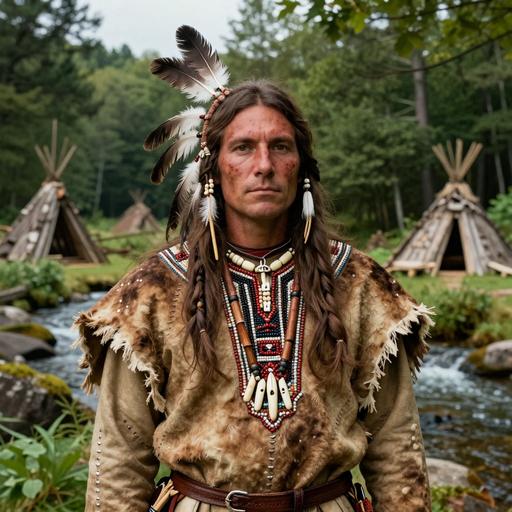
Portrait reconstruction of US-14
Ancient Individual

A man buried in USA in the Colonial Era North America era

US-14
1521 CE - 1797 CE
Male
Colonial Period Pennsylvania, USA
USA
Scroll to begin
Chapter I

Identity

The biological and cultural markers that define this ancient individual

Sample ID

US-14

Date Range

1521 CE - 1797 CE

Biological Sex

Male

mtDNA Haplogroup

U4c1a

Y-DNA Haplogroup

I-Z73

Cultural Period

Colonial Period Pennsylvania, USA

Chapter II

Place

Where this individual was discovered

Country USA
Locality Shohola Creek. Indian Cabin Ridge. PA
Chapter III

Time

When this individual lived in the broader context of human history

US-14 1521 CE - 1797 CE
Chapter IV

Story

The narrative of this ancient life

The Colonial Period in Pennsylvania, part of the broader Anglo-American civilization, is a fascinating era characterized by diverse cultural, social, political, and economic elements that shaped the region's development. This period, spanning from the early 17th century to the American Revolution in the late 18th century, presents a mosaic of experiences and interactions among various groups, including European settlers, Indigenous peoples, and enslaved Africans.

Historical Context

Pennsylvania's colonial history began when the English King Charles II granted a land charter to William Penn in 1681. This land charter was partly to settle a debt owed to Penn's father but also to provide a place where Penn's Quaker religious beliefs could be freely practiced. Named \Penn's Woods," Pennsylvania was envisioned as a "Holy Experiment," a society based on religious freedom, fair governance, and peaceful coexistence with Native Americans.

Cultural and Religious Tapestry

One of the most distinctive aspects of colonial Pennsylvania was its religious tolerance and diversity. Unlike other colonies with dominant religious practices, Pennsylvania attracted a variety of religious and ethnic groups seeking refuge and freedom. The Quakers, who played a central role, were known for their pacifism, equality, and opposition to slavery. However, the colony also became home to other religious groups, including German Lutherans, Moravians, Mennonites, Amish, Anglicans, and Jews. This religious pluralism laid the foundations for a society that valued individual freedoms and community welfare.

Interactions with Indigenous Peoples

The relationship between Pennsylvania colonists and Native American tribes, such as the Lenape (Delaware), Susquehannock, and Iroquois, was relatively more peaceful compared to other colonies. William Penn's treaties, including the famous Treaty of Shackamaxon, emphasized negotiation and mutual respect, although this peace gradually eroded as more settlers arrived and land competition intensified.

Economic Development

Pennsylvania's economy flourished through agriculture, trade, and industry. The fertile land allowed for the cultivation of crops such as wheat, corn, and rye, making the colony known as the "Breadbasket" for the middle colonies. Additionally, Pennsylvania's forests supplied timber for shipbuilding and other industries. The colony's rivers, particularly the Delaware and the Schuylkill, facilitated trade and transportation.

Philadelphia, Pennsylvania's main city, quickly became a bustling port and commercial center. It attracted merchants, artisans, and laborers who contributed to a diverse economy. By the mid-18th century, Philadelphia was the largest city in British North America and an intellectual and cultural hub, hosting events like the establishment of the American Philosophical Society.

Governance and Political Life

Pennsylvania's political framework was marked by democratic principles and an emphasis on representative government. William Penn's Frame of Government, which emphasized fairness, inclusivity, and individual rights, influenced Pennsylvania's governance model. The colony had a popularly elected assembly, which contributed to a tradition of self-governance that impacted American political thought.

Social Structure and Everyday Life

The social structure in colonial Pennsylvania was less rigid than in other colonies, partly due to Quaker beliefs in equality. However, class distinctions existed, influenced by wealth, occupation, and origins. Pennsylvania's population comprised English, Welsh, Irish, Scots-Irish, German, Dutch, Swedish, and African peoples, each contributing to the colony's vibrant cultural mosaic.

Everyday life revolved around communities and family units, with a heavy emphasis on communal work and religious observance. Education was valued, and institutions like the University of Pennsylvania were established during this period.

Decline and Transition

The colonial period in Pennsylvania began to transform as tensions rose between the American colonies and Great Britain. The growing discontent with British rule and the desire for independence set the stage for Pennsylvania's significant role in the American Revolution. The colony's principles of liberty and freedom would influence the emerging nation profoundly.

In summary, the Colonial Period in Pennsylvania was an era marked by religious freedom, economic prosperity, diverse cultural influences, and a commitment to democratic governance. It set the stage for Pennsylvania's vital contributions to the founding and development of the United States."

Chapter V

Genetics

The genetic ancestry of this ancient individual

Ancient Genetic Admixture

This analysis compares the DNA profile of US-14 with ancient reference populations, showing the genetic composition in terms of prehistoric ancestral groups.

European Hunter-Gatherers 42.9%
Western Steppe Pastoralists 31.5%
Neolithic Farmers 23.5%
Ancient Native Americans 2.2%

Modern Genetic Admixture

This analysis compares the DNA profile with present-day reference populations, showing what percentage of genetic makeup resembles modern populations from different regions.

Europe 95.6%
Northwestern European 48.9%
English 29.0%
Scandinavian 13.5%
Northwestern European 4.4%
Finnish 2.0%
Southern European 29.7%
Italian 17.5%
Balkan 11.9%
Eastern European 17.1%
Africa 3.2%
North African 2.8%
North African 2.8%
America 1.2%
America 1.2%
Native American 1.2%

Closest Modern Populations

These are the modern populations showing the closest statistical alignment to A man buried in USA in the Colonial Era North America era, ranked by genetic distance. Lower distance values indicate closer statistical similarity.

1
Orcadian
2.5274
2
Scottish
2.6746
3
Irish
2.8928
4
Shetlandic
3.0043
5
English
3.0065
6
Dutch
3.0066
7
Afrikaner
3.0372
8
English Cornwall
3.1816
9
Welsh
3.2024
10
Norwegian
3.2323
Chapter VI

Context

Other ancient individuals connected to this sample

Sources

References

Scientific publications and genetic data

Scientific Publication

Ancient human parallel lineages within North America contributed to a coastal expansion

Authors Scheib CL, Li H, Desai T
Abstract

Little is known regarding the first people to enter the Americas and their genetic legacy. Genomic analysis of the oldest human remains from the Americas showed a direct relationship between a Clovis-related ancestral population and all modern Central and South Americans as well as a deep split separating them from North Americans in Canada. We present 91 ancient human genomes from California and Southwestern Ontario and demonstrate the existence of two distinct ancestries in North America, which possibly split south of the ice sheets. A contribution from both of these ancestral populations is found in all modern Central and South Americans. The proportions of these two ancestries in ancient and modern populations are consistent with a coastal dispersal and multiple admixture events.

G25 Coordinates

The G25 coordinates for sample US-14 can be used for detailed admixture analysis in our G25 Studio tool.

US-14,0.12434462,0.12021654,0.05676628,0.0448863,0.03420368,0.01611944,-0.0023311,-0.00303502,0.00179114,-0.00341936,-0.00657846,0.00515074,-0.01297256,-0.00702816,0.02107996,-0.00837702,-0.0190819,0.0014283,0.0001736,-0.00226842,0.00520376,0.00187026,-0.00441196,0.01308078,-0.00161118
Analyze in G25 Studio
Use code for 40% off Expires Feb 27