BAJ022 - A man buried in Jordan in the Neolithic era

Download PDF creates a visual, rasterized copy. Use Print for selectable text and better assistive-technology support.

Loading Report

Preparing your ancestry journey

Connecting to ancient matches...

Preparing your report

Skip to main content
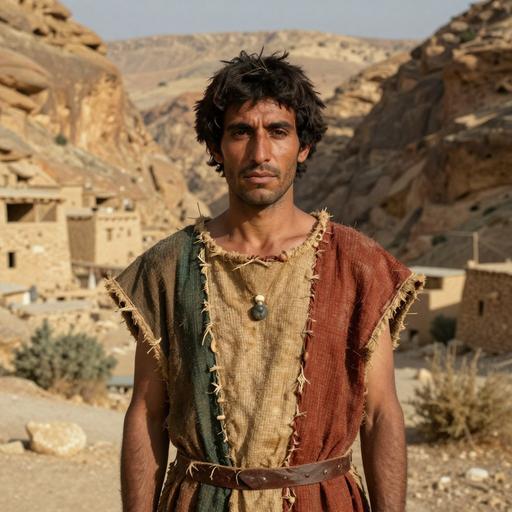
Portrait reconstruction of A man buried in Jordan in the Neolithic era
Ancient Individual

A man buried in Jordan in the Neolithic era

A man buried in Jordan during the Pre-Pottery Neolithic B of Baja

A fragment of the ancient world, preserved across millennia in strands of DNA.

BAJ022
7250 BCE - 6800 BCE
Male
Jordan
Scroll to begin
Chapter I

Identity

The biological and cultural markers that define this ancient individual

Sample ID

BAJ022

Date Range

7250 BCE - 6800 BCE

Cultural Period

Pre-Pottery Neolithic B of Baja

Biological Sex

Male

mtDNA Haplogroup

N1a1a

Y-DNA Haplogroup

E-M84

Social Role

Laborer (AI estimate, era-typical)

Chapter II

Place

Where this individual was discovered

Country Jordan
Locality Ba’ja (Ma'an, Wadi Musa)
Coordinates 30.4153, 35.4625
Chapter III

Time

When this individual lived in the broader context of human history

BAJ022 7250 BCE - 6800 BCE
Chapter IV

Story

The narrative of this ancient life

Pre-Pottery Neolithic B of Baja (c. 7500–6000 BCE) refers to an early Holocene Neolithic horizon on the Baja California peninsula characterized by a pre-pottery technological base and a mixed subsistence economy. The designation “Baja PPNB” is used for archaeological phases that show sustained lifeways oriented toward early farming practices in a coastal-desert environment.

Region & Environment

Baja California spans arid to semi-arid landscapes with coastal zones that could support fishing and seasonal harvesting. In such settings, water availability and local productivity would have strongly influenced settlement locations, duration of occupation, and food strategies.

Historical Context

During the late 8th to 6th millennium BCE, Neolithic lifeways were spreading in various forms across the broader Americas, with regional solutions reflecting local ecologies. This interval highlights early agricultural or proto-agricultural activity in Baja California while still relying on local ecological knowledge.

Populations & Lifeways

Populations likely lived in small communities that balanced cultivation with hunting and gathering opportunities. Even when agriculture was present, mobile or seasonally adjusted practices would have helped manage variable coastal and terrestrial resources, supporting resilient year-round subsistence.

Archaeology & Material Culture

Because this is a pre-pottery horizon, key archaeological indicators include stone tools for cutting and processing, worked lithics associated with food preparation, and possible evidence of cultivation or plant-processing activities. Storage and cooking would have used perishable containers or alternative technologies not always preserved archaeologically. Artifact assemblages therefore emphasize lithic technologies and activity areas.

Culture & Society

Social organization in early Neolithic settings typically involved household- and community-level coordination to manage planting schedules, food processing, and seasonal mobility. Shared material traditions and patterned toolkits likely reflect knowledge transmission and cooperation within small groups.

Legacy & Transition

This horizon contributes to understanding how early Neolithic strategies developed in the region prior to later technological and settlement changes. Subsequent periods would be expected to show shifting subsistence emphases and new material technologies as communities adapted to long-term environmental and social change.

Chapter V

Genetics

These comparisons show genetic similarity, not identity or origin. The populations listed are those whose genomes show statistical alignment to this ancient individual.

Similarity reflects shared history, not shared identity. These are analytical comparisons, not claims about who this person was.

Modern Genetic Admixture

This analysis compares the DNA profile with present-day reference populations, showing statistical similarity to modern reference populations from different regions. The excavation site records where this individual was found, not a fixed modern genetic identity.

Asia 63.6%
Arab, Egyptian & Levantine 63.0%
Levantine 35.1%
Arabian 28.0%
Northern West Asian 0.5%
Cypriot 0.5%
Africa 18.3%
North African 18.3%
North African 11.4%
Egyptian 6.9%
Europe 18.1%
Southern European 18.1%
Sardinian 18.1%
Context

Related Samples

This individual exists within a broader network of ancient samples. No ancient genome stands alone.

Sample ID Culture/Period Date Location Action
BAJ020 Pre-Pottery Neolithic B of Baja 7250 BCE Ba’ja (Ma'an, Wadi Musa), Jordan View
BAJ022 Pre-Pottery Neolithic B of Baja 7250 BCE Ba’ja (Ma'an, Wadi Musa), Jordan View
NEV009 Pre-Pottery Neolithic Culture of Nevalı Çori 8281 BCE NevalıÇori (Şanlıurfa Province), Turkey View
NEV014 Pre-Pottery Neolithic Culture of Nevalı Çori 8527 BCE NevalıÇori (Şanlıurfa Province), Turkey View
NEV020 Nevalı Çori Roman Period 80 CE NevalıÇori (Şanlıurfa Province), Turkey View
NEV021 Nevalı Çori Roman Period 66 CE NevalıÇori (Şanlıurfa Province), Turkey View
NEV030 Nevalı Çori Iron Age Culture 769 BCE NevalıÇori (Şanlıurfa Province), Turkey View
Sample ID Culture/Period Date Location Action
BAJ020 Pre-Pottery Neolithic B of Baja 7250 BCE Ba’ja (Ma'an, Wadi Musa), Jordan View
BAJ022 Pre-Pottery Neolithic B of Baja 7250 BCE Ba’ja (Ma'an, Wadi Musa), Jordan View
Sources

References

Scientific publications and genetic data that inform this profile.
Scientific Publication

Isotopic and DNA analyses reveal multiscale PPNB mobility and migration across Southeastern Anatolia and the Southern Levant

Authors Wang X, Skourtanioti E, Benz M, Gresky J, Ilgner J et al.
Abstract

Growing reliance on animal and plant domestication in the Near East and beyond during the Pre-Pottery Neolithic B (PPNB) (the ninth to eighth millennium BC) has often been associated with a "revolutionary" social transformation from mobility toward more sedentary lifestyles. We are able to yield nuanced insights into the process of the Neolithization in the Near East based on a bioarchaeological approach integrating isotopic and archaeogenetic analyses on the bone remains recovered from Nevalı Çori, a site occupied from the early PPNB in Turkey where some of the earliest evidence of animal and plant domestication emerged, and from Ba'ja, a typical late PPNB site in Jordan. In addition, we present the archaeological sequence of Nevalı Çori together with newly generated radiocarbon dates. Our results are based on strontium (87Sr/86Sr), carbon, and oxygen (δ18O and δ13Ccarb) isotopic analyses conducted on 28 human and 29 animal individuals from the site of Nevalı Çori. 87Sr/86Sr results indicate mobility and connection with the contemporaneous surrounding sites during the earlier PPNB prior to an apparent decline in this mobility at a time of growing reliance on domesticates. Genome-wide data from six human individuals from Nevalı Çori and Ba'ja demonstrate a diverse gene pool at Nevalı Çori that supports connectedness within the Fertile Crescent during the earlier phases of Neolithization and evidence of consanguineous union in the PPNB Ba'ja and the Iron Age Nevalı Çori.

G25 Coordinates

These coordinates represent a position in genetic space, a tool for comparison, not a conclusion. You can use these to perform custom admixture analysis in G25 Studio.

BAJ022,0.0341784,0.14270004,-0.03386098,-0.08573964,0.00659212,-0.03749344,-0.01028766,-0.00110188,0.0430293,0.01684188,0.00656174,-0.008705,0.02329286,-0.00321518,-0.00015896,0.00755966,-0.00718932,-0.00258336,-0.00491868,0.01175152,0.0042675,0.00352632,-0.00238166,-0.00531584,-0.00043289
Continue in G25 Studio
Use code for 35% off Expires Aug 21