NEV020 - A woman buried in Turkey in the Roman era

Download PDF creates a visual, rasterized copy. Use Print for selectable text and better assistive-technology support.

Loading Report

Preparing your ancestry journey

Connecting to ancient matches...

Preparing your report

Skip to main content
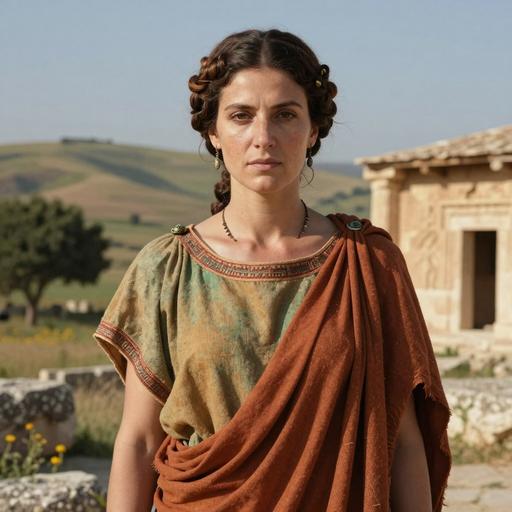
Portrait reconstruction of A woman buried in Turkey in the Roman era
Ancient Individual

A woman buried in Turkey in the Roman era

A woman buried in Turkey during the Nevalı Çori Roman Period

A fragment of the ancient world, preserved across millennia in strands of DNA.

NEV020
80 CE - 227 CE
Female
Turkey
Scroll to begin
Chapter I

Identity

The biological and cultural markers that define this ancient individual

Sample ID

NEV020

Date Range

80 CE - 227 CE

Cultural Period

Nevalı Çori Roman Period

Biological Sex

Female

mtDNA Haplogroup

L2a1+143+@16309

Y-DNA Haplogroup

N/A (Female)

Social Role

Farmer (AI estimate, era-typical)

Chapter II

Place

Where this individual was discovered

Country Turkey
Locality NevalıÇori (Şanlıurfa Province)
Coordinates 37.5190, 38.6060
Chapter III

Time

When this individual lived in the broader context of human history

NEV020 80 CE - 227 CE
Chapter IV

Story

The narrative of this ancient life

Overview

Roman-period Southeast Anatolia witnessed the integration of local populations into the administrative and economic rhythms of the Roman Empire. Archaeological evidence from the Nevalı Çori tradition helps illustrate how rural life and older regional practices persisted alongside new imperial networks.

Region & Environment

The region lies in southeastern Anatolia, characterized by river valleys, rolling uplands, and areas suitable for dry-farming and grazing. Seasonal water availability and arable patches shaped where communities could settle and how they organized agriculture and herding.

Historical Context

By the 1st–4th centuries CE, Roman authority in Anatolia was expressed through provincial administration, military presence, and communication routes that linked towns and estates. Even when imperial structures were present nearby, rural settlements often retained local patterns of building, subsistence, and craft production.

Populations & Lifeways

People in the area were likely mixed in origin and experience, combining local histories with connections to Roman provincial life. Many households would have depended on agriculture, herding, and exchange within regional circuits, with daily practices shaped by the local landscape and access to markets.

Archaeology & Material Culture

Material culture in such Roman provincial contexts commonly includes locally made pottery, small finds, and building traces, alongside occasional imported items. Archaeological patterns attributed to the Nevalı Çori tradition can be used to track continuity and change in settlement organization, household technology, and craft practices over time.

Culture & Society

Society was structured by households and communities operating within a broader provincial framework. Roman-period taxation, land administration, and commercial networks likely influenced what goods moved through the region, while local affiliations and customary practices informed social life.

Legacy & Transition

As Roman rule evolved and political control shifted in late antiquity, regional settlement and economic networks also changed. The archaeological record from this era remains important for understanding how earlier cultural traditions could persist while participating in imperial-era transformations.

Chapter V

Genetics

These comparisons show genetic similarity, not identity or origin. The populations listed are those whose genomes show statistical alignment to this ancient individual.

Similarity reflects shared history, not shared identity. These are analytical comparisons, not claims about who this person was.

Modern Genetic Admixture

This analysis compares the DNA profile with present-day reference populations, showing statistical similarity to modern reference populations from different regions. The excavation site records where this individual was found, not a fixed modern genetic identity.

Europe 93.3%
Southern European 93.3%
Italian 93.3%
Asia 6.7%
Arab, Egyptian & Levantine 6.7%
Levantine 6.7%

Closest Modern Populations

These are the modern populations showing the closest statistical alignment to A woman buried in Turkey in the Roman era, ranked by genetic distance. Lower distance values indicate closer statistical similarity. Cross-region similarity can reflect shared ancestry, population movement, continuity, or later admixture.

1
Druze
1.4381
2
Lebanese Druze
1.5155
3
Alawite
1.6421
4
Lebanese Muslim
2.0595
5
Lebanese Christian
2.1065
6
Karaite Egypt
2.3389
7
Syrian Jew
2.3473
8
Cypriot
2.6982
9
Cochin Jews Paradesi
3.1921
10
Palestinian Beit Sahour
3.3804
Context

Related Samples

This individual exists within a broader network of ancient samples. No ancient genome stands alone.
Sample ID Culture/Period Date Location Action
BAJ020 Pre-Pottery Neolithic B of Baja 7250 BCE Ba’ja (Ma'an, Wadi Musa), Jordan View
BAJ022 Pre-Pottery Neolithic B of Baja 7250 BCE Ba’ja (Ma'an, Wadi Musa), Jordan View
NEV009 Pre-Pottery Neolithic Culture of Nevalı Çori 8281 BCE NevalıÇori (Şanlıurfa Province), Turkey View
NEV014 Pre-Pottery Neolithic Culture of Nevalı Çori 8527 BCE NevalıÇori (Şanlıurfa Province), Turkey View
NEV020 Nevalı Çori Roman Period 80 CE NevalıÇori (Şanlıurfa Province), Turkey View
NEV021 Nevalı Çori Roman Period 66 CE NevalıÇori (Şanlıurfa Province), Turkey View
NEV030 Nevalı Çori Iron Age Culture 769 BCE NevalıÇori (Şanlıurfa Province), Turkey View
Sample ID Culture/Period Date Location Action
NEV020 Nevalı Çori Roman Period 80 CE NevalıÇori (Şanlıurfa Province), Turkey View
NEV021 Nevalı Çori Roman Period 66 CE NevalıÇori (Şanlıurfa Province), Turkey View
Sources

References

Scientific publications and genetic data that inform this profile.

Scientific Publication

Isotopic and DNA analyses reveal multiscale PPNB mobility and migration across Southeastern Anatolia and the Southern Levant

Authors Wang X, Skourtanioti E, Benz M, Gresky J, Ilgner J et al.
Abstract

Growing reliance on animal and plant domestication in the Near East and beyond during the Pre-Pottery Neolithic B (PPNB) (the ninth to eighth millennium BC) has often been associated with a "revolutionary" social transformation from mobility toward more sedentary lifestyles. We are able to yield nuanced insights into the process of the Neolithization in the Near East based on a bioarchaeological approach integrating isotopic and archaeogenetic analyses on the bone remains recovered from Nevalı Çori, a site occupied from the early PPNB in Turkey where some of the earliest evidence of animal and plant domestication emerged, and from Ba'ja, a typical late PPNB site in Jordan. In addition, we present the archaeological sequence of Nevalı Çori together with newly generated radiocarbon dates. Our results are based on strontium (87Sr/86Sr), carbon, and oxygen (δ18O and δ13Ccarb) isotopic analyses conducted on 28 human and 29 animal individuals from the site of Nevalı Çori. 87Sr/86Sr results indicate mobility and connection with the contemporaneous surrounding sites during the earlier PPNB prior to an apparent decline in this mobility at a time of growing reliance on domesticates. Genome-wide data from six human individuals from Nevalı Çori and Ba'ja demonstrate a diverse gene pool at Nevalı Çori that supports connectedness within the Fertile Crescent during the earlier phases of Neolithization and evidence of consanguineous union in the PPNB Ba'ja and the Iron Age Nevalı Çori.

G25 Coordinates

These coordinates represent a position in genetic space, a tool for comparison, not a conclusion. You can use these to perform custom admixture analysis in G25 Studio.

NEV020,0.09220372,0.13845626,-0.04598876,-0.068219,-0.01106654,-0.02451502,0.00044548,-0.00708908,0.00155358,0.00608244,0.0011047,-0.0040459,0.00918078,0.00618012,-0.00572152,0.002749,-0.00089074,0.00091322,0.003318,0.00133664,0.00034514,0.00307056,-0.00172728,-0.0029186,0.00027208
Continue in G25 Studio
Use code for 35% off Expires Aug 21