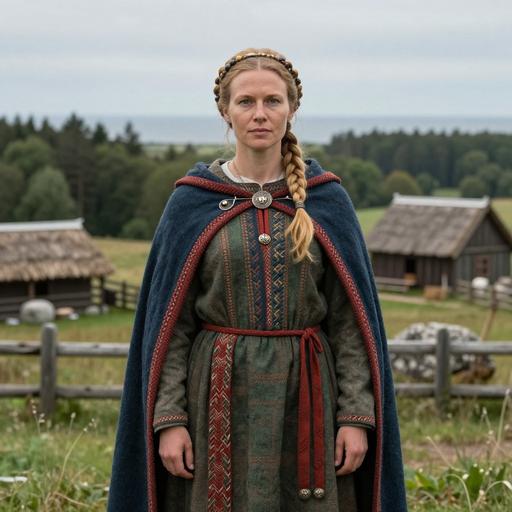
The Late Viking Age, approximately spanning from the late 10th century to around the 11th century, marks a vibrant and transformative period in Scandinavian history, prominently featuring the unique culture of Gotland, an island in the Baltic Sea. During this era, Gotland was a thriving hub of trade, art, and social development, distinct from mainland Viking societies due to its strategic location and interactions with diverse cultures. Here, we explore various facets of this remarkable era: trade, society, art, religion, and architecture.
Trade and Economy
Gotland's prime location in the Baltic Sea made it a crucial center for trade during the Late Viking Age. The island’s inhabitants, known as the Gotlanders, were exceptional merchants and navigators who dominated trade routes between the East, including Byzantine and Arab territories, and the West. They facilitated the exchange of goods such as furs, textiles, silver, spices, glassware, and weapons. Archaeological evidence, such as hoards of Arabic silver coins and Byzantine artifacts, highlights Gotland’s extensive trade network.
The Gotlanders developed a highly monetized economy, evident from the numerous coin hoards discovered across the island, which contain coins from as far afield as the Islamic Caliphates and the Holy Roman Empire. This wealth enabled the Gotlanders to craft high-quality goods and art, further cementing their role as pivotal players in Northern European trade.
Society and Governance
Gotlandic society was relatively egalitarian compared to other Viking cultures. The island was organized into roughly ninety districts, each governed by local assemblies called “Things.” These assemblies played crucial roles in legal matters and collective decision-making, reflecting a sophisticated level of self-governance. Unlike the more hierarchical structures elsewhere in Scandinavia, Gotland did not have a powerful central king but rather a collective system of chieftains and influential families.
The Gotlanders were known for their strong sense of identity and independence. This distinctiveness was partly due to their semi-autonomous governance system, which allowed for considerable local power and decision-making, even as they engaged in broader Viking expeditions and trade networks.
Art and Craftsmanship
Gotlandic art from the Late Viking Age is renowned for its unique blend of indigenous styles and foreign influences brought through extensive trade. This amalgamation is especially evident in their metalwork, jewelry, and the famous Gotlandic picture stones. These stones, intricately carved, served as grave markers or memorials and depicted scenes of mythology, Norse legends, ships, and daily life, with some featuring runic inscriptions.
Silversmiths and craftspeople of Gotland were highly skilled, creating intricate brooches, necklaces, and rings that were both domestic items and trade commodities. They employed a variety of techniques, including filigree and granulation, often incorporating diverse motifs inspired by interactions with other cultures across Europe and the Near East.
Religion and Mythology
The religious landscape of Gotland during the Late Viking Age was in flux, reflecting broader shifts across Scandinavia. Pagan traditions were still strong, characterized by the worship of the old Norse pantheon, but Christianity began to make significant inroads. This period saw a fascinating blend of old and new beliefs, as reflected in burial practices that combined Christian motifs with traditional Viking funerary rites.
Christianity’s spread on Gotland was partly facilitated through trade. Merchants and missionaries introduced Christian artifacts and symbols, gradually influencing local belief systems. By the end of the Viking Age, Christianity had begun to take root, leading to the construction of some of the island’s earliest churches, which would continue to shape its society in the subsequent medieval period.
Architecture and Settlement
The Late Viking Age saw the development of distinct Gotlandic architecture. Settlements were characterized by both permanent farmsteads and seasonal trading posts along the coasts. Farmsteads typically consisted of longhouses made from timber and stone, reflecting both practicality and the adaptation to Gotland’s resources.
As Christianity grew, the architectural landscape began to change. Churches were among the first major stone structures built on the island. Early church designs often mirrored the basilica style seen elsewhere in Europe but adapted to local aesthetic preferences and materials. The integration of fortified structures within settlements also became more common, perhaps as a response to increased trade-related wealth and corresponding security needs.
In summary, the Late Viking Age culture of Gotland stands out for its vibrant trade-based economy, unique governance, rich artistic traditions, and evolving religious landscape. This era marked a critical juncture in Gotland's history, where it emerged not only as a nexus of Viking commerce but also as a melting pot of cultural influences that shaped its development into the medieval period.