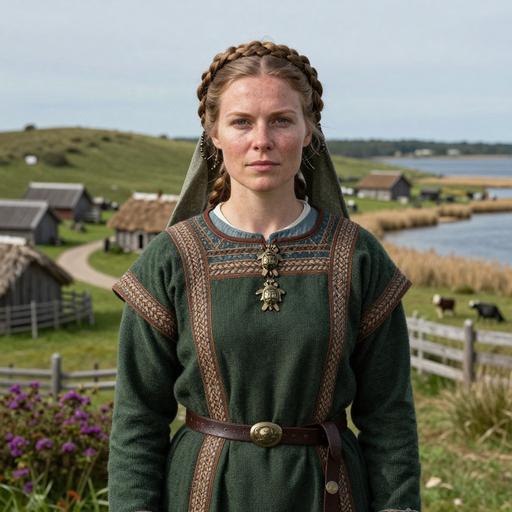
kvi001 - A woman buried in Sweden in the Viking Age era

Download PDF creates a visual, rasterized copy. Use Print for selectable text and better assistive-technology support.

Menu
Currency
Main
Store
Blog

Loading Report

Preparing your ancestry journey

Connecting to ancient matches...

Preparing your report

Skip to main content
Portrait reconstruction of A woman buried in Sweden in the Viking Age era
Ancient Individual

A woman buried in Sweden in the Viking Age era

A woman buried in Sweden during the Viking Age Gotlanders

A fragment of the ancient world, preserved across millennia in strands of DNA.

kvi001
800 CE - 1050 CE
Female
Sweden
Scroll to begin
Chapter I

Identity

The biological and cultural markers that define this ancient individual

Sample ID

kvi001

Date Range

800 CE - 1050 CE

Cultural Period

Viking Age Gotlanders

Biological Sex

Female

mtDNA Haplogroup

U4a1a1:U4a1

Y-DNA Haplogroup

N/A (Female)

Social Role

Farmer (AI estimate, era-typical)

Chapter II

Place

Where this individual was discovered

Country Sweden
Locality Eksta Kvie (Gotlands län, Gotland)
Coordinates 57.4700, 18.4700
Chapter III

Time

When this individual lived in the broader context of human history

kvi001 800 CE - 1050 CE
Chapter IV

Story

The narrative of this ancient life

Overview

This era covers the Viking Age on Gotland (approximately 750–1100 CE), a period when the island’s Norse-aligned culture was strongly connected to wider maritime worlds. Archaeological evidence highlights both local settlement practices and material traces of exchange.

Region & Environment

Gotland’s Baltic island environment enabled maritime travel and access to coastal resources. Stable access to fish and arable land supported household economies, while seaways facilitated contact with other Norse regions.

Historical Context

The Viking Age is marked by expanding seafaring networks across northern Europe. Gotland participated through trade, travel, and shared Norse cultural forms, even as political developments across Scandinavia evolved. Local communities maintained their own cultural patterns while remaining linked to broader exchange systems.

Populations & Lifeways

Viking Age Gotlanders likely lived in community-based settlements supported by mixed subsistence: farming, fishing, and craft production. Artifacts indicate ongoing tool use and maintenance, and settlement remains suggest relatively continuous occupation for many households. Daily life also included participation in exchange networks that brought foreign goods and raw materials.

Archaeology & Material Culture

Archaeological remains often include domestic and craft-related structures, artifact scatters, and durable objects such as metalwork and tools. Some materials reflect wider Norse styles, while others demonstrate local Gotlandic approaches. The combination of everyday items and signs of production helps reveal how communities balanced subsistence with the demands of connected maritime economies.

Culture & Society

Within a Norse complex, shared cultural practices may be reflected in styles of personal items, technologies, and patterns of everyday consumption. At the same time, Gotland’s material record shows continuity of local traditions that distinguish island communities from mainland centers. Social life was likely reinforced through household production, cooperation in settlement maintenance, and exchange with visiting or connected groups.

Legacy & Transition

As the Viking Age advanced toward the later eleventh century, cultural practices across the North changed in response to political consolidation and shifting religious life. Gotland’s Viking Age record preserves the material basis for later transitions, showing how island communities integrated into changing northern European systems.

Chapter V

Genetics

These comparisons show genetic similarity, not identity or origin. The populations listed are those whose genomes show statistical alignment to this ancient individual.

Similarity reflects shared history, not shared identity. These are analytical comparisons, not claims about who this person was.

Modern Genetic Admixture

This analysis compares the DNA profile with present-day reference populations, showing statistical similarity to modern reference populations from different regions. The excavation site records where this individual was found, not a fixed modern genetic identity.

Europe 100.0%
Northwestern European 69.6%
Finnish 23.1%
English 20.0%
Scandinavian 15.0%
Northwestern European 11.6%
Eastern European 24.2%
Southern European 6.2%
Balkan 6.2%
Context

Related Samples

This individual exists within a broader network of ancient samples. No ancient genome stands alone.

Sample ID Culture/Period Date Location Action
wes003 Medieval Northern Swedish Culture 1016 CE Vasterhus (Jämtlands län, Östersund), Sweden View
wes004 Medieval Northern Swedish Culture 1016 CE Vasterhus (Jämtlands län, Östersund), Sweden View
snb017 Southern Swedish Pre-Viking Culture 450 CE Sandby Borg (Kalmar län, Mörbylånga), Sweden View
snb018 Southern Swedish Pre-Viking Culture 450 CE Sandby Borg (Kalmar län, Mörbylånga), Sweden View
kro004 Southern Swedish Post-Medieval Culture 1676 CE Kronan (Kalmar län, Mörbylånga), Sweden View
kro006 Southern Swedish Post-Medieval Culture 1676 CE Kronan (Kalmar län, Mörbylånga), Sweden View
wes005 Medieval Northern Swedish Culture 1016 CE Vasterhus (Jämtlands län, Östersund), Sweden View
wes007 Medieval Northern Swedish Culture 1163 CE Vasterhus (Jämtlands län, Östersund), Sweden View
gam872 Late Viking Age Culture of Central Sweden 950 CE Gammelbyn Börstil (Uppsala län, Östhammar), Sweden View
kro010 Southern Swedish Post-Medieval Culture 1676 CE Kronan (Kalmar län, Mörbylånga), Sweden View
kro011 Southern Swedish Post-Medieval Culture 1676 CE Kronan (Kalmar län, Mörbylånga), Sweden View
kvi001 Viking Age Gotlanders 800 CE Eksta Kvie (Gotlands län, Gotland), Sweden View
lau001 Pre-Viking Gotland Culture 600 CE Gannor (Gotlands län, Gotland), Sweden View
vls696 Late Viking Age Culture of Central Sweden 996 CE Norrsunda (Stockholms län, Sigtuna), Sweden View
wes001 Medieval Northern Swedish Culture 1016 CE Vasterhus (Jämtlands län, Östersund), Sweden View
ven001_viking Vendel Culture 560 CE Vendel (Uppsala), Sweden View
als010 Late Viking Age Culture of Central Sweden 950 CE Alsike (Uppsala län, Knivsta), Sweden View
als015 Late Viking Age Culture of Central Sweden 800 CE Alsike (Uppsala län, Knivsta), Sweden View
frc007 Northern Swedish Viking Culture 950 CE Frösön (Jämtlands län, Östersund), Sweden View
ful001 Vendel Culture 242 CE Fullero (Uppsala län, Uppsala), Sweden View
kro001 Southern Swedish Post-Medieval Culture 1676 CE Kronan (Kalmar län, Mörbylånga), Sweden View
kro002 Southern Swedish Post-Medieval Culture 1676 CE Kronan (Kalmar län, Mörbylånga), Sweden View
kro012 Southern Swedish Post-Medieval Culture 1676 CE Kronan (Kalmar län, Mörbylånga), Sweden View
kro013 Southern Swedish Post-Medieval Culture 1676 CE Kronan (Kalmar län, Mörbylånga), Sweden View
gor164 Late Viking Age Culture of Central Sweden 1000 CE Gorla (Stockholms län, Norrtälje), Sweden View
gor358 Late Viking Age Culture of Central Sweden 750 CE Gorla (Stockholms län, Norrtälje), Sweden View
rtp001 Northern Swedish Pre-Viking Culture 450 CE Romback (Västernorrlands län, Ånge), Sweden View
rtp003 Northern Swedish Pre-Viking Culture 450 CE Romback (Västernorrlands län, Ånge), Sweden View
lov001 Vendel Culture 475 CE Lovö (Stockholms län, Ekerö), Sweden View
kro008_viking Southern Swedish Post-Medieval Culture 1676 CE Kronan (Kalmar län, Mörbylånga), Sweden View
kro009_viking Southern Swedish Post-Medieval Culture 1676 CE Kronan (Kalmar län, Mörbylånga), Sweden View
snb010 Southern Swedish Pre-Viking Culture 450 CE Sandby Borg (Kalmar län, Mörbylånga), Sweden View
snb012 Southern Swedish Pre-Viking Culture 450 CE Sandby Borg (Kalmar län, Mörbylånga), Sweden View
bro100 Late Viking Age Culture of Central Sweden 750 CE Sasta (Stockholms län, Täby), Sweden View
hav001 Late Viking Age Culture of Gotland 1000 CE Hablingbo Havor (Gotlands län, Gotland), Sweden View
snb019 Southern Swedish Pre-Viking Culture 450 CE Sandby Borg (Kalmar län, Mörbylånga), Sweden View
stg018 Late Viking Age Culture of Central Sweden 892 CE Sigtuna (Stockholms län, Upplands-Bro), Sweden View
enb508 Late Viking Age Culture of Central Sweden 950 CE Enbacken (Örebro län, Örebro), Sweden View
snb013 Southern Swedish Pre-Viking Culture 450 CE Sandby Borg (Kalmar län, Mörbylånga), Sweden View
snb014 Southern Swedish Pre-Viking Culture 450 CE Sandby Borg (Kalmar län, Mörbylånga), Sweden View
kro014 Southern Swedish Post-Medieval Culture 1676 CE Kronan (Kalmar län, Mörbylånga), Sweden View
kro015 Southern Swedish Post-Medieval Culture 1676 CE Kronan (Kalmar län, Mörbylånga), Sweden View
wes008 Medieval Northern Swedish Culture 1016 CE Vasterhus (Jämtlands län, Östersund), Sweden View
wes056 Northern Swedish Viking Culture 1016 CE Vasterhus (Jämtlands län, Östersund), Sweden View
hvr009 Northern Norwegian Pre-Viking Culture 60 CE Nordland, Alstahaug, Norway View
als001 Vendel Culture 575 CE Alsike (Uppsala län, Knivsta), Sweden View
als007 Late Viking Age Culture of Central Sweden 950 CE Alsike (Uppsala län, Knivsta), Sweden View
sal002 Late Viking Age Culture of Central Sweden 950 CE Sala (Västmanlands län, Sala), Sweden View
Sample ID Culture/Period Date Location Action
kvi001 Viking Age Gotlanders 800 CE Eksta Kvie (Gotlands län, Gotland), Sweden View
Sources

References

Scientific publications and genetic data that inform this profile.

Scientific Publication

The genetic history of Scandinavia from the Roman Iron Age to the present

Authors Rodríguez-Varela R, Moore KHS, Ebenesersdóttir SS, Kilinc GM, Kjellström A et al.
Abstract

We investigate a 2,000-year genetic transect through Scandinavia spanning the Iron Age to the present, based on 48 new and 249 published ancient genomes and genotypes from 16,638 modern individuals. We find regional variation in the timing and magnitude of gene flow from three sources: the eastern Baltic, the British-Irish Isles, and southern Europe. British-Irish ancestry was widespread in Scandinavia from the Viking period, whereas eastern Baltic ancestry is more localized to Gotland and central Sweden. In some regions, a drop in current levels of external ancestry suggests that ancient immigrants contributed proportionately less to the modern Scandinavian gene pool than indicated by the ancestry of genomes from the Viking and Medieval periods. Finally, we show that a north-south genetic cline that characterizes modern Scandinavians is mainly due to the differential levels of Uralic ancestry and that this cline existed in the Viking Age and possibly earlier.

G25 Coordinates

These coordinates represent a position in genetic space, a tool for comparison, not a conclusion. You can use these to perform custom admixture analysis in G25 Studio.

kvi001,0.1366597,0.1260777,0.0766793,0.0714027,0.04101232,0.03020008,0.00963528,0.01294196,0.0009584,-0.02191132,-0.0078699,-0.00476856,0.01518756,0.02083776,-0.00181256,0.00579336,-0.0026228,0.0001387,0.00488648,0.0020255,0.00121732,-0.0028042,0.00826276,0.00053706,-0.00215689
Continue in G25 Studio
Use code for 25% off Expires Jul 29