Menu
Currency
Main
Store
Blog

Loading Report

Preparing your ancestry journey

Connecting to ancient matches...

Preparing your report

Skip to main content
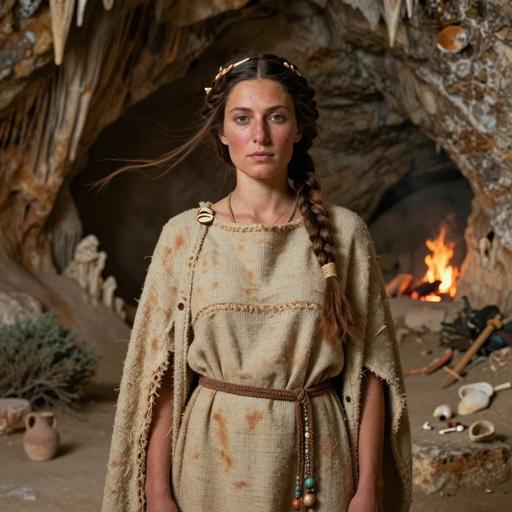
Portrait reconstruction of A woman buried in Greece in the Neolithic era
Ancient Individual

A woman buried in Greece in the Neolithic era

A woman buried in Greece during the Neolithic Peloponnese, Greece

A fragment of the ancient world, preserved across millennia in strands of DNA.

I2937
5477 BCE - 5331 BCE
Female
Greece
Scroll to begin
Chapter I

Identity

The biological and cultural markers that define this ancient individual

Sample ID

I2937

Date Range

5477 BCE - 5331 BCE

Cultural Period

Neolithic Peloponnese, Greece

Biological Sex

Female

mtDNA Haplogroup

K1a26

Y-DNA Haplogroup

N/A (Female)

Chapter II

Place

Where this individual was discovered

Country Greece
Locality Diros. Alepotrypa Cave
Coordinates 36.6383, 22.3825
Chapter III

Time

When this individual lived in the broader context of human history

I2937 5477 BCE - 5331 BCE
Chapter IV

Story

The narrative of this ancient life

The Neolithic period in the Peloponnese, part of the greater Aegean Neolithic culture, began around 7000 BCE and lasted until approximately 3000 BCE. This era marked a significant transformation in human history as communities transitioned from nomadic lifestyles to more settled, agricultural-based societies. The Peloponnese, with its fertile land and moderate climate, was well-suited for this pivotal change, making it a vibrant center for Neolithic development.

Geographical Setting

The Peloponnese is a large peninsula located in southern Greece. During the Neolithic period, the region was rich in natural resources — forests, fertile plains, and abundant water sources provided a conducive environment for early agricultural practices. This geographical advantage facilitated the establishment of permanent settlements and the growth of complex communities throughout the area.

Agricultural Developments

The Aegean Neolithic was characterized by the domestication of plants and animals, which significantly impacted the communities in the Peloponnese. People cultivated cereals such as wheat and barley, along with legumes like lentils and peas. The introduction of these staple crops reshaped the economy and diet of the inhabitants. Additionally, the domestication of animals such as sheep, goats, pigs, and cattle provided secondary products like milk, wool, and meat, further stabilizing the food supply and supporting population growth.

Settlement and Architecture

Neolithic communities in the Peloponnese transitioned from temporary shelters to more permanent structures. Excavations reveal that settlements were typically small, with houses constructed from materials such as mud-bricks and wood, often featuring stone foundations. These dwellings were simple, usually comprising one or two rooms, but they demonstrated the early development of architectural skills and a shift in community organization.

Significant sites from this period include Franchthi Cave, which shows continuous human occupation from the Paleolithic to the Neolithic, and the site of Lerna, known for its unique architectural forms, including the \House of the Tiles," showing more complex social and administrative organization.

Social and Cultural Aspects

The Neolithic period in the Peloponnese saw the emergence of more organized social structures. Evidence suggests a shift towards communal living and possibly the development of social hierarchies, as certain individuals or groups may have controlled the production and distribution of resources. This is supported by the presence of collective burial sites, which may indicate emerging social stratification or shared community rituals.

Material culture flourished during this time, with advancements in pottery making, weaving, and tool production. Pottery from this era is particularly notable for its diversity and decoration, with intricate designs and varied forms reflecting both practical needs and aesthetic developments. The presence of figurines and other symbolic artifacts suggest an evolving spiritual and cultural life, with rituals potentially linked to agriculture, fertility, and community identity.

Trade and External Contacts

Despite being relatively isolated geographically, the Neolithic Peloponnese engaged in trade and exchange with other regions in the Aegean. Obsidian from the island of Melos has been found in Peloponnesian sites, indicating long-distance trade networks. These interactions were crucial in the diffusion of technological innovations, material goods, and cultural ideas, enriching the Neolithic experience in the region.

Conclusion

The Neolithic period in the Peloponnese was marked by substantial developments in agriculture, settlement, social organization, and culture. As part of the Aegean Neolithic culture, this era laid the groundwork for the later Bronze Age civilizations that would emerge in Greece. Through archaeological discoveries, we continue to gain insight into the life and legacy of these early communities, whose innovations and adaptions significantly shaped the course of human history in the region."

Context

Related Samples

This individual exists within a broader network of ancient samples. No ancient genome stands alone.

Sample ID Culture/Period Date Location Action
I0070 Minoan Lassithi, Greece 2400 BCE Crete. Lassithi, Greece View
I0071 Minoan Lassithi, Greece 2400 BCE Crete. Lassithi, Greece View
I0073 Minoan Lassithi, Greece 2400 BCE Crete. Lassithi, Greece View
I0074 Minoan Lassithi, Greece 2400 BCE Crete. Lassithi, Greece View
I9010 Mycenaean Greece 1400 BCE Peloponnese. Galatas Apatheia, Greece View
I9005 Minoan Lassithi, Greece 2400 BCE Crete. Lassithi, Greece View
I9006 Mycenaean Greece 1413 BCE Agia Kyriaki. Salamis, Greece View
I9033 Mycenaean Greece 1418 BCE Peristeria Tryfilia. Peloponnese, Greece View
I9041 Mycenaean Greece 1400 BCE Peloponnese. Galatas Apatheia, Greece View
I9123 Armenoi Site, Crete, Greece 1370 BCE Armenoi. Crete, Greece View
I9127 Minoan Odigitria, Greece 2210 BCE Crete. Heraklion. Moni Odigitria, Greece View
I9128 Minoan Odigitria, Greece 2210 BCE Crete. Heraklion. Moni Odigitria, Greece View
I9129 Minoan Odigitria, Greece 2210 BCE Crete. Heraklion. Moni Odigitria, Greece View
I9130 Minoan Odigitria, Greece 2210 BCE Crete. Heraklion. Moni Odigitria, Greece View
I9131 Minoan Odigitria, Greece 2210 BCE Crete. Heraklion. Moni Odigitria, Greece View
I2683 Early Bronze Age Turkey 2621 BCE Mediterranean. Isparta. Harmanören-Göndürle Höyük, Turkey View
I2495 Early Bronze Age Turkey 2560 BCE Mediterranean. Isparta. Harmanören-Göndürle Höyük, Turkey View
I2937 Neolithic Peloponnese, Greece 5477 BCE Diros. Alepotrypa Cave, Greece View
I2499 Early Bronze Age Turkey 2836 BCE Mediterranean. Isparta. Harmanören-Göndürle Höyük, Turkey View
I2937 5477 BCE Diros. Alepotrypa Cave, Greece View
Sample ID Culture/Period Date Location Action
I3708 Neolithic Peloponnese, Greece 5500 BCE Diros. Alepotrypa Cave, Greece View
I3709 Neolithic Peloponnese, Greece 4036 BCE Diros. Alepotrypa Cave, Greece View
I2318 Neolithic Peloponnese, Greece 4049 BCE Argolid. Franchthi Cave, Greece View
I2937 Neolithic Peloponnese, Greece 5477 BCE Diros. Alepotrypa Cave, Greece View
I3920 Neolithic Peloponnese, Greece 3938 BCE Diros. Alepotrypa Cave, Greece View
Sources

References

Scientific publications and genetic data that inform this profile.

Scientific Publication

Genetic origins of the Minoans and Mycenaeans

Authors Lazaridis I, Mittnik A, Patterson N, Mallick S, Rohland N et al.
Abstract

The origins of the Bronze Age Minoan and Mycenaean cultures have puzzled archaeologists for more than a century. We have assembled genome-wide data from 19 ancient individuals, including Minoans from Crete, Mycenaeans from mainland Greece, and their eastern neighbours from southwestern Anatolia. Here we show that Minoans and Mycenaeans were genetically similar, having at least three-quarters of their ancestry from the first Neolithic farmers of western Anatolia and the Aegean, and most of the remainder from ancient populations related to those of the Caucasus and Iran. However, the Mycenaeans differed from Minoans in deriving additional ancestry from an ultimate source related to the hunter-gatherers of eastern Europe and Siberia, introduced via a proximal source related to the inhabitants of either the Eurasian steppe or Armenia. Modern Greeks resemble the Mycenaeans, but with some additional dilution of the Early Neolithic ancestry. Our results support the idea of continuity but not isolation in the history of populations of the Aegean, before and after the time of its earliest civilizations.