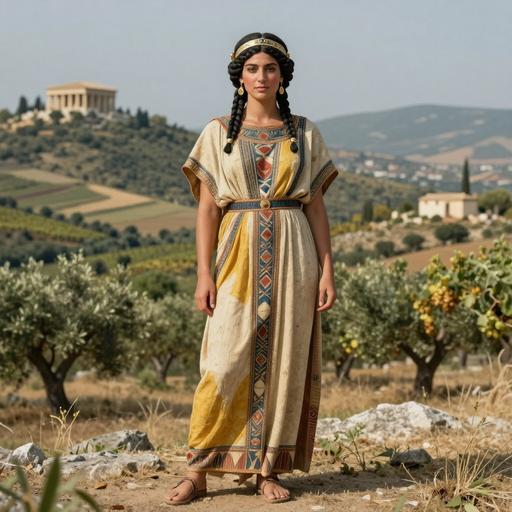
The Mycenaean civilization, flourishing from approximately 1600 to 1100 BCE, is a significant period in ancient Greek history, representing the final phase of the Bronze Age in Greece. This era is named after Mycenae, one of the most prominent Mycenaean centers, and is considered a vital link between the advanced Minoan civilization on Crete and the later classical Greek period.
Geography and Palatial Centers
Mycenaean Greece was centered in mainland Greece, especially the Peloponnese, but Mycenaean influence extended throughout the Aegean region, including Crete and other islands, and even reaching Asia Minor. The civilization is primarily known for its palace-centered cultures, with major sites including Mycenae, Tiryns, Pylos, Thebes, and Athens. Each of these centers functioned as independent political states, managing surrounding territories rather than a unified empire.
Society and Administration
The Mycenaean society was hierarchical. At the top were the kings, often referred to by the title \wanax," which signified supreme authority and religious leadership. Below the wanax were the "lawagetas," likely military commanders or high-ranking officials, and a class of elites who helped administer territories. Mycenaean administration was highly organized, using a bureaucratic system recorded in Linear B script, an early form of Greek. These records have been pivotal in understanding their socio-political structure, economy, and everyday life.
Architecture and Art
Architecturally, the Mycenaeans are renowned for their fortification walls—often termed "Cyclopean" due to their massive size—which protected their palace complexes. The most famous example is the Citadel of Mycenae, with its iconic Lion Gate. They constructed Megaron-style palace complexes which served as the center of political, economic, and religious activities.
In art, the Mycenaeans were heavily influenced by Minoan aesthetics, yet they developed their own distinct style. Their frescoes often depicted warlike and hunting scenes, a reflection of their martial culture. Mycenaean pottery, particularly the stirrup jar, is another hallmark, widely traded and found across the Mediterranean.
Economy and Trade
The Mycenaean economy was dominated by agriculture, but they were also skilled traders and craftsmen. Their palaces acted as economic hubs, overseeing agriculture, animal husbandry, and craft production. They engaged extensively in trade, as evidenced by the discovery of Mycenaean goods as far as Egypt, the Near East, and Sicily. Mycenaean merchants traded olive oil, wine, pottery, and textiles in exchange for metals and other goods.
Religion and Culture
Religiously, the Mycenaeans shared several deities with the later Greeks; names recognizable from Linear B inscriptions include Zeus, Hera, Poseidon, and Athena. Their religious practices involved offerings at altars and within sacred groves; however, it appears that formal temples were not yet prevalent.
Culturally, the Mycenaeans were a martial society, evidenced by their heavily fortified palaces and the military themes in their art. The Iliad and the Odyssey, attributed to Homer and composed centuries later, give a semi-mythical account of Mycenaean martial exploits, notably the Trojan War, believed to echo Mycenaean military activities.
Decline and Legacy
The decline of the Mycenaean civilization around 1100 BCE remains partly enigmatic, often attributed to a combination of factors including natural disasters, societal upheaval, and foreign invasions—the so-called "Sea Peoples," or internal revolts. This collapse led to a period of decline in literacy and economic practice, known as the Greek Dark Ages.
Despite their disappearance, the Mycenaeans left a lasting legacy on the subsequent Greek Archaic and Classical eras. Their myths, fortified citadels, and Linear B script significantly influenced Greek heritage, setting the scene for the emergence of classical Greek culture.
In summary, the Mycenaean civilization stands out as a sophisticated, vibrant, and influential period in Greek prehistory. Its contributions to art, architecture, administration, and mythology continue to be vital to our understanding of ancient Greek culture and its profound influence on Western civilization."