Menu
Currency
Main
Store
Blog

Loading Report

Preparing your ancestry journey

Connecting to ancient matches...

Preparing your report

Skip to main content
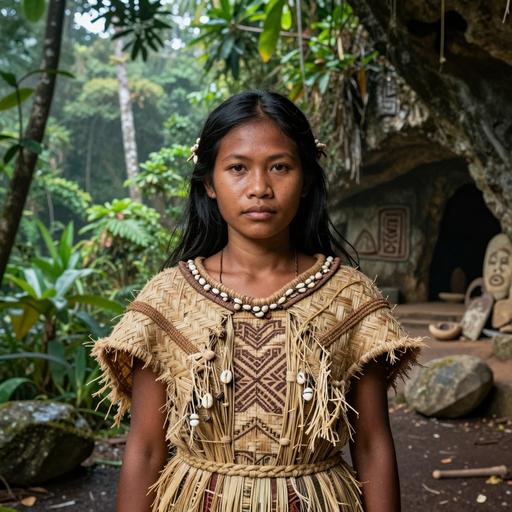
Portrait reconstruction of A woman buried in Indonesia in the Late Neolithic To Bronze Age era
Ancient Individual

A woman buried in Indonesia in the Late Neolithic To Bronze Age era

A woman buried in Indonesia during the Late Neolithic to Iron Age Indonesia

A fragment of the ancient world, preserved across millennia in strands of DNA.

In661
30 CE - 209 CE
Female
Indonesia
Scroll to begin
Chapter I

Identity

The biological and cultural markers that define this ancient individual

Sample ID

In661

Date Range

30 CE - 209 CE

Cultural Period

Late Neolithic to Iron Age Indonesia

Biological Sex

Female

mtDNA Haplogroup

F1a1a

Y-DNA Haplogroup

N/A (Female)

Chapter II

Place

Where this individual was discovered

Country Indonesia
Locality Sumatra. Northwest Aceh. Loyang Ujung Cave
Coordinates 4.6454, 96.8560
Chapter III

Time

When this individual lived in the broader context of human history

In661 30 CE - 209 CE
Chapter IV

Story

The narrative of this ancient life

The Late Neolithic to Iron Age period in Indonesia, marked by the Austronesian migrations, is a fascinating era characterized by significant cultural, technological, and societal transformations. This epoch, roughly spanning from 2000 BCE to 500 CE, witnessed the spread and establishment of Austronesian-speaking peoples across the Indonesian archipelago, profoundly shaping its demographic and cultural landscape.

Background and Migration:

The Austronesian expansion is one of the most remarkable prehistoric migration events, originating from Taiwan and moving through the Philippines and into the broader Southeast Asian region, including Indonesia. This migration introduced new languages, technologies, and cultural practices to the region. By the onset of the Late Neolithic period, Austronesian peoples had settled extensively across the Indonesian islands, including Sumatra, Java, Borneo, Sulawesi, and the Lesser Sundas.

Technological Advances:

The transition from the Late Neolithic to the Iron Age in Indonesia was marked by significant technological advances. During the Late Neolithic period, Austronesian settlers primarily used stone tools but gradually advanced to metalworking. By around 500 BCE, iron smelting was becoming increasingly common, enabling the production of more effective tools and weapons. This transition not only facilitated agricultural productivity but also enhanced capabilities in crafting, carpentry, and warfare.

Agriculture and Economy:

The Austronesians in Indonesia were skilled agriculturalists and their knowledge markedly improved agricultural productivity. They primarily cultivated rice, a staple crop that remains central to Indonesian agriculture today. The introduction of advanced irrigation techniques, such as terracing and the use of metal tools, further bolstered their agricultural output. Additionally, they cultivated taro, millet, and bananas, and engaged in fishing and animal husbandry.

The Austronesian peoples also participated in regional trade networks, exchanging goods such as spices, metals, and pottery with neighboring regions. This network would eventually lay the groundwork for the internationally significant trade routes of later periods.

Society and Culture:

Austronesian societies during this period were typically organized into small, kinship-based communities led by chieftains. These communities were often situated in coastal areas or along rivers, which facilitated trade and communication. Social organization was primarily hierarchical, with power often concentrated in the hands of a few elite individuals or families.

A distinct characteristic of Austronesian culture is their intricate craftsmanship, particularly in textiles and pottery. The pottery from this period often features elaborate decorations and geometric patterns, indicative of the aesthetic sensibilities of the society.

The Austronesians also possessed a rich oral tradition, which included mythology, poetry, and songs that conveyed social values and historical narratives. They practiced animism, revering natural spirits and ancestors, a belief system that would later merge with Hinduism, Buddhism, and Islam as these religious influences permeated the region.

Architecture and Settlements:

The architectural practices of this era saw the construction of stilt houses, which were well-suited to the tropical and often flood-prone environments of Indonesia. These houses were typically made of wood and bamboo, featuring thatched roofs, and they often clustered to form compact villages. Over time, these architectural styles evolved, influenced by both internal innovations and external contacts.

Summary:

The Late Neolithic to Iron Age period in Indonesia, characterized by the dominance of Austronesian cultures, was a time of immense change and development. The Austronesian migrations brought about a rich tapestry of cultural practices and technological advancements, setting the stage for the complex societies and rich cultures that would later define Indonesia. The synthesis of indigenous and Austronesian elements during this era laid the foundations for the diverse and interconnected civilization that would continue to thrive and evolve in the centuries to follow.

Context

Related Samples

This individual exists within a broader network of ancient samples. No ancient genome stands alone.

Sample ID Culture/Period Date Location Action
In661 Late Neolithic to Iron Age Indonesia 30 CE Sumatra. Northwest Aceh. Loyang Ujung Cave, Indonesia View
In662 Late Neolithic to Iron Age Indonesia 353 BCE Sumatra. Northwest Aceh. Loyang Ujung Cave, Indonesia View
La364 Late Neolithic to Bronze Age Laos 1125 BCE Northeast Huapan. Tam Pa Ping, Laos View
La368 The Hoabinhian Culture 6012 BCE Northern Bolikhamsay. Pha Faen, Laos View
La727 Bronze Age Laos 459 BCE Northeast Huapan. Tam Hang, Laos View
La898 Unknown Era in Laos 8000 BCE Northeast Huapan. Tam Hang, Laos View
Ma554 Historical Malaysia 1448 CE Northeast Borneo. Sabah. Supu Hujung4, Malaysia View
Ma555 Historical Malaysia 1505 CE Northeast Borneo. Sabah. Kinabatagan, Malaysia View
Ma911 Hoabinhian Culture, Malaysia 2463 BCE West Peninsular Kelantan. Gua Cha Cave, Malaysia View
Phl534 Red Slipped Pottery Culture, Philippines 84 CE Luzon. Northern Cagayan. Nagsabaran, Philippines View
Th519 Iron Age Thailand 236 CE Northern Mae Hong Son. Long Long Rak, Thailand View
Th521 Iron Age Thailand 215 CE Northern Mae Hong Son. Long Long Rak, Thailand View
Th530 Iron Age Thailand 238 CE Northern Mae Hong Son. Long Long Rak, Thailand View
Th531 Iron Age Thailand 259 CE Northern Mae Hong Son. Long Long Rak, Thailand View
Vt833 Late Neolithic Vietnam 2343 BCE Northern Thanh Hoa. Mai Da Dieu, Vietnam View
Vt880 Late Neolithic Vietnam 2500 BCE Northeast Quang Ninh. Hhon Hai Co Tien, Vietnam View
JHF05 Modern Malaysia 2000 CE West Peninsular Northern Perak, Malaysia View
JHM06 Modern Malaysia 2000 CE West Peninsular Northern Perak, Malaysia View
IK002 The Jomon Period in Japan 897 BCE Honshu. Central Aichi. Ikawazu, Japan View
Ma912 Late Neolithic Malaysia 744 BCE West Peninsular Kelantan. Gua Cha Cave, Malaysia View
Vt779 Bronze Age Dong Son Culture, Vietnam 386 BCE Northern Thanh Noa. Nui Nap, Vietnam View
Vt781 Bronze Age Dong Son Culture, Vietnam 389 BCE Northern Thanh Noa. Nui Nap, Vietnam View
Vt796 Bronze Age Dong Son Culture, Vietnam 350 BCE Northern Thanh Noa. Nui Nap, Vietnam View
Vt808 Bronze Age Dong Son Culture, Vietnam 391 BCE Northern Thanh Noa. Nui Nap, Vietnam View
Vt719 Historical Vietnam 1641 CE Northeast Quang Ninh. Hon Hai Co Tien, Vietnam View
Vt777 Late Neolithic Vietnam 399 BCE Northern Thanh Hoa. Mai Da Dieu, Vietnam View
Vt778 Late Neolithic Vietnam 800 BCE Northwest Lai Châu. Nam Tun, Vietnam View
Th519 236 CE Northern Mae Hong Son. Long Long Rak, Thailand View
IK002 897 BCE Honshu. Central Aichi. Ikawazu, Japan View
Ma912 744 BCE West Peninsular Kelantan. Gua Cha Cave, Malaysia View
Vt719 1641 CE Northeast Quang Ninh. Hon Hai Co Tien, Vietnam View
Vt777 399 BCE Northern Thanh Hoa. Mai Da Dieu, Vietnam View
Vt778 800 BCE Northwest Lai Châu. Nam Tun, Vietnam View
Vt779 386 BCE Northern Thanh Noa. Nui Nap, Vietnam View
Vt781 389 BCE Northern Thanh Noa. Nui Nap, Vietnam View
Vt796 350 BCE Northern Thanh Noa. Nui Nap, Vietnam View
Vt808 391 BCE Northern Thanh Noa. Nui Nap, Vietnam View
Sample ID Culture/Period Date Location Action
In661 Late Neolithic to Iron Age Indonesia 30 CE Sumatra. Northwest Aceh. Loyang Ujung Cave, Indonesia View
In662 Late Neolithic to Iron Age Indonesia 353 BCE Sumatra. Northwest Aceh. Loyang Ujung Cave, Indonesia View
Sources

References

Scientific publications and genetic data that inform this profile.

Scientific Publication

The prehistoric peopling of Southeast Asia

Authors McColl H, Racimo F, Vinner L, Demeter F, Gakuhari T et al.
Abstract

The human occupation history of Southeast Asia (SEA) remains heavily debated. Current evidence suggests that SEA was occupied by Hòabìnhian hunter-gatherers until ~4000 years ago, when farming economies developed and expanded, restricting foraging groups to remote habitats. Some argue that agricultural development was indigenous; others favor the "two-layer" hypothesis that posits a southward expansion of farmers giving rise to present-day Southeast Asian genetic diversity. By sequencing 26 ancient human genomes (25 from SEA, 1 Japanese Jōmon), we show that neither interpretation fits the complexity of Southeast Asian history: Both Hòabìnhian hunter-gatherers and East Asian farmers contributed to current Southeast Asian diversity, with further migrations affecting island SEA and Vietnam. Our results help resolve one of the long-standing controversies in Southeast Asian prehistory.