Menu
Currency
Main
Store
Blog

Loading Report

Preparing your ancestry journey

Connecting to ancient matches...

Preparing your report

Skip to main content
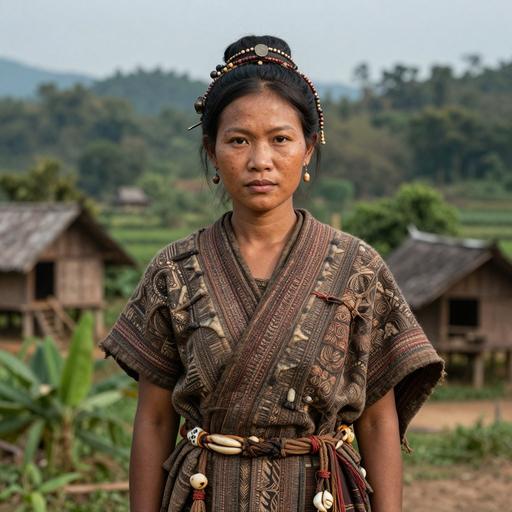
Portrait reconstruction of A woman buried in Thailand in the Iron Age era
Ancient Individual

A woman buried in Thailand in the Iron Age era

A woman buried in Thailand during the Iron Age Thailand

A fragment of the ancient world, preserved across millennia in strands of DNA.

Th531
259 CE - 419 CE
Female
Thailand
Scroll to begin
Chapter I

Identity

The biological and cultural markers that define this ancient individual

Sample ID

Th531

Date Range

259 CE - 419 CE

Cultural Period

Iron Age Thailand

Biological Sex

Female

mtDNA Haplogroup

G2b1a

Y-DNA Haplogroup

N/A (Female)

Chapter II

Place

Where this individual was discovered

Country Thailand
Locality Northern Mae Hong Son. Long Long Rak
Coordinates 19.5889, 98.2026
Chapter III

Time

When this individual lived in the broader context of human history

Th531 259 CE - 419 CE
Chapter IV

Story

The narrative of this ancient life

The Iron Age in Thailand, dating from around 500 BCE to 500 CE, represents a pivotal period in the development of Southeast Asian civilizations. This era is marked by significant advancements in technology, society, and culture, contributing to the foundations of complex societies that would emerge later in the region.

Technological Advancements and Metallurgy

One of the defining features of the Iron Age in Thailand is the widespread adoption of iron over the previously used bronze. Iron technology allowed for the production of more durable and effective tools and weapons, which in turn accelerated agricultural productivity and enabled the expansion of settlements. This technological shift was instrumental for social transformation, as it supported increased food production, allowing for larger population densities and more complex societal structures.

Settlements and Urbanization

Iron Age Thailand saw the growth of larger and more permanent settlements. Archaeological evidence points to the emergence of proto-urban centers, which functioned as hubs of economic and social activity. Sites like Ban Chiang and Ban Non Wat provide insights into these emerging communities. These settlements were often strategically located near resources such as fertile land, water, and trade routes, facilitating their growth and sustainability.

Social Structure and Economy

This period witnessed the initial stages of social stratification, with evidence suggesting the presence of hierarchical social structures. As communities became more complex, roles within society diversified, leading to the development of specialized crafts and professions. The economy during this era was largely agrarian, supplemented by hunting, gathering, and fishing. However, the production of iron goods, pottery, and textiles indicated a broadening economic base and the beginnings of trade networks that extended beyond the immediate region.

Trade and Interaction

The Iron Age in Thailand was characterized by increasing interaction with neighboring regions, which facilitated the exchange of goods, ideas, and cultural practices. Thailand occupied a strategic position in Southeast Asia, serving as a crossroads between India and China. This facilitated the flow of trade items such as ceramics, beads, and precious metals, and enabled cultural exchanges that introduced new religious and artistic ideas to the area.

Religious and Cultural Developments

Cultural life in Iron Age Thailand was rich and dynamic, heavily influenced by both indigenous beliefs and contacts with Indian and Chinese civilizations. Religious practices during this time likely included animism and ancestor worship, as evidenced by burial sites and artifacts found at archaeological sites. The region's exposure to Indian culture introduced early concepts of Buddhism and Hinduism, which would later become significant in shaping the spiritual landscape of Southeast Asia.

Art and Craftsmanship

The period is marked by notable development in art and craftsmanship, with significant achievements in pottery and metallurgy. Artifacts from this era, including intricately designed ceramics and metalwork, reflect a high degree of skill and aesthetic sensibility. The artistic traditions of Iron Age Thailand illustrate both local innovation and external influences, with styles evolving through contact with trading partners.

Environmental Impact and Adaptation

The communities of Iron Age Thailand were adept at adapting to their environmental conditions. The region's fertile plains and river valleys supported agricultural development, particularly rice cultivation, which became a staple of the diet. As populations grew, there was increasing pressure on natural resources, which necessitated innovative agricultural practices and water management techniques, setting the stage for sustainable development strategies in subsequent eras.

In summary, the Iron Age in Thailand was a transformative period marked by technological innovation, increased social complexity, and significant cultural exchange. It laid crucial groundwork for the evolution of later Southeast Asian societies, influencing the region's historical trajectory and leaving a lasting legacy in its cultural and technological practices.

Context

Related Samples

This individual exists within a broader network of ancient samples. No ancient genome stands alone.

Sample ID Culture/Period Date Location Action
In661 Late Neolithic to Iron Age Indonesia 30 CE Sumatra. Northwest Aceh. Loyang Ujung Cave, Indonesia View
In662 Late Neolithic to Iron Age Indonesia 353 BCE Sumatra. Northwest Aceh. Loyang Ujung Cave, Indonesia View
La364 Late Neolithic to Bronze Age Laos 1125 BCE Northeast Huapan. Tam Pa Ping, Laos View
La368 The Hoabinhian Culture 6012 BCE Northern Bolikhamsay. Pha Faen, Laos View
La727 Bronze Age Laos 459 BCE Northeast Huapan. Tam Hang, Laos View
La898 Unknown Era in Laos 8000 BCE Northeast Huapan. Tam Hang, Laos View
Ma554 Historical Malaysia 1448 CE Northeast Borneo. Sabah. Supu Hujung4, Malaysia View
Ma555 Historical Malaysia 1505 CE Northeast Borneo. Sabah. Kinabatagan, Malaysia View
Ma911 Hoabinhian Culture, Malaysia 2463 BCE West Peninsular Kelantan. Gua Cha Cave, Malaysia View
Phl534 Red Slipped Pottery Culture, Philippines 84 CE Luzon. Northern Cagayan. Nagsabaran, Philippines View
Th519 Iron Age Thailand 236 CE Northern Mae Hong Son. Long Long Rak, Thailand View
Th521 Iron Age Thailand 215 CE Northern Mae Hong Son. Long Long Rak, Thailand View
Th530 Iron Age Thailand 238 CE Northern Mae Hong Son. Long Long Rak, Thailand View
Th531 Iron Age Thailand 259 CE Northern Mae Hong Son. Long Long Rak, Thailand View
Vt833 Late Neolithic Vietnam 2343 BCE Northern Thanh Hoa. Mai Da Dieu, Vietnam View
Vt880 Late Neolithic Vietnam 2500 BCE Northeast Quang Ninh. Hhon Hai Co Tien, Vietnam View
JHF05 Modern Malaysia 2000 CE West Peninsular Northern Perak, Malaysia View
JHM06 Modern Malaysia 2000 CE West Peninsular Northern Perak, Malaysia View
IK002 The Jomon Period in Japan 897 BCE Honshu. Central Aichi. Ikawazu, Japan View
Ma912 Late Neolithic Malaysia 744 BCE West Peninsular Kelantan. Gua Cha Cave, Malaysia View
Vt779 Bronze Age Dong Son Culture, Vietnam 386 BCE Northern Thanh Noa. Nui Nap, Vietnam View
Vt781 Bronze Age Dong Son Culture, Vietnam 389 BCE Northern Thanh Noa. Nui Nap, Vietnam View
Vt796 Bronze Age Dong Son Culture, Vietnam 350 BCE Northern Thanh Noa. Nui Nap, Vietnam View
Vt808 Bronze Age Dong Son Culture, Vietnam 391 BCE Northern Thanh Noa. Nui Nap, Vietnam View
Vt719 Historical Vietnam 1641 CE Northeast Quang Ninh. Hon Hai Co Tien, Vietnam View
Vt777 Late Neolithic Vietnam 399 BCE Northern Thanh Hoa. Mai Da Dieu, Vietnam View
Vt778 Late Neolithic Vietnam 800 BCE Northwest Lai Châu. Nam Tun, Vietnam View
Th519 236 CE Northern Mae Hong Son. Long Long Rak, Thailand View
IK002 897 BCE Honshu. Central Aichi. Ikawazu, Japan View
Ma912 744 BCE West Peninsular Kelantan. Gua Cha Cave, Malaysia View
Vt719 1641 CE Northeast Quang Ninh. Hon Hai Co Tien, Vietnam View
Vt777 399 BCE Northern Thanh Hoa. Mai Da Dieu, Vietnam View
Vt778 800 BCE Northwest Lai Châu. Nam Tun, Vietnam View
Vt779 386 BCE Northern Thanh Noa. Nui Nap, Vietnam View
Vt781 389 BCE Northern Thanh Noa. Nui Nap, Vietnam View
Vt796 350 BCE Northern Thanh Noa. Nui Nap, Vietnam View
Vt808 391 BCE Northern Thanh Noa. Nui Nap, Vietnam View
Sample ID Culture/Period Date Location Action
I8970 Iron Age Thailand 600 BCE Ban Chiang, Thailand View
Th519 Iron Age Thailand 236 CE Northern Mae Hong Son. Long Long Rak, Thailand View
Th521 Iron Age Thailand 215 CE Northern Mae Hong Son. Long Long Rak, Thailand View
Th530 Iron Age Thailand 238 CE Northern Mae Hong Son. Long Long Rak, Thailand View
Th531 Iron Age Thailand 259 CE Northern Mae Hong Son. Long Long Rak, Thailand View
Th519 236 CE Northern Mae Hong Son. Long Long Rak, Thailand View
Sources

References

Scientific publications and genetic data that inform this profile.

Scientific Publication

The prehistoric peopling of Southeast Asia

Authors McColl H, Racimo F, Vinner L, Demeter F, Gakuhari T et al.
Abstract

The human occupation history of Southeast Asia (SEA) remains heavily debated. Current evidence suggests that SEA was occupied by Hòabìnhian hunter-gatherers until ~4000 years ago, when farming economies developed and expanded, restricting foraging groups to remote habitats. Some argue that agricultural development was indigenous; others favor the "two-layer" hypothesis that posits a southward expansion of farmers giving rise to present-day Southeast Asian genetic diversity. By sequencing 26 ancient human genomes (25 from SEA, 1 Japanese Jōmon), we show that neither interpretation fits the complexity of Southeast Asian history: Both Hòabìnhian hunter-gatherers and East Asian farmers contributed to current Southeast Asian diversity, with further migrations affecting island SEA and Vietnam. Our results help resolve one of the long-standing controversies in Southeast Asian prehistory.

Use code for 25% off Expires Jul 13