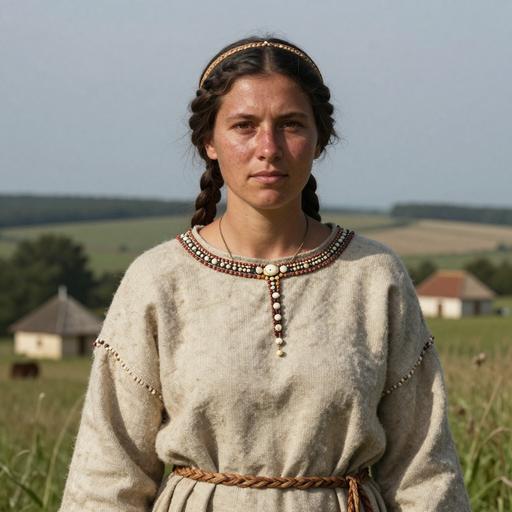
The Late Neolithic Lengyel Culture, particularly in the Racot region, represents a fascinating period in European prehistory that dates approximately between 5000 and 3400 BCE. This culture is part of the wider Neolithic transformation in Central Europe and is notable for its social complexity, artistic expression, and early agricultural practices. It is named after the village of Lengyel in Hungary, where key archaeological sites have been studied extensively.
Geographic and Temporal Context
The Lengyel Culture primarily stretched across parts of Central and Eastern Europe, encompassing areas of modern-day Austria, Czech Republic, Slovakia, Poland, Hungary, and Slovenia. In the specific context of Racot, this culture was influenced by its geographical setting in what's today western Poland. This setting was critical for their subsistence strategies, societal organization, and interactions with neighboring cultures.
The timeframe of the Lengyel Culture coincided with significant climatic and environmental shifts, as Europe was gradually warming up after the last Ice Age. This transition facilitated agricultural expansion and the subsequent stabilization of human settlements.
Social and Political Structure
The Lengyel Culture is characterized by its complex social organization, which was more hierarchical compared to earlier Neolithic societies. Evidence from burial sites suggests a stratified society, as indicated by the varying richness of grave goods. These items, such as pottery, tools, and ornaments, appear to signify social status, implying a community with social differentiation possibly based on roles, wealth, or lineage.
Settlements were sometimes fortified, indicating a need for defense and implying a certain level of organized communal planning and leadership. This may suggest emerging forms of proto-political organization where decisions were likely made by elders or leaders, possibly ingrained in spiritual or ritualistic significance.
Economy and Subsistence
The Lengyel Culture was predominantly agrarian, engaging in early farming practices that included the cultivation of crops such as wheat, barley, and legumes. They also domesticated animals like cattle, pigs, sheep, and goats, which contributed to their diet and economy. This reliance on agriculture and animal husbandry marked a significant shift from the preceding hunter-gatherer lifestyles.
Supplementing their agrarian economy, Lengyel people also practiced hunting and gathering, which likely formed a smaller portion of their dietary practices but still played a role in their subsistence strategies, especially in times of crop failure or seasonal scarcity.
Art and Material Culture
Artistic expression is one of the hallmarks of the Lengyel Culture, most notably through their pottery. Lengyel ceramics are renowned for their fine craftsmanship, intricate designs, and painted decorations. The pottery often features geometric patterns, spirals, and sometimes simple figurative motifs, painted in black, red, or white on a polished surface.
Additionally, the Lengyel Culture is known for its use of personal adornments, including beads and pendants made from bone, shell, or copper, indicating a developed sense of aesthetics and possibly serving as status symbols.
Architecture and Settlement Patterns
Settlements during the Lengyel period were often strategically located near water sources and fertile land. The architectural structures were typically rectangular timber houses with thatched roofs, organized in either open or enclosed villages. Their construction methods reflect an understanding of local environmental conditions and available resources.
Some settlements were accompanied by circular or elliptical earthworks, possibly used for defensive purposes or as ceremonial centers, suggesting a complex relationship with the landscape and spiritual beliefs.
Religion and Rituals
Religion in the Lengyel Culture, like in many prehistoric societies, is a subject of interpretation based on archaeological evidence. Burial practices indicate a belief in an afterlife, with the deceased often accompanied by grave goods, suggesting that these items were considered necessary for the next world. Some graves show evidence of ritual feasting or offerings, indicative of complex ceremonial traditions.
While specific deities or mythological beliefs are not directly documented, the presence of enigmatic figurines and possibly ritualistic artifacts suggests a spiritual or religious system in which nature, fertility, and community ancestors likely played crucial roles.
Conclusion
The Late Neolithic Lengyel Culture in the Racot region embodies a critical phase of prehistoric development in Central Europe, characterized by advancements in social organization, art, and agriculture. Through archaeological findings, scholars can appreciate how these early Europeans adapted to their environment, developed intricate social structures, and laid the foundations for subsequent cultural developments. This culture, encapsulated by its material and spiritual legacies, underscores a transformative era in human history during the Neolithic period.