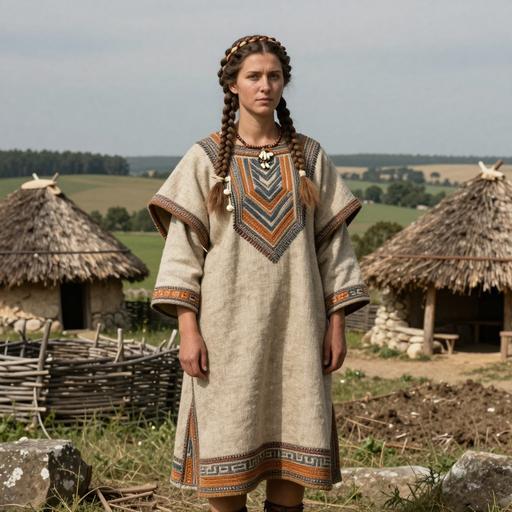
The Late Lengyel Culture, especially as exemplified by the site at Krusza Zamkowa in modern-day Poland, represents a significant Neolithic society in Central Europe. This period, roughly dated between 4500 and 4000 BCE, is characterized by remarkable advancements in socio-economic structures, agriculture, pottery, and religious practices. The Lengyel Culture itself extended over present-day Poland, Austria, Slovakia, the Czech Republic, and Hungary, but sites like Krusza Zamkowa provide specific insights into regional variations and developments.
Geography and Environment
Situated in the fertile plains of Central Europe, the site of Krusza Zamkowa benefited from a temperate climate, making it conducive to agriculture. The area likely featured mixed deciduous forests, which provided resources such as timber and game, while the proximity to rivers and water bodies would have supported both irrigation and fishing activities.
Settlement Patterns
The Late Lengyel Culture at Krusza Zamkowa is characterized by semi-permanent settlements. These were often composed of longhouses, reflecting a communal mode of living. The longhouses, typically constructed using wattle and daub techniques with thatched roofs, served as multifamily dwellings, indicating a complex social structure that possibly revolved around kinship and extended family units.
Economy and Technology
Agriculture was the backbone of the Lengyel economy. Evidence from Krusza Zamkowa suggests the cultivation of emmer wheat, barley, and pulses. These crops were complemented by animal husbandry, including cattle, pigs, sheep, and goats. The Lengyel people likely practiced slash-and-burn techniques to clear forests for agriculture, reflecting an advanced understanding of land management.
In terms of technology, the Late Lengyel Culture shows sophisticated tool-making skills. Flint, obsidian, and stone tools have been uncovered at Krusza Zamkowa, indicating a rich tradition of craftsmanship. The culture is especially noted for its pottery; the ceramics from this era are distinguished by intricate geometric patterns and a rich diversity of forms, often with painted, incised, or stamped decorations.
Social Structure and Organization
The social organization of the Late Lengyel Culture was likely hierarchical to some extent, as suggested by varied grave goods and differences in house sizes. The presence of ornate pottery and tools in certain burials indicates a differentiation in status, possibly based on lineage, spiritual roles, or economic prowess. However, the communal nature of settlements points towards a society that valued collective living and cooperation.
Religion and Spirituality
Although the exact religious practices of the Lengyel Culture remain partially speculative, archaeological findings provide some insights. Artifacts and burial rites at Krusza Zamkowa suggest a belief system with a focus on ancestor worship and possibly a pantheon of nature deities. Ritualistic items, such as figurines and altars, indicate that spirituality was an integral part of daily life, with rituals likely centered around agricultural cycles, fertility, and the changing seasons.
Art and Symbolism
Art in the Late Lengyel Culture often manifested in the form of pottery and small figurines, which were rich in symbolic content. These artistic expressions not only served functional and decorative purposes but also played a role in spiritual and communal activities. Pottery motifs, for example, may have been linked to clan identity or spiritual beliefs, while anthropomorphic and zoomorphic figurines likely held cultural or religious significance.
Conclusion
The Late Lengyel Culture at Krusza Zamkowa represents a pivotal chapter in the Neolithic era of Central Europe, highlighting a society that was both innovative and deeply connected to its environment. Through its agricultural practices, technological advancements, and rich cultural artifacts, it laid down a foundation that significantly influenced subsequent European prehistoric cultures. The site at Krusza Zamkowa serves as a vital archaeological record, offering insights into the daily lives, spiritual beliefs, and social organization of a vibrant Neolithic community.