Yunatsite Chalcolithic Echoes

Download PDF creates a visual, rasterized copy. Use Print for selectable text and better assistive-technology support.

Skip to main content
Civilization Spotlight

Yunatsite Chalcolithic Echoes

A tell of copper glint, painted pottery and genetic traces from 4600–4200 BCE

4600 CE - 4200 BCE
Yunatsite, Pazardzhik province, Bulgaria

The Story

Archaeological and genetic evidence from 17 individuals at Yunatsite (Pazardzhik, Bulgaria) illuminates the Gumelnița‑Karanovo Chalcolithic world (4600–4200 BCE): dense tells, early copper use, and a mixed ancestral profile linking local Neolithic farmers and lingering hunter‑gatherer lineages.

Time Period

4600–4200 BCE

Region

Yunatsite, Pazardzhik province, Bulgaria

Common Y-DNA

FGC (2), SK (1), Z (1), L (1), P96 (1)

Common mtDNA

U (3), K (3), H (2), K2a (1), K1a (1)

Timeline

4600 BCE

Flourishing of Gumelnița‑Karanovo at Yunatsite

Thick Chalcolithic occupation layers at Yunatsite reflect dense settlement, early copper use, and active exchange across the lower Danube (arrival of the Gumelnița‑Karanovo horizon).

Origins & Emergence

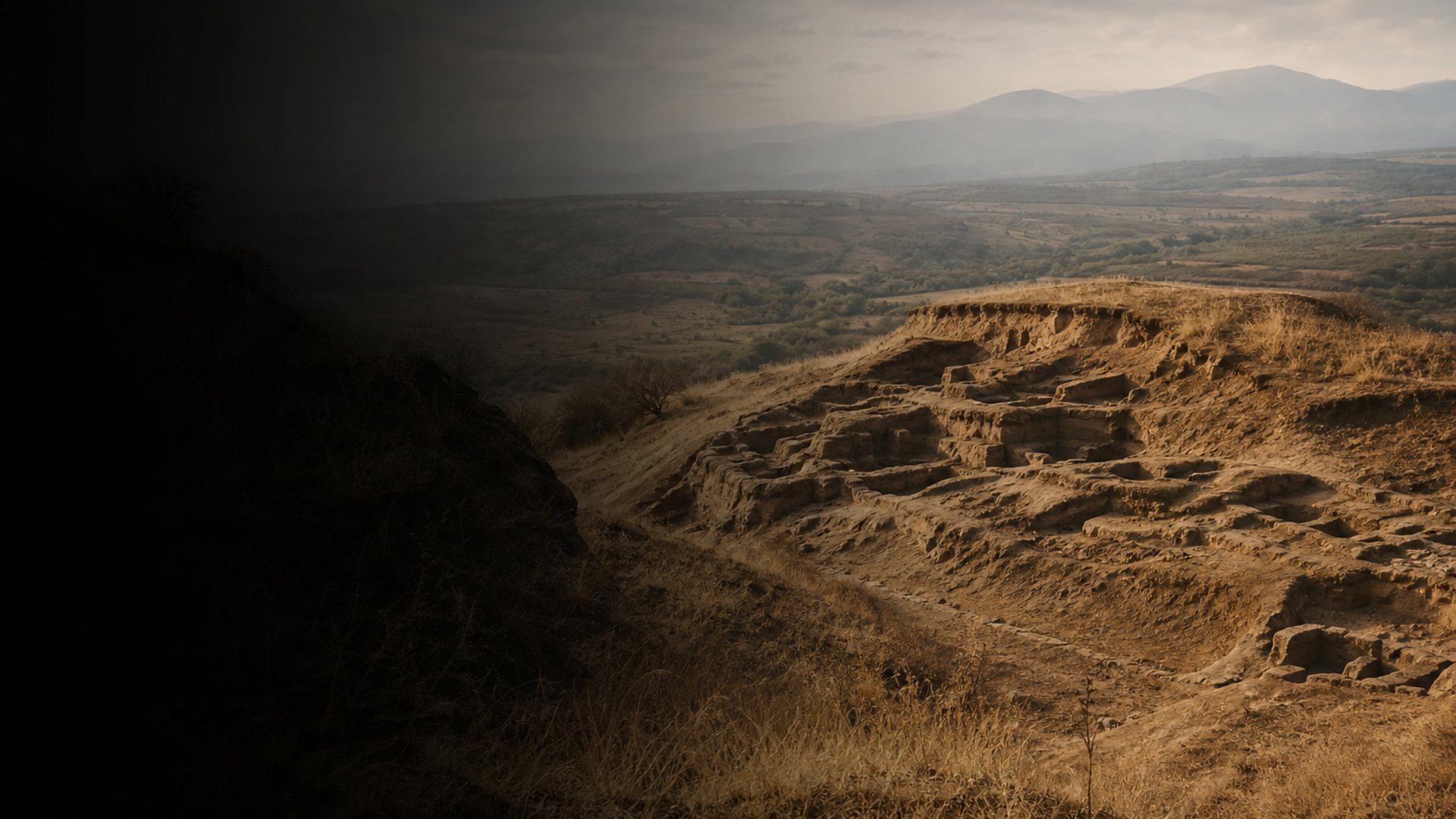
The Yunatsite settlement sits atop a multi‑layered tell in the Thracian plain, a place where soil, craft and memory accreted over centuries. Archaeological layers dated to 4600–4200 BCE belong to the Gumelnița‑Karanovo cultural horizon, a dense network of tell sites stretching along the lower Danube and into today's Bulgarian plains. Excavations at Yunatsite reveal thick occupation deposits, evidence for planned architecture, and repeated episodes of renewal and destruction that shaped community memory.

Material culture—wheel‑made and painted pottery, anthropomorphic figurines, and early copper artifacts—speaks to a society experimenting with new technologies while maintaining strong ties to Neolithic farming traditions. Archaeological data indicates active exchange with neighboring Aegean and Danubian groups; imported raw materials and shared decorative vocabularies suggest long‑distance connections.

Genetic sampling from 17 individuals offers a complementary window: the population shows a mosaic of lineages consistent with local Neolithic farmer ancestry augmented by lingering hunter‑gatherer maternal lines. While the dataset is robust enough to identify broad patterns, regional variability and later trans‑Balkan movements mean interpretations remain provisional and benefit from expanded sampling.

  • Yunatsite: a multi‑layered Chalcolithic tell in Pazardzhik province
  • Gumelnița‑Karanovo horizon, dated 4600–4200 BCE
  • Material links across the Balkans and Aegean suggest exchange networks

Daily Life & Society

Life at Yunatsite was tactile and communal: packed earth floors, hearths, storage pits and craft areas record routines of food preparation, repair and ceremony. Archaeobotanical and zooarchaeological remains indicate mixed farming—emmer and barley, pulses, cattle, sheep and goats—supplemented by hunting and wild plant foraging. Pottery and personal ornaments, often finely painted or incised, attest to aesthetic traditions and social signaling.

Evidence for copper working—small ingots, tools, and slag—places Yunatsite in the early chapters of Chalcolithic metallurgy in southeastern Europe. Workshops and specialized tool assemblages suggest craft specialization and likely craft households. Burials and domestic deposition patterns imply complex social structures: some houses show high investment in architecture or assemblage wealth, pointing to emerging status differentiation, while figurines and ritual deposits indicate communal beliefs and rites.

Archaeological data indicates episodes of burning and collapse in the late Chalcolithic levels at Yunatsite; whether these reflect conflict, ritualized abandonment, or accidental destruction remains debated. Combining material culture and genetic snapshots offers a richer sense of daily life—families rooted in agriculture, mobile exchange networks, and evolving social hierarchies.

  • Mixed farming economy with evidence of early copper working
  • Craft specialization and household variability indicate emerging social complexity

Genetic Profile

Seventeen sampled individuals from Yunatsite provide a meaningful but not exhaustive window into Chalcolithic population dynamics. The recovered Y‑chromosome lineages show diversity: FGC (2 instances), SK (1), Z (1), L (1) and P96 (1) among identified males. These paternal markers do not include high counts of the later steppe‑associated R1a/R1b haplogroups, which suggests that at Yunatsite during 4600–4200 BCE, steppe male lineages were not yet dominant in this community. However, absence of evidence is not evidence of absence: broader regional sampling could reveal different patterns.
Maternal lineages are dominated by haplogroups common in Neolithic and post‑Neolithic Europe: U (3), K (3), H (2), and subclades K2a (1) and K1a (1). Haplogroup U links to deeper Mesolithic and local hunter‑gatherer ancestry, while K and H are frequent in farming populations originating from Anatolia and the Aegean. Together, the mtDNA distribution indicates continuity of maternal lines alongside admixture.

Autosomal signals (regional comparative studies) typically place Balkan Chalcolithic populations between Anatolian Neolithic farmers and local hunter‑gatherers, with only limited input from steppe groups before the third millennium BCE. With 17 genomes, conclusions about kinship structure, sex‑biased migration, and fine‑scale admixture are promising but provisional; increasing sample counts will refine these inferences.

  • Paternal diversity without strong representation of later steppe R1a/R1b lineages
  • Maternal haplogroups (U, K, H) show farmer‑hunter‑gatherer mixture

Legacy & Modern Connections

The people of Yunatsite helped shape the dense tell landscapes and material traditions that influenced later Balkan prehistory. Ceramic forms, figurative motifs and early metalworking techniques disseminated across the region and contributed to successor Chalcolithic and Early Bronze Age cultures. Genetically, some maternal lineages observed at Yunatsite (H, K, U) persist in modern European populations, but direct ancestry lines are complex: millennia of migrations, demographic shifts and admixture have reshuffled genetic profiles across the Balkans.

Ancient DNA from Yunatsite offers a tangible bridge between archaeology and modern genomes: it anchors material traditions to biological lineages and highlights continuity and change. Nevertheless, population history is mosaic — local continuity at Yunatsite coexisted with episodic contacts and later large‑scale movements. Future sampling across time and sites will clarify how much of the Chalcolithic legacy flowed into subsequent populations in Bulgaria and beyond.

  • Material and genetic echoes persist, but long‑term continuity is complex
  • Yunatsite contributes to understanding Balkan prehistory and its genetic imprint

AI Assistant

AI Assistant by DNAGENICS

Unlock this feature
Ask questions about the Yunatsite Chalcolithic Echoes culture. Our AI assistant can explain genetic findings, historical context, archaeological evidence, and modern connections.
Sample AI Analysis

The Yunatsite Chalcolithic Echoes culture represents a fascinating chapter in human history...

Genetic analysis reveals connections to earlier populations while showing evidence of unique adaptations and cultural innovations. The ancient DNA samples provide insights into migration patterns, social structures, and the biological relationships between ancient populations.

This is a preview of the AI analysis. Unlock the full AI Assistant to explore detailed insights about:

  • Genetic composition and ancestry
  • Migration patterns and origins
  • Daily life and cultural practices
  • Modern genetic legacy
Use code for 30% off • Expires Nov 15




