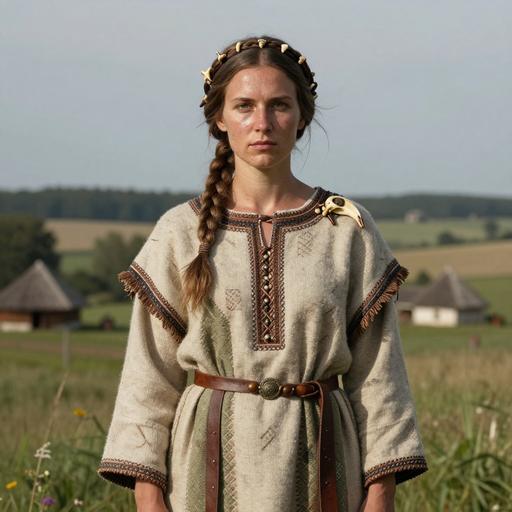
A woman buried in Poland in the Middle Neolithic to Late Neolithic era

Download PDF creates a visual, rasterized copy. Use Print for selectable text and better assistive-technology support.

Loading Report

Preparing your ancestry journey

Preparing the available report content...

Your report will open automatically.

Skip to main content
Reference library / Sample profile

A woman buried in Poland in the Middle Neolithic to Late Neolithic era

Explore the recorded context, genetic comparisons and research behind this reference sample.

PolandPoland TRB

A reference profile describes this sample. It does not establish a personal or family relationship.

AI portrait reconstruction for A woman buried in Poland in the Middle Neolithic to Late Neolithic era
AI-generated artistic reconstruction, not a photograph of the individual.
Record

Sample details

Recorded details and available lineage markers.

Individual

European Neolithic individual, Poland

Sample ID: N18

Date Range

3632 BCE - 3376 BCE

Cultural Period

Poland TRB

Biological Sex

Female

mtDNA Haplogroup

N1a1a1

Y-DNA Haplogroup

Not available

Social Role

Farmer (AI estimate, era-typical)

Geography

Location

Where this individual was discovered

Country Poland
Locality Pikutkowo
Coordinates 52.6200, 18.9600
Chronology

Date range

When this individual lived in the broader context of human history

European Neolithic individual, Poland 3632 BCE - 3376 BCE
Context

Historical context

Background information associated with the reference record.

Overview

The Funnel Beaker tradition (TRB) in Poland belongs to a middle-to-late Neolithic horizon in which farming communities expanded and reorganized settlement across central and northern parts of the region. Their material culture combines well-made pottery, large communal burial practices, and everyday toolkits suited to agricultural life.

Region & Environment

TRB-era sites in Poland are typically set within fertile plains and river corridors, where alluvial soils supported cultivation and grazing. Forest patches, lakes, and wetlands shaped where people could settle and how they moved between fields, water sources, and burial grounds. In such landscapes, soils and waterways strongly influenced site choice and the placement of monuments.

Historical Context

Across Neolithic Europe, the TRB horizon is associated with intensified farming and the spread of shared cultural practices. In Poland, this horizon marks a period of increasing monumentality in burial and a continued emphasis on domestic production. While local trajectories varied by region, the overall pattern is one of Neolithic communities sustaining themselves through agriculture and livestock while maintaining broader connections through shared styles.

Populations & Lifeways

The population consisted of settled agricultural groups, likely with mixed herding and crop cultivation as core subsistence. Communities lived in small settlements and farms that changed over time, with access to arable land and pasture. Labor needs for cultivation and herding would have encouraged stable households and repeated seasonal activities.

Archaeology & Material Culture

Archaeological signatures include Funnel Beaker pottery and associated ceramic styles, along with polished stone axes and other ground-stone tools. Burial archaeology is especially important: TRB groups are known for large collective tombs and burial practices that stand out from earlier Neolithic patterns. Flint processing—through blades, scrapers, and related tool forms—also appears frequently, reflecting local stone procurement and craft work.

Culture & Society

TRB material culture suggests shared norms that extended beyond individual villages, visible most clearly in pottery styles and mortuary architecture. Collective burial settings imply social coordination and an emphasis on community identity. At the same time, variation in local monument styles and settlement organization indicates that TRB practices were adapted to different regional conditions.

Legacy & Transition

Later Neolithic and early Bronze Age developments in Poland build on the established farming economy and monument tradition, but shift in ceramic styles, burial practices, and broader cultural affiliations. The TRB horizon thus represents an important middle Neolithic stage in the longer sequence of European Neolithic-to-Bronze Age change, when regional networks and identities continued to evolve rather than disappear.

Analysis

Genetic comparisons

These comparisons show genetic similarity, not identity or origin. The populations listed are those whose genomes show statistical alignment to this ancient individual.

Similarity reflects shared history, not shared identity. These are analytical comparisons, not claims about who this person was.

Modern Genetic Admixture

This analysis compares the DNA profile with present-day reference populations, showing statistical similarity to modern reference populations from different regions. The excavation site records where this individual was found, not a fixed modern genetic identity.

Europe 100.0%
Southern European 98.3%
Italian 47.2%
Iberian 29.8%
Sardinian 21.4%
Northwestern European 1.7%

Closest Modern Populations

These are the modern populations showing the closest statistical alignment to A woman buried in Poland in the Middle Neolithic to Late Neolithic era, ranked by genetic distance. Lower distance values indicate closer statistical similarity. Cross-region similarity can reflect shared ancestry, population movement, continuity, or later admixture.

1
Sardinian
2.8684
2
French Corsica
5.5039
3
Spanish La Rioja
6.1310
4
Spanish Castilla La Mancha
6.3071
5
Spanish Murcia
6.3494
6
Spanish Menorca
6.3678
7
Spanish Andalucia
6.3766
8
Spanish Castello
6.4309
9
Spanish Pirineu
6.4711
10
Spanish Aragon
6.4952
Context

Related Samples

This individual exists within a broader network of ancient samples. No ancient genome stands alone.

Individual Culture/Period Date Location Action
European Neolithic individual, Poland Brześć Kujawski Group, Poland 4600 BCE Oslonki, Poland View
Indo-European individual, Poland Early Bronze Age Poland 2020 BCE Gustorzyn, Poland View
Indo-European individual, Poland Corded Ware Culture, Poland 2600 BCE Pikutkowo, Poland View
European Neolithic individual, Poland Brześć Kujawski Group, Poland 4335 BCE Konary, Poland View
Indo-European individual, Poland Corded Ware Culture, Poland 2600 BCE Pikutkowo, Poland View
Indo-European individual, Poland Globular Amphora Culture, Poland 3307 BCE Brzesc Kujawski, Poland View
Indo-European individual, Poland Corded Ware Culture, Poland 2571 BCE Pikutkowo, Poland View
European Neolithic individual, Poland Funnel Beaker Culture, Poland 3636 BCE Pikutkowo, Poland View
European Neolithic individual, Poland Brześć Kujawski Group, Poland 4600 BCE Oslonki, Poland View
European Neolithic individual, Poland Brześć Kujawski Group, Poland 4600 BCE Konary, Poland View
European Neolithic individual, Poland Funnel Beaker Culture, Poland 3632 BCE Pikutkowo, Poland View
European Neolithic individual, Poland Brześć Kujawski Group, Poland 4442 BCE Brzesc Kujawski, Poland View
European Neolithic individual, Poland Brześć Kujawski Group, Poland 4327 BCE Oslonki, Poland View
European Neolithic individual, Poland Brześć Kujawski Group, Poland 4251 BCE Oslonki, Poland View
European Neolithic individual, Poland Funnel Beaker Culture, Poland 3633 BCE Pikutkowo, Poland View
European Neolithic individual, Poland Brześć Kujawski Group, Poland 4233 BCE Oslonki, Poland View
Poland Eba individual, Poland 2020 BCE Gustorzyn, Poland View
Ceu Mn individual, Poland 3632 BCE Pikutkowo, Poland View
Anglian individual, Poland 3636 BCE Pikutkowo, Poland View
Ceu Mn individual, Poland 3633 BCE Pikutkowo, Poland View
Poland N individual, Poland 4442 BCE Brzesc Kujawski, Poland View
Poland N individual, Poland 4600 BCE Oslonki, Poland View
Poland N individual, Poland 4335 BCE Konary, Poland View
Poland N individual, Poland 4600 BCE Oslonki, Poland View
Poland N individual, Poland 4251 BCE Oslonki, Poland View
Poland N individual, Poland 4327 BCE Oslonki, Poland View
Poland N individual, Poland 4600 BCE Konary, Poland View
Globular Amphora individual, Poland 3307 BCE Brzesc Kujawski, Poland View
Poland N individual, Poland 4233 BCE Oslonki, Poland View
Corded Ware individual, Poland 2571 BCE Pikutkowo, Poland View
Corded Ware individual, Poland 2600 BCE Pikutkowo, Poland View
Page 1
Individual Culture/Period Date Location Action
European Neolithic individual, Poland Funnel Beaker Culture, Poland 3636 BCE Pikutkowo, Poland View
European Neolithic individual, Poland Funnel Beaker Culture, Poland 3632 BCE Pikutkowo, Poland View
European Neolithic individual, Poland Funnel Beaker Culture, Poland 3633 BCE Pikutkowo, Poland View
Page 1
Sources

References

Scientific publications and genetic data that inform this profile.

G25 Coordinates

These coordinates represent a position in genetic space, a tool for comparison, not a conclusion. You can use these to perform custom admixture analysis in G25 Studio.

N18,0.11703896,0.16009462,0.02726218,-0.03651972,0.0562376,-0.01858808,-0.00239572,0.00594264,0.03839488,0.0649193,-0.0045293,0.01360896,-0.023873,-0.01272584,-0.00708664,0.004349,0.00761478,-0.00065412,-0.00129672,-0.00299484,0.0010641,0.00459444,-0.01149878,-0.018055,0.00403645
Continue in G25 Studio
Use code for 30% off • Expires Nov 16