A man buried in Poland in the Neolithic era

Download PDF creates a visual, rasterized copy. Use Print for selectable text and better assistive-technology support.

Loading Report

Preparing your ancestry journey

Preparing the available report content...

Your report will open automatically.

Skip to main content
Reference library / Sample profile

A man buried in Poland in the Neolithic era

Explore the recorded context, genetic comparisons and research behind this reference sample.

PolandPoland BKG

A reference profile describes this sample. It does not establish a personal or family relationship.

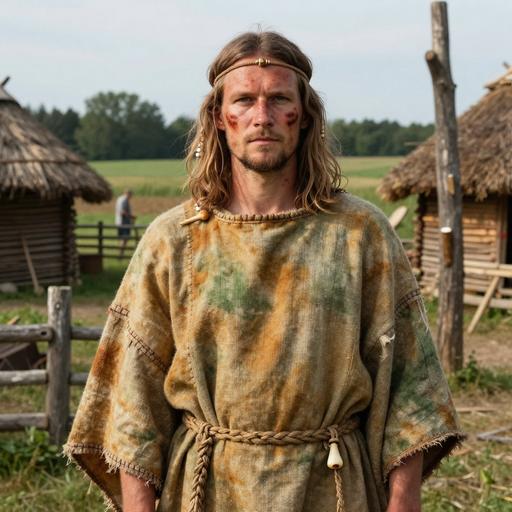
AI portrait reconstruction for A man buried in Poland in the Neolithic era
AI-generated artistic reconstruction, not a photograph of the individual.
Record

Sample details

Recorded details and available lineage markers.

Individual

European Neolithic individual, Poland

Sample ID: N27

Date Range

4600 BCE - 4000 BCE

Cultural Period

Poland BKG

Biological Sex

Male

mtDNA Haplogroup

V14

Y-DNA Haplogroup

G-PF3345

Social Role

Farmer (AI estimate, era-typical)

Geography

Location

Where this individual was discovered

Country Poland
Locality Oslonki
Coordinates 52.6100, 18.8000
Chronology

Date range

When this individual lived in the broader context of human history

European Neolithic individual, Poland 4600 BCE - 4000 BCE
Context

Historical context

Background information associated with the reference record.

Overview

The Poland BKG era dates to about 4500–4000 BCE and is associated with Neolithic cultural developments within the Lengyel sphere. It is represented in the archaeological record through distinctive material traditions—especially ceramics—and through evidence for settled community life.

Region & Environment

In Poland, Neolithic communities inhabited landscapes suitable for agriculture, including river valleys and fertile plains. Access to water supported farming, transportation, and the exploitation of surrounding ecosystems for building materials and food resources.

Historical Context

During the 5th millennium BCE, Neolithic societies across central Europe developed complex and interconnected regional traditions. The Lengyel sphere is often used archaeologically to describe recurring patterns in pottery styles, settlement forms, and craft practice, with regional variants such as those attributed to Brześć Kujawski.

Populations & Lifeways

People lived in village-based communities, organizing labor around cultivation and animal husbandry. Household routines included producing and using pottery for daily tasks like food preparation and storage, as well as maintaining tools and domestic spaces.

Archaeology & Material Culture

Material culture most strongly reflects ceramic technology and style: Brześć Kujawski is identified through recurring pottery traits within the broader Lengyel tradition. Stone and other utilitarian tools, along with locally made craft goods, indicate ongoing production within community networks rather than reliance on a single external source.

Culture & Society

Shared ceramic traditions point to communal learning and social ties that could link neighboring settlements. At the same time, differences in decoration and vessel form suggest local identities and functional preferences, implying that communities negotiated both participation in wider norms and independent local practice.

Legacy & Transition

By the later 4th millennium BCE, Neolithic traditions in Poland continued to evolve as new styles and cultural influences spread. The transition from this horizon reflects broader changes in social networks, craft traditions, and how communities adapted to changing conditions and connections across central Europe.

Analysis

Genetic comparisons

These comparisons show genetic similarity, not identity or origin. The populations listed are those whose genomes show statistical alignment to this ancient individual.

Similarity reflects shared history, not shared identity. These are analytical comparisons, not claims about who this person was.

Modern Genetic Admixture

This analysis compares the DNA profile with present-day reference populations, showing statistical similarity to modern reference populations from different regions. The excavation site records where this individual was found, not a fixed modern genetic identity.

Europe 99.9%
Southern European 99.9%
Sardinian 99.9%

Closest Modern Populations

These are the modern populations showing the closest statistical alignment to A man buried in Poland in the Neolithic era, ranked by genetic distance. Lower distance values indicate closer statistical similarity. Cross-region similarity can reflect shared ancestry, population movement, continuity, or later admixture.

1
Sardinian
3.9744
2
French Corsica
5.6948
3
Belmonte Jew
5.9590
4
Italian Lazio
6.7712
5
Sicilian West
7.0362
6
Italian Umbria
7.0441
7
Italian Lombardy
7.1408
8
Spanish Murcia
7.1645
9
Spanish Andalucia
7.2044
10
Spanish Menorca
7.2447
Context

Related Samples

This individual exists within a broader network of ancient samples. No ancient genome stands alone.

Individual Culture/Period Date Location Action
European Neolithic individual, Poland Brześć Kujawski Group, Poland 4600 BCE Oslonki, Poland View
Indo-European individual, Poland Early Bronze Age Poland 2020 BCE Gustorzyn, Poland View
Indo-European individual, Poland Corded Ware Culture, Poland 2600 BCE Pikutkowo, Poland View
European Neolithic individual, Poland Brześć Kujawski Group, Poland 4335 BCE Konary, Poland View
Indo-European individual, Poland Corded Ware Culture, Poland 2600 BCE Pikutkowo, Poland View
Indo-European individual, Poland Globular Amphora Culture, Poland 3307 BCE Brzesc Kujawski, Poland View
Indo-European individual, Poland Corded Ware Culture, Poland 2571 BCE Pikutkowo, Poland View
European Neolithic individual, Poland Funnel Beaker Culture, Poland 3636 BCE Pikutkowo, Poland View
European Neolithic individual, Poland Brześć Kujawski Group, Poland 4600 BCE Oslonki, Poland View
European Neolithic individual, Poland Brześć Kujawski Group, Poland 4600 BCE Konary, Poland View
European Neolithic individual, Poland Funnel Beaker Culture, Poland 3632 BCE Pikutkowo, Poland View
European Neolithic individual, Poland Brześć Kujawski Group, Poland 4442 BCE Brzesc Kujawski, Poland View
European Neolithic individual, Poland Brześć Kujawski Group, Poland 4327 BCE Oslonki, Poland View
European Neolithic individual, Poland Brześć Kujawski Group, Poland 4251 BCE Oslonki, Poland View
European Neolithic individual, Poland Funnel Beaker Culture, Poland 3633 BCE Pikutkowo, Poland View
European Neolithic individual, Poland Brześć Kujawski Group, Poland 4233 BCE Oslonki, Poland View
Poland Eba individual, Poland 2020 BCE Gustorzyn, Poland View
Ceu Mn individual, Poland 3632 BCE Pikutkowo, Poland View
Anglian individual, Poland 3636 BCE Pikutkowo, Poland View
Ceu Mn individual, Poland 3633 BCE Pikutkowo, Poland View
Poland N individual, Poland 4442 BCE Brzesc Kujawski, Poland View
Poland N individual, Poland 4600 BCE Oslonki, Poland View
Poland N individual, Poland 4335 BCE Konary, Poland View
Poland N individual, Poland 4600 BCE Oslonki, Poland View
Poland N individual, Poland 4251 BCE Oslonki, Poland View
Poland N individual, Poland 4327 BCE Oslonki, Poland View
Poland N individual, Poland 4600 BCE Konary, Poland View
Globular Amphora individual, Poland 3307 BCE Brzesc Kujawski, Poland View
Poland N individual, Poland 4233 BCE Oslonki, Poland View
Corded Ware individual, Poland 2571 BCE Pikutkowo, Poland View
Corded Ware individual, Poland 2600 BCE Pikutkowo, Poland View
Page 1
Individual Culture/Period Date Location Action
European Neolithic individual, Poland Brześć Kujawski Group, Poland 4600 BCE Oslonki, Poland View
European Neolithic individual, Poland Brześć Kujawski Group, Poland 4335 BCE Konary, Poland View
European Neolithic individual, Poland Brześć Kujawski Group, Poland 4600 BCE Oslonki, Poland View
European Neolithic individual, Poland Brześć Kujawski Group, Poland 4600 BCE Konary, Poland View
European Neolithic individual, Poland Brześć Kujawski Group, Poland 4442 BCE Brzesc Kujawski, Poland View
European Neolithic individual, Poland Brześć Kujawski Group, Poland 4327 BCE Oslonki, Poland View
European Neolithic individual, Poland Brześć Kujawski Group, Poland 4251 BCE Oslonki, Poland View
European Neolithic individual, Poland Brześć Kujawski Group, Poland 4233 BCE Oslonki, Poland View
Page 1
Sources

References

Scientific publications and genetic data that inform this profile.

G25 Coordinates

These coordinates represent a position in genetic space, a tool for comparison, not a conclusion. You can use these to perform custom admixture analysis in G25 Studio.

N27,0.10940194,0.15884256,0.01491104,-0.05069058,0.0488036,-0.02508756,-0.00306658,0.0043492,0.04188714,0.05900122,-0.00192716,0.00947912,-0.01523906,-0.01133916,-0.00816878,0.00655596,0.0045321,0.00041718,0.00113898,-0.00070108,0.00366124,0.007258,-0.01257214,-0.01708958,0.00286915
Continue in G25 Studio
Use code for 30% off • Expires Nov 16