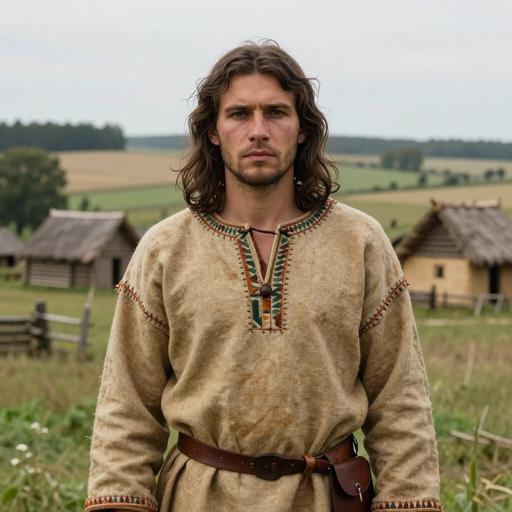
A man buried in Poland in the Early Bronze Age era

Download PDF creates a visual, rasterized copy. Use Print for selectable text and better assistive-technology support.

Loading Report

Preparing your ancestry journey

Preparing the available report content...

Your report will open automatically.

Skip to main content
Reference library / Sample profile

A man buried in Poland in the Early Bronze Age era

Explore the recorded context, genetic comparisons and research behind this reference sample.

PolandPoland EBA

A reference profile describes this sample. It does not establish a personal or family relationship.

AI portrait reconstruction for A man buried in Poland in the Early Bronze Age era
AI-generated artistic reconstruction, not a photograph of the individual.
Record

Sample details

Recorded details and available lineage markers.

Individual

Indo-European individual, Poland

Sample ID: N17

Date Range

2020 BCE - 1774 BCE

Cultural Period

Poland EBA

Biological Sex

Male

mtDNA Haplogroup

J1c1b1a

Y-DNA Haplogroup

R-S24902

Social Role

Farmer (AI estimate, era-typical)

Geography

Location

Where this individual was discovered

Country Poland
Locality Gustorzyn
Coordinates 52.6600, 18.8800
Chronology

Date range

When this individual lived in the broader context of human history

Indo-European individual, Poland 2020 BCE - 1774 BCE
Context

Historical context

Background information associated with the reference record.

Early Bronze Age Poland falls within the broader Central European Bronze Age expansion in metallurgy and interregional contact. While regional traditions are archaeologically identifiable, local communities also shared shared patterns in metal object production and ceremonial practice.

Region & Environment

The Early Bronze Age record in Poland concerns a landscape of plains, river valleys, and lake/wetland environments. These settings supported farming and livestock, while waterways and nearby wetlands provided additional resources such as fish and game.

Historical Context

Between about 2300 and 1600 BCE, exchange networks carried people, ideas, and materials across Central Europe. Bronze objects—when present in graves and settlements—reflect both access to raw materials and participation in wider technological traditions.

Populations & Lifeways

Populations likely lived in small settlements with an economy based on crop cultivation and animal husbandry, supplemented by hunting and fishing. Household and community production would have included pottery manufacture and craft work, with metalworking activities indicating specialization or access to specialized artisans.

Archaeology & Material Culture

Archaeological evidence typically includes pottery traditions and metal artifacts, alongside burial remains that help define archaeological phases. Regional ceramic styles and the forms of bronze objects are especially important for tracking change across time within this part of Poland.

Culture & Society

The distribution of grave goods and differences in burial treatment provide evidence for social roles and status differentiation. Recurrent stylistic features in ceramics and metalworking suggest that communities maintained recognizable cultural norms while also adapting to influences from neighboring regions.

Legacy & Transition

As the Early Bronze Age came to a close, cultural patterns continued to develop, with later Bronze Age phases showing new combinations of burial customs and material styles. These transitions illustrate how technological and social change unfolded gradually through the archaeological record rather than as a single event.

Analysis

Genetic comparisons

These comparisons show genetic similarity, not identity or origin. The populations listed are those whose genomes show statistical alignment to this ancient individual.

Similarity reflects shared history, not shared identity. These are analytical comparisons, not claims about who this person was.

Modern Genetic Admixture

This analysis compares the DNA profile with present-day reference populations, showing statistical similarity to modern reference populations from different regions. The excavation site records where this individual was found, not a fixed modern genetic identity.

Europe 96.8%
Northwestern European 69.6%
Scandinavian 25.9%
Northwestern European 23.1%
English 20.6%
Eastern European 27.3%
Asia 2.8%
Northern West Asian 2.5%
Caucasian 1.4%
Anatolian 1.2%

Closest Modern Populations

These are the modern populations showing the closest statistical alignment to A man buried in Poland in the Early Bronze Age era, ranked by genetic distance. Lower distance values indicate closer statistical similarity. Cross-region similarity can reflect shared ancestry, population movement, continuity, or later admixture.

1
Swedish
3.1209
2
Czech
3.3860
3
German Hamburg
3.4981
4
Polish Silesian
3.5207
5
Polish
3.5802
6
Ukrainian Dnipro
3.7184
7
Polish Kashubian
3.7186
8
Slovakian
3.7329
9
Russian Ryazan
3.8044
10
Moldovan O
3.8074
Context

Related Samples

This individual exists within a broader network of ancient samples. No ancient genome stands alone.

Individual Culture/Period Date Location Action
European Neolithic individual, Poland Brześć Kujawski Group, Poland 4600 BCE Oslonki, Poland View
Indo-European individual, Poland Early Bronze Age Poland 2020 BCE Gustorzyn, Poland View
Indo-European individual, Poland Corded Ware Culture, Poland 2600 BCE Pikutkowo, Poland View
European Neolithic individual, Poland Brześć Kujawski Group, Poland 4335 BCE Konary, Poland View
Indo-European individual, Poland Corded Ware Culture, Poland 2600 BCE Pikutkowo, Poland View
Indo-European individual, Poland Globular Amphora Culture, Poland 3307 BCE Brzesc Kujawski, Poland View
Indo-European individual, Poland Corded Ware Culture, Poland 2571 BCE Pikutkowo, Poland View
European Neolithic individual, Poland Funnel Beaker Culture, Poland 3636 BCE Pikutkowo, Poland View
European Neolithic individual, Poland Brześć Kujawski Group, Poland 4600 BCE Oslonki, Poland View
European Neolithic individual, Poland Brześć Kujawski Group, Poland 4600 BCE Konary, Poland View
European Neolithic individual, Poland Funnel Beaker Culture, Poland 3632 BCE Pikutkowo, Poland View
European Neolithic individual, Poland Brześć Kujawski Group, Poland 4442 BCE Brzesc Kujawski, Poland View
European Neolithic individual, Poland Brześć Kujawski Group, Poland 4327 BCE Oslonki, Poland View
European Neolithic individual, Poland Brześć Kujawski Group, Poland 4251 BCE Oslonki, Poland View
European Neolithic individual, Poland Funnel Beaker Culture, Poland 3633 BCE Pikutkowo, Poland View
European Neolithic individual, Poland Brześć Kujawski Group, Poland 4233 BCE Oslonki, Poland View
Poland Eba individual, Poland 2020 BCE Gustorzyn, Poland View
Ceu Mn individual, Poland 3632 BCE Pikutkowo, Poland View
Anglian individual, Poland 3636 BCE Pikutkowo, Poland View
Ceu Mn individual, Poland 3633 BCE Pikutkowo, Poland View
Poland N individual, Poland 4442 BCE Brzesc Kujawski, Poland View
Poland N individual, Poland 4600 BCE Oslonki, Poland View
Poland N individual, Poland 4335 BCE Konary, Poland View
Poland N individual, Poland 4600 BCE Oslonki, Poland View
Poland N individual, Poland 4251 BCE Oslonki, Poland View
Poland N individual, Poland 4327 BCE Oslonki, Poland View
Poland N individual, Poland 4600 BCE Konary, Poland View
Globular Amphora individual, Poland 3307 BCE Brzesc Kujawski, Poland View
Poland N individual, Poland 4233 BCE Oslonki, Poland View
Corded Ware individual, Poland 2571 BCE Pikutkowo, Poland View
Corded Ware individual, Poland 2600 BCE Pikutkowo, Poland View
Page 1
Individual Culture/Period Date Location Action
EBA individual, Poland Early Bronze Age Poland 2340 BCE Iwiny, Poland View
Indo-European individual, Poland Early Bronze Age Poland 2020 BCE Gustorzyn, Poland View
Poland Eba individual, Poland 2020 BCE Gustorzyn, Poland View
Page 1
Sources

References

Scientific publications and genetic data that inform this profile.

G25 Coordinates

These coordinates represent a position in genetic space, a tool for comparison, not a conclusion. You can use these to perform custom admixture analysis in G25 Studio.

N17,0.12974542,0.11573276,0.06327738,0.05988432,0.02941872,0.02786438,0.00483268,0.00812552,-0.0057205,-0.02261352,-0.00277446,3.126E-05,0.0053409,0.00288688,0.00702774,0.0007321,-0.00190534,-0.00137354,0.0015949,0.00202646,0.00388216,-0.00104178,-0.00166158,0.0087947,-0.0001978
Continue in G25 Studio
Use code for 30% off • Expires Nov 16