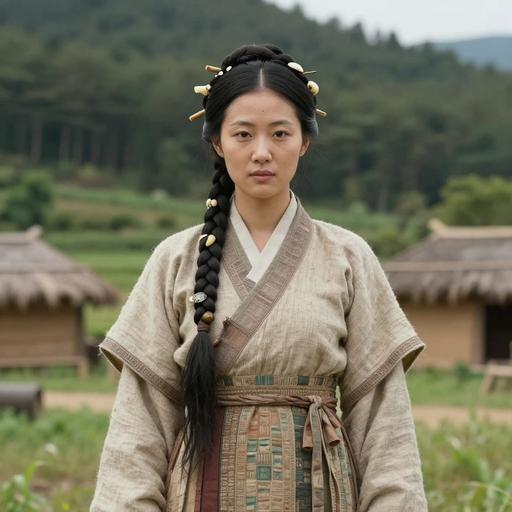
A woman buried in South Korea in the Bronze Age era

Download PDF creates a visual, rasterized copy. Use Print for selectable text and better assistive-technology support.

Loading Report

Preparing your ancestry journey

Preparing the available report content...

Your report will open automatically.

Skip to main content
Reference library / Sample profile

A woman buried in South Korea in the Bronze Age era

Explore the recorded context, genetic comparisons and research behind this reference sample.

South KoreaBronze Age Korea

A reference profile describes this sample. It does not establish a personal or family relationship.

AI portrait reconstruction for A woman buried in South Korea in the Bronze Age era
AI-generated artistic reconstruction, not a photograph of the individual.
Record

Sample details

Recorded details and available lineage markers.

Individual

Republicof Korea Yokchido individual, South Korea

Sample ID: TYJ001

Date Range

2500 BCE - 1500 BCE

Cultural Period

Bronze Age Korea

Biological Sex

Female

mtDNA Haplogroup

Not available

Y-DNA Haplogroup

Not available

Social Role

Farmer (AI estimate, era-typical)

Geography

Location

Where this individual was discovered

Country South Korea
Locality Yokchido
Chronology

Date range

When this individual lived in the broader context of human history

Republicof Korea Yokchido individual, South Korea 2500 BCE - 1500 BCE
Context

Historical context

Background information associated with the reference record.

The Bronze Age in Korea, also referred to as the \Korea Bronze Age," spanned roughly from the around 1000 BCE to 300 BCE. This era marked significant advancements in technology, social organization, and cultural developments across the Korean Peninsula and parts of Manchuria, laying foundational elements for later periods.

Socio-political Structure

During the Korean Bronze Age, society began to show more complex levels of organization. Communities were typically agrarian, with evidence of rice cultivation becoming increasingly dominant, a vital contribution to social stability and growth. Villages started to evolve into larger settlements with distinct social hierarchies. The elite class likely controlled bronze production and distribution, which was crucial for maintaining power and influence. These leaders possibly functioned as war leaders, religious figures, or both, reflecting a system where authority was often military and spiritual.

Technological Advancements

The arrival and spread of bronze technology represented a transformative phase for Korea. Bronze, an alloy of copper and tin, was primarily used for tools, weapons, and ritual items, such as mirrors and bells. The metal's use helped improve agricultural productivity due to the superior tools available compared to those made solely from stone. These advancements undoubtedly played a role in the increased stability and growth of Bronze Age Korean societies.

Pottery and Material Culture

Bronze Age pottery in Korea is distinguished by its sophistication and variety. This period saw the transition from Neolithic-style comb-patterned pottery to more refined, wheel-thrown pieces. Many items were ornately decorated, suggesting they were not only utilitarian but also served ceremonial purposes or demonstrated personal status.

Bronze items themselves became significant cultural artifacts. Many bronze artifacts discovered in Korea include daggers, mirrors, and bells, showcasing a blend of functionality and artistry. The intricate designs on these items may hold symbolic meanings related to power, cosmology, or spiritual life.

Trade and Interaction

During this era, Korea was not an isolated culture; there was continuous interaction with neighboring regions, particularly China and Japan. The Korean Peninsula served as a corridor for the transfer of goods, ideas, technologies, and even people. This interaction is evidenced by similarities in material culture, such as bronze artifacts and pottery styles, found in Korea, the Chinese Liaoning region, and the Japanese archipelago.

Trade likely facilitated the spread of bronze technology and other cultural influences. Moreover, the influx of new ideas through trade and interaction might have spurred local innovations and adaptations, which defined the distinct character of Korean Bronze Age culture.

Religious and Ritual Practices

Religious beliefs during the Bronze Age in Korea were likely animistic, with a pantheon of spirits associated with natural elements such as mountains, rivers, and trees. Rituals may have played a significant role in community life, underpinning social cohesion and the authority of leaders. Evidence suggests that ritualistic items like bronze daggers and mirrors were used in ceremonies that possibly aimed to ensure agricultural fertility, protection against natural calamities, or the community’s well-being.

Burial Practices

Burial practices offer profound insights into the sociocultural dynamics of Bronze Age Korea. Reflecting the era’s social stratification, tombs ranged from simple pit burials to more elaborate dolmens. These monumental stone structures, prevalent in Korea, served as burial sites for elites and are often associated with grave goods, including bronze artifacts, pottery, and personal ornaments. Such findings indicate beliefs in an afterlife where social status persisted, emphasizing the importance of honoring ancestors and reinforcing societal hierarchies.

In summary, the Bronze Age in Korea was a period of vital transformation characterized by advancements in technology, the rise of more complex societal structures, and the enrichment of cultural practices. It set the stage for subsequent historical phases, profoundly impacting the trajectory of Korean civilization and its development."

Analysis

Genetic comparisons

These comparisons show genetic similarity, not identity or origin. The populations listed are those whose genomes show statistical alignment to this ancient individual.

Similarity reflects shared history, not shared identity. These are analytical comparisons, not claims about who this person was.

Modern Genetic Admixture

This analysis compares the DNA profile with present-day reference populations, showing statistical similarity to modern reference populations from different regions. The excavation site records where this individual was found, not a fixed modern genetic identity.

Asia 96.1%
Japanese & Korean 86.9%
Japanese 86.9%
Central Asian, Northern Indian & Pakistani 9.2%
Indian 9.2%
Europe 2.8%
Northwestern European 2.8%
Oceania 0.7%
Melanesian 0.7%
Papuan 0.7%

Closest Modern Populations

These are the modern populations showing the closest statistical alignment to A woman buried in South Korea in the Bronze Age era, ranked by genetic distance. Lower distance values indicate closer statistical similarity. Cross-region similarity can reflect shared ancestry, population movement, continuity, or later admixture.

1
Nepali Tamang Simigaon
5.6145
2
Tamang
5.6905
3
Magar
5.7536
4
Yuku
6.1127
5
Gurung
6.7506
6
Mongol Inner Mongolia
7.0622
7
Dongxiang
7.1658
8
Salar
7.3965
9
Tibetan Gangcha
7.5335
10
Nepali Tamang Tashinam
7.6577
Context

Related Samples

This individual exists within a broader network of ancient samples. No ancient genome stands alone.

Individual Culture/Period Date Location Action
Republicof Korea individual, South Korea Ancient Korea 6,300-3,000 BCE Ando, South Korea View
Republicof Korea Taejungni individual, South Korea Iron Age Korea 768-542 BCE Taejungni, South Korea View
Republicof Korea Changhang individual, South Korea The Changhang Culture of Korea 4,696-4,505 BCE Changhang, South Korea View
Republicof Korea Changhang individual, South Korea The Changhang Culture of Korea 4,706-4,542 BCE Changhang, South Korea View
Nagabaka Historic individual, Japan Historical Japan 900-1 BCE Nagabaka, Japan View
Nagabaka individual, Japan Nagabaka 2800BP 900-1 BCE Nagabaka, Japan View
Nagabaka individual, Japan Bronze Age Japan 100 BCE-50 CE Nagabaka, Japan View
Nagabaka individual, Japan Nagabaka 2800BP 796-560 BCE Nagabaka, Japan View
Nagabaka individual, Japan Nagabaka 2800BP 900-1 BCE Nagabaka, Japan View
Nagabaka individual, Japan Nagabaka 2800BP 821-794 BCE Nagabaka, Japan View
Republicof Korea Yondaedo-1 individual, South Korea Yondaedo Culture 1, Korea 5,500-4,500 BCE Yŏndaedo, South Korea View
Republicof Korea Yondaedo-2 individual, South Korea Yondaedo Culture 2, Korea 5,500-4,500 BCE Yŏndaedo, South Korea View
Republicof Korea Yokchido individual, South Korea Bronze Age Korea 2,500-1,500 BCE Yokchido, South Korea View
Yayoi individual, Japan The Yayoi Period 200-100 BCE Kuma−Nishioda, Japan View
Page 1
Individual Culture/Period Date Location Action
Republicof Korea Yokchido individual, South Korea Bronze Age Korea 2,500-1,500 BCE Yokchido, South Korea View
Page 1
Sources

References

Scientific publications and genetic data that inform this profile.

G25 Coordinates

These coordinates represent a position in genetic space, a tool for comparison, not a conclusion. You can use these to perform custom admixture analysis in G25 Studio.

TYJ001,0.02565924,-0.34999246,0.00323654,-0.00078494,-0.0077206,-0.00938788,0.00115516,0.00190232,0.0077933,0.01268372,-0.04823524,-0.00373172,0.00693854,0.0031473,-0.0072126,-0.00633176,0.00120794,-0.00159382,-0.00182156,0.00240832,0.00463496,0.01076328,0.00327598,0.0032986,0.02096055
Continue in G25 Studio

Our analyses use reference samples for comparison. A sample’s place, period and source help explain how to interpret a match.

Use code for 35% off • Expires Nov 30