A woman buried in South Korea in the Mesolithic era

Download PDF creates a visual, rasterized copy. Use Print for selectable text and better assistive-technology support.

Loading Report

Preparing your ancestry journey

Preparing the available report content...

Your report will open automatically.

Skip to main content
Reference library / Sample profile

A woman buried in South Korea in the Mesolithic era

Explore the recorded context, genetic comparisons and research behind this reference sample.

South KoreaAncient Korea

A reference profile describes this sample. It does not establish a personal or family relationship.

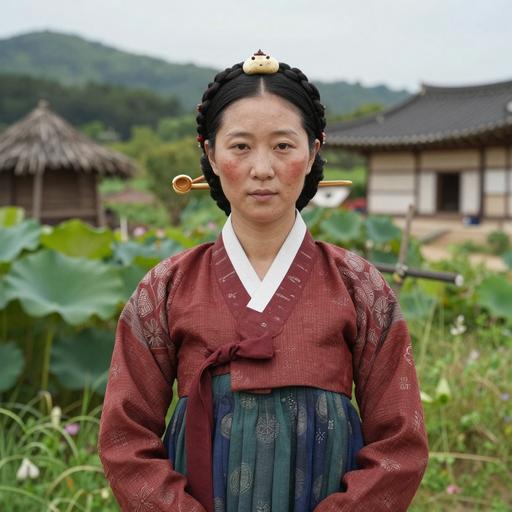
AI portrait reconstruction for A woman buried in South Korea in the Mesolithic era
AI-generated artistic reconstruction, not a photograph of the individual.
Record

Sample details

Recorded details and available lineage markers.

Individual

Republicof Korea individual, South Korea

Sample ID: AND004

Date Range

6300 BCE - 3000 BCE

Cultural Period

Ancient Korea

Biological Sex

Female

mtDNA Haplogroup

Not available

Y-DNA Haplogroup

Not available

Social Role

Farmer (AI estimate, era-typical)

Geography

Location

Where this individual was discovered

Country South Korea
Locality Ando
Chronology

Date range

When this individual lived in the broader context of human history

Republicof Korea individual, South Korea 6300 BCE - 3000 BCE
Context

Historical context

Background information associated with the reference record.

Ancient Korea is a significant period in East Asian history, known for its rich cultural heritage, dynamic inter-regional interactions, and remarkable advancements in art, technology, and society. The history of ancient Korea is typically divided into several key periods: the Gojoseon, the Three Kingdoms of Korea, the Silla and Baekje periods, and eventually the Unified Silla and Balhae states.

Gojoseon Era (c. 2333 BCE – 108 BCE)

Origins and Mythology:

  • Foundation Myth: Gojoseon is considered the first Korean kingdom, traditionally founded by Dangun Wanggeom in 2333 BCE. According to Korean mythology, Dangun was the grandson of heaven, highlighting the divine origins attributed to Korean civilization.
  • Location and Society: Early Gojoseon was located in northern Korea and parts of Manchuria. It evolved from tribal entities to a more centralized society.

Development:

  • Bronze Age Culture: Gojoseon is noted for its advancements in bronze technology, reflected in the distinct Gojoseon-style bronze daggers and mirror artifacts.
  • Agricultural Practices: Evidence of rice cultivation and use of iron tools suggests a shift towards a more agrarian economy.
  • Conflicts and Diplomacy: Gojoseon had interactions with neighboring Chinese states. It engaged in trade and at times conflict, which influenced its political landscape.

The Three Kingdoms Era (c. 57 BCE – 668 CE)

This era marks the emergence of significant states that competed for dominance over the Korean Peninsula: Goguryeo, Baekje, and Silla.

Goguryeo:

  • Territorial Expansion: Goguryeo was the largest and northernmost of the three kingdoms, extending its influence into Manchuria and parts of the Korean Peninsula.
  • Military Prowess: Known for its powerful military and fortress architecture, Goguryeo engaged in frequent conflicts with Chinese dynasties.
  • Cultural Flourishing: The kingdom housed magnificent tomb complexes and developed its distinct Goguryeo art.

Baekje:

  • Cultural Influence: Located in the southwestern part of the peninsula, Baekje was a center of cultural exchange, particularly with Japan. Its contributions to Korean Buddhist art and architecture are notable.
  • Diplomatic Endeavors: Baekje maintained strong diplomatic and cultural connections with both China and Japan, facilitating the spread of Buddhism to Japan.

Silla:

  • Economic Growth and Buddhism: Silla, initially the least powerful, capitalized on its rich resources and trade routes. It played a pivotal role in the spread of Buddhism across Korea.
  • Hwarang Warriors: Silla is famed for its Hwarang, an elite group of young warriors who were deeply influenced by Buddhist and Confucian philosophies.

The Unified Silla and Balhae Era (668 CE – 935 CE)

Unified Silla:

  • Unification and Prosperity: Silla achieved unification of most of the Korean Peninsula by 668 CE with the help of the Tang Dynasty. This ushered in a golden age for Korean art, science, and culture.
  • Cultural Achievements: This period saw the construction of architectural masterpieces like Bulguksa Temple and Seokguram Grotto.
  • Cultural Diffusion: Buddhism flourished with the artistic promotion of the religion through sculptures and temple architecture.

Balhae:

  • Northern Influence: Following the fall of Goguryeo, the Balhae kingdom (698 CE – 926 CE) emerged in the north, embodying the Goguryeo and local cultures.
  • Cultural Synthesis: Balhae was characterized by a blending of Korean, Chinese, and indigenous elements, maintaining relations with neighboring states.
  • Trade and Economy: Balhae prospered through agricultural production and trade, linking the Korean Peninsula with Northeast Asia.

Art and Culture:

  • Artistic Heritage: Throughout ancient Korea, there was an emphasis on intricate ceramics, metalwork, and stone sculpture. Pilgrimages to China led to the incorporation of Chinese artistic trends, particularly during the later stages of ancient Korea.
  • Buddhism and Confucianism: These philosophies profoundly shaped Korean culture, influencing art, governance, and daily life.

Conclusion:

Ancient Korea laid the foundation for the peninsula's rich cultural and historical tapestry. The periods of Gojoseon, the Three Kingdoms, and Unified Silla and Balhae illustrate Korea's evolving societies, which engaged in dynamic cultural exchanges and created a unique Korean identity in the area. The innovations in governance, technology, art, and philosophy during this time command appreciation and are seen as essential components of Korea's historical narrative, marking its place within the broader spectrum of East Asian history.

Analysis

Genetic comparisons

These comparisons show genetic similarity, not identity or origin. The populations listed are those whose genomes show statistical alignment to this ancient individual.

Similarity reflects shared history, not shared identity. These are analytical comparisons, not claims about who this person was.
Modern Genetic Admixture

This analysis compares the DNA profile with present-day reference populations, showing statistical similarity to modern reference populations from different regions. The excavation site records where this individual was found, not a fixed modern genetic identity.

Asia 94.6%
Japanese & Korean 50.3%
Japanese 50.3%
Chinese & Southeast Asian 32.4%
Chinese 32.4%
Northern Asian 7.0%
Siberian 3.9%
Mongolian 3.1%
Central Asian, Northern Indian & Pakistani 4.9%
Indian 4.9%
Europe 4.5%
Eastern European 4.5%
Oceania 0.9%
Melanesian 0.9%
Papuan 0.9%

Closest Modern Populations

These are the modern populations showing the closest statistical alignment to A woman buried in South Korea in the Mesolithic era, ranked by genetic distance. Lower distance values indicate closer statistical similarity. Cross-region similarity can reflect shared ancestry, population movement, continuity, or later admixture.

1
Tibetan Xinlong
2.7938
2
Yi
3.0317
3
Bai
3.0800
4
Naxi
3.1234
5
Hui Guizhou
3.4883
6
Yugur
3.5590
7
Tu
4.0476
8
Han Shanxi
4.2057
9
Tibetan Yunnan
4.3234
10
Qiang Danba
4.3431
Context

Related Samples

This individual exists within a broader network of ancient samples. No ancient genome stands alone.

Individual Culture/Period Date Location Action
Republicof Korea individual, South Korea Ancient Korea 6,300-3,000 BCE Ando, South Korea View
Republicof Korea Taejungni individual, South Korea Iron Age Korea 768-542 BCE Taejungni, South Korea View
Republicof Korea Changhang individual, South Korea The Changhang Culture of Korea 4,696-4,505 BCE Changhang, South Korea View
Republicof Korea Changhang individual, South Korea The Changhang Culture of Korea 4,706-4,542 BCE Changhang, South Korea View
Nagabaka Historic individual, Japan Historical Japan 900-1 BCE Nagabaka, Japan View
Nagabaka individual, Japan Nagabaka 2800BP 900-1 BCE Nagabaka, Japan View
Nagabaka individual, Japan Bronze Age Japan 100 BCE-50 CE Nagabaka, Japan View
Nagabaka individual, Japan Nagabaka 2800BP 796-560 BCE Nagabaka, Japan View
Nagabaka individual, Japan Nagabaka 2800BP 900-1 BCE Nagabaka, Japan View
Nagabaka individual, Japan Nagabaka 2800BP 821-794 BCE Nagabaka, Japan View
Republicof Korea Yondaedo-1 individual, South Korea Yondaedo Culture 1, Korea 5,500-4,500 BCE Yŏndaedo, South Korea View
Republicof Korea Yondaedo-2 individual, South Korea Yondaedo Culture 2, Korea 5,500-4,500 BCE Yŏndaedo, South Korea View
Republicof Korea Yokchido individual, South Korea Bronze Age Korea 2,500-1,500 BCE Yokchido, South Korea View
Yayoi individual, Japan The Yayoi Period 200-100 BCE Kuma−Nishioda, Japan View
Page 1
Individual Culture/Period Date Location Action
Republicof Korea individual, South Korea Ancient Korea 6,300-3,000 BCE Ando, South Korea View
Page 1
Sources

References

Scientific publications and genetic data that inform this profile.

G25 Coordinates

These coordinates represent a position in genetic space, a tool for comparison, not a conclusion. You can use these to perform custom admixture analysis in G25 Studio.

AND004,0.02140482,-0.42457864,-0.01191468,-0.0446036,0.05053358,0.00857658,0.0034969,0.00274744,-0.0025887,0.00355442,-0.05773502,-0.00695856,0.00795626,-0.00420682,-0.0038431,-0.00423434,0.00276164,0.00050184,-0.00735906,-0.00168526,0.00951512,0.01157666,0.00759092,-0.0024378,0.01362876
Continue in G25 Studio

Our analyses use reference samples for comparison. A sample’s place, period and source help explain how to interpret a match.

Use code for 35% off • Expires Nov 30