A man buried in Japan in the Iron Age era

Download PDF creates a visual, rasterized copy. Use Print for selectable text and better assistive-technology support.

Loading Report

Preparing your ancestry journey

Preparing the available report content...

Your report will open automatically.

Skip to main content
Reference library / Sample profile

A man buried in Japan in the Iron Age era

Explore the recorded context, genetic comparisons and research behind this reference sample.

JapanThe Yayoi Period

A reference profile describes this sample. It does not establish a personal or family relationship.

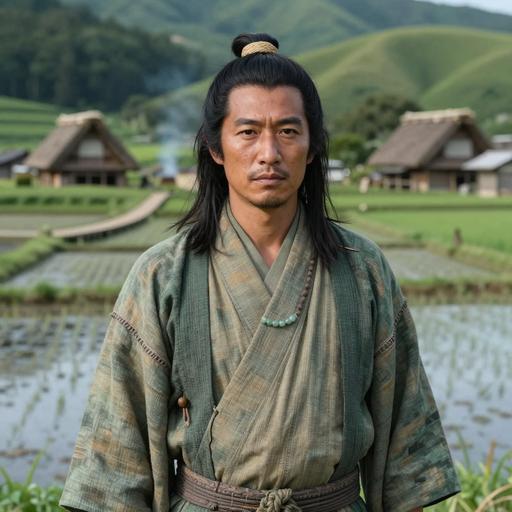
AI portrait reconstruction for A man buried in Japan in the Iron Age era
AI-generated artistic reconstruction, not a photograph of the individual.
Record

Sample details

Recorded details and available lineage markers.

Individual

Yayoi individual, Japan

Sample ID: YAK002

Date Range

200 BCE - 100 BCE

Cultural Period

The Yayoi Period

Biological Sex

Male

mtDNA Haplogroup

Not available

Y-DNA Haplogroup

K2

Social Role

Farmer (AI estimate, era-typical)

Geography

Location

Where this individual was discovered

Country Japan
Locality Kuma−Nishioda
Chronology

Date range

When this individual lived in the broader context of human history

Yayoi individual, Japan 200 BCE - 100 BCE
Context

Historical context

Background information associated with the reference record.

The Yayoi Period, which spans from approximately 300 BCE to 300 CE, represents a critical era in the history of Japan, marking a transition from the Jomon Period and leading into the subsequent Kofun Period. This era witnessed the introduction of rice agriculture, significant technological and social innovations, and substantial cultural changes in the Japanese archipelago, primarily influenced by interactions with the Korean Peninsula and China.

Agricultural and Technological Advancements:

The Yayoi Period is particularly noted for its agricultural revolution, with the adoption of wet-rice cultivation playing a central role. This transformation was facilitated by migrants from the Korean Peninsula who introduced advanced farming techniques and new crop varieties. The resulting agricultural surplus supported larger population densities and the formation of more complex societal structures.

The period also saw advancements in tools and technology. Yayoi people utilized iron and bronze implements, which were crucial for farming and warfare. Bronze was used primarily for ceremonial objects, such as bells (known as dōtaku), mirrors, and weapons, while iron tools became integral in agriculture and daily life. These metal-working skills likely arrived through cultural diffusion from neighboring regions.

Social and Political Structures:

As a result of increased agricultural productivity and technological innovation, Yayoi society became more stratified compared to the Jomon Period. There is evidence of emerging social hierarchies and the development of regional political entities resembling chiefdoms. These were often led by powerful clan leaders who wielded significant influence and controlled considerable resources. Settlements in the Yayoi Period varied from small villages to larger, semi-fortified communities.

Trade and exchange networks expanded during this period, both within the islands and with continental Asia. Yayoi communities obtained metallic resources and other exotic goods through these connections, which facilitated the rise of local elites.

Cultural Characteristics:

Culturally, the Yayoi Period is distinguished by its pottery, which evolved from the cord-marked styles of the Jomon to more refined, wheel-made forms. Yayoi pottery often consisted of simple, functional shapes, adorned with minimal decoration. This transition signifies a shift towards practicality, possibly driven by the demands of agricultural life.

The Yayoi people practiced animistic and shamanistic religious beliefs, venerating natural elements and forces. Evidence of ritual practices has been uncovered, including remains of ceremonial structures, offerings, and burials. These suggest the presence of complex spiritual beliefs and a focus on community-centric rituals.

Regional Variations and Influences:

There were regional variations in Yayoi culture throughout Japan, suggesting a degree of local adaptation and innovation. For example, northern regions retained more Jomon cultural traits, while southern areas, closer to Korea, exhibit stronger continental influences.

The impact of continental neighbors on the Yayoi culture is evident in diverse aspects, ranging from agricultural practices to metallurgy. Interaction with China, particularly during the Han dynasty, brought increased cultural exchange and influence, opening pathways for the transfer of technology, goods, and ideas.

End of the Yayoi Period:

The Yayoi Period eventually transitioned into the Kofun Period around 300 CE. This shift is marked by the appearance of large burial mounds (kofun) and further political unification under increasingly powerful regional powers. The foundation for later Japanese state formation processes can be traced back to the social developments of the Yayoi era.

The Yayoi Period was thus a transformative era that laid the technological, agricultural, and social groundwork for the future of Japan, embodying a significant cultural amalgamation that combined the indigenous and imported practices to forge a new direction in Japanese history.

Analysis

Genetic comparisons

These comparisons show genetic similarity, not identity or origin. The populations listed are those whose genomes show statistical alignment to this ancient individual.

Similarity reflects shared history, not shared identity. These are analytical comparisons, not claims about who this person was.
Modern Genetic Admixture

This analysis compares the DNA profile with present-day reference populations, showing statistical similarity to modern reference populations from different regions. The excavation site records where this individual was found, not a fixed modern genetic identity.

Asia 98.6%
Japanese & Korean 75.1%
Japanese 75.1%
Chinese & Southeast Asian 11.7%
Vietnamese 5.5%
Indonesian Khmer Thai Myanma 4.3%
Tibetan 1.9%
Central Asian, Northern Indian & Pakistani 6.7%
Central Asian 6.7%
Northern Asian 5.1%
Mongolian 5.1%
Europe 1.4%
Northwestern European 1.4%
Finnish 1.4%

Closest Modern Populations

These are the modern populations showing the closest statistical alignment to A man buried in Japan in the Iron Age era, ranked by genetic distance. Lower distance values indicate closer statistical similarity. Cross-region similarity can reflect shared ancestry, population movement, continuity, or later admixture.

1
Tu
2.7430
2
Yugur
2.8738
3
Tibetan Xinlong
2.9045
4
Naxi
3.0456
5
Bonan
3.2048
6
Tibetan Gannan
3.4231
7
Tibetan Yajiang
3.4305
8
Tibetan Yunnan
3.4648
9
Tibetan Xunhua
3.5193
10
Hui
3.5422
Context

Related Samples

This individual exists within a broader network of ancient samples. No ancient genome stands alone.

Individual Culture/Period Date Location Action
Republicof Korea individual, South Korea Ancient Korea 6,300-3,000 BCE Ando, South Korea View
Republicof Korea Taejungni individual, South Korea Iron Age Korea 768-542 BCE Taejungni, South Korea View
Republicof Korea Changhang individual, South Korea The Changhang Culture of Korea 4,696-4,505 BCE Changhang, South Korea View
Republicof Korea Changhang individual, South Korea The Changhang Culture of Korea 4,706-4,542 BCE Changhang, South Korea View
Nagabaka Historic individual, Japan Historical Japan 900-1 BCE Nagabaka, Japan View
Nagabaka individual, Japan Nagabaka 2800BP 900-1 BCE Nagabaka, Japan View
Nagabaka individual, Japan Bronze Age Japan 100 BCE-50 CE Nagabaka, Japan View
Nagabaka individual, Japan Nagabaka 2800BP 796-560 BCE Nagabaka, Japan View
Nagabaka individual, Japan Nagabaka 2800BP 900-1 BCE Nagabaka, Japan View
Nagabaka individual, Japan Nagabaka 2800BP 821-794 BCE Nagabaka, Japan View
Republicof Korea Yondaedo-1 individual, South Korea Yondaedo Culture 1, Korea 5,500-4,500 BCE Yŏndaedo, South Korea View
Republicof Korea Yondaedo-2 individual, South Korea Yondaedo Culture 2, Korea 5,500-4,500 BCE Yŏndaedo, South Korea View
Republicof Korea Yokchido individual, South Korea Bronze Age Korea 2,500-1,500 BCE Yokchido, South Korea View
Yayoi individual, Japan The Yayoi Period 200-100 BCE Kuma−Nishioda, Japan View
Page 1
Individual Culture/Period Date Location Action
Yayoi individual, Japan The Yayoi Period 200-100 BCE Kuma−Nishioda, Japan View
Page 1
Sources

References

Scientific publications and genetic data that inform this profile.

G25 Coordinates

These coordinates represent a position in genetic space, a tool for comparison, not a conclusion. You can use these to perform custom admixture analysis in G25 Studio.

YAK002,0.02578764,-0.4165094,-0.00301186,-0.04568662,0.03625604,0.01867412,0.0046451,0.00455062,0.00069152,0.00687778,-0.06003606,-0.00658118,0.00707328,-0.00264026,-0.00407294,-0.00499594,0.0033608,0.0001894,-0.00807932,-0.0008286,0.00888642,0.01494738,0.00802542,-0.00316898,0.02059847
Continue in G25 Studio

Our analyses use reference samples for comparison. A sample’s place, period and source help explain how to interpret a match.

Use code for 35% off • Expires Nov 30