
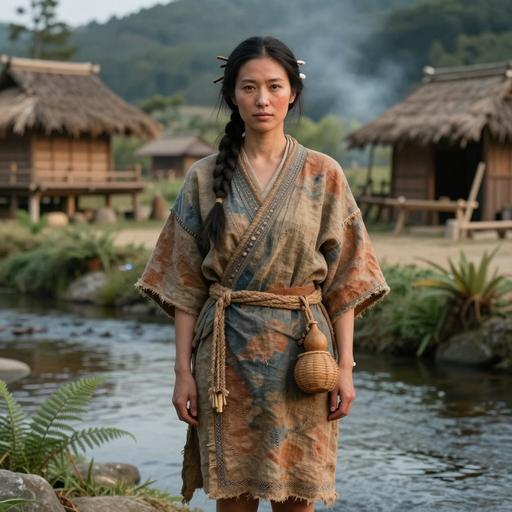
A woman buried in Japan in the Iron Age era

Download PDF creates a visual, rasterized copy. Use Print for selectable text and better assistive-technology support.

Loading Report

Preparing your ancestry journey

Preparing the available report content...

Your report will open automatically.

Skip to main content
Reference library / Sample profile

A woman buried in Japan in the Iron Age era

Explore the recorded context, genetic comparisons and research behind this reference sample.

JapanJapan Nagabaka 2800BP

A reference profile describes this sample. It does not establish a personal or family relationship.

AI portrait reconstruction for A woman buried in Japan in the Iron Age era
AI-generated artistic reconstruction, not a photograph of the individual.
Record

Sample details

Recorded details and available lineage markers.

Individual

Nagabaka individual, Japan

Sample ID: NAG038

Date Range

821 BCE - 794 BCE

Cultural Period

Japan Nagabaka 2800BP

Biological Sex

Female

mtDNA Haplogroup

Not available

Y-DNA Haplogroup

Not available

Social Role

Pastoralist (AI estimate, era-typical)

Geography

Location

Where this individual was discovered

Country Japan
Locality Nagabaka
Chronology

Date range

When this individual lived in the broader context of human history

Nagabaka individual, Japan 821 BCE - 794 BCE
Context

Historical context

Background information associated with the reference record.

Region & Environment

This entry assigns the Nagabaka horizon to Indonesia, in an island context where coastal and interior ecological niches supported repeated use of the landscape. Such environments generally provide marine and freshwater resources near coasts and forest-based resources inland.

Historical Context

The provided timeframe centers on 800 BCE as a single-year horizon, indicating a tightly circumscribed archaeological phase. In broader regional sequences, named horizons often help organize changes in ceramic and other material traditions and allow comparisons between neighboring islands.

Populations & Lifeways

Populations associated with hunter-gatherer and mixed foraging patterns in island Southeast Asia typically relied on seasonal availability of resources. Communities would have organized daily work—fishing, hunting, gathering, and processing—around reliable local habitats and repeatedly visited or occupied favorable locations.

Archaeology & Material Culture

Nagabaka is treated as a culture label used to group sites with shared material characteristics. Archaeologically, this usually involves consistent patterns in pottery manufacture and form (where present), stone tool technologies, and features of domestic or activity contexts that reflect food processing and everyday labor.

Culture & Society

Material styles such as those associated with pottery and tool traditions can reflect shared learning and social connectivity across communities. Even when horizons are short, they can indicate the spread of preferences or routines in craft production and daily practice.

Legacy & Transition

As a dated marker within a larger chronological framework, Nagabaka helps track how regional archaeological traditions changed through time. Its broader significance is best evaluated through stratigraphic relationships and cross-regional comparisons rather than through speculative reconstructions of political history.

Analysis

Genetic comparisons

These comparisons show genetic similarity, not identity or origin. The populations listed are those whose genomes show statistical alignment to this ancient individual.

Similarity reflects shared history, not shared identity. These are analytical comparisons, not claims about who this person was.

Modern Genetic Admixture

This analysis compares the DNA profile with present-day reference populations, showing statistical similarity to modern reference populations from different regions. The excavation site records where this individual was found, not a fixed modern genetic identity.

Asia 95.2%
Japanese & Korean 84.2%
Japanese 84.2%
Central Asian, Northern Indian & Pakistani 11.0%
Indian 11.0%
Africa 3.0%
Northern East African 3.0%
Ethiopian 3.0%
Oceania 1.7%
Melanesian 1.7%
Papuan 1.7%

Closest Modern Populations

These are the modern populations showing the closest statistical alignment to A woman buried in Japan in the Iron Age era, ranked by genetic distance. Lower distance values indicate closer statistical similarity. Cross-region similarity can reflect shared ancestry, population movement, continuity, or later admixture.

1
Tamang
4.6084
2
Nepali Tamang Simigaon
4.8347
3
Magar
4.8448
4
Gurung
5.3896
5
Yuku
6.2511
6
Nepali Tamang Tashinam
6.3495
7
Tibetan Gangcha
6.9451
8
Tibetan Xunhua
6.9755
9
Nepali Sherpa Rolwaling
6.9979
10
Dongxiang
7.0786
Context

Related Samples

This individual exists within a broader network of ancient samples. No ancient genome stands alone.

Individual Culture/Period Date Location Action
Republicof Korea individual, South Korea Ancient Korea 6,300-3,000 BCE Ando, South Korea View
Republicof Korea Taejungni individual, South Korea Iron Age Korea 768-542 BCE Taejungni, South Korea View
Republicof Korea Changhang individual, South Korea The Changhang Culture of Korea 4,696-4,505 BCE Changhang, South Korea View
Republicof Korea Changhang individual, South Korea The Changhang Culture of Korea 4,706-4,542 BCE Changhang, South Korea View
Nagabaka Historic individual, Japan Historical Japan 900-1 BCE Nagabaka, Japan View
Nagabaka individual, Japan Nagabaka 2800BP 900-1 BCE Nagabaka, Japan View
Nagabaka individual, Japan Bronze Age Japan 100 BCE-50 CE Nagabaka, Japan View
Nagabaka individual, Japan Nagabaka 2800BP 796-560 BCE Nagabaka, Japan View
Nagabaka individual, Japan Nagabaka 2800BP 900-1 BCE Nagabaka, Japan View
Nagabaka individual, Japan Nagabaka 2800BP 821-794 BCE Nagabaka, Japan View
Republicof Korea Yondaedo-1 individual, South Korea Yondaedo Culture 1, Korea 5,500-4,500 BCE Yŏndaedo, South Korea View
Republicof Korea Yondaedo-2 individual, South Korea Yondaedo Culture 2, Korea 5,500-4,500 BCE Yŏndaedo, South Korea View
Republicof Korea Yokchido individual, South Korea Bronze Age Korea 2,500-1,500 BCE Yokchido, South Korea View
Yayoi individual, Japan The Yayoi Period 200-100 BCE Kuma−Nishioda, Japan View
Page 1
Individual Culture/Period Date Location Action
Nagabaka individual, Japan Nagabaka 2800BP 900-1 BCE Nagabaka, Japan View
Nagabaka individual, Japan Nagabaka 2800BP 796-560 BCE Nagabaka, Japan View
Nagabaka individual, Japan Nagabaka 2800BP 900-1 BCE Nagabaka, Japan View
Nagabaka individual, Japan Nagabaka 2800BP 821-794 BCE Nagabaka, Japan View
Page 1
Sources

References

Scientific publications and genetic data that inform this profile.

G25 Coordinates

These coordinates represent a position in genetic space, a tool for comparison, not a conclusion. You can use these to perform custom admixture analysis in G25 Studio.

NAG038,0.02102032,-0.35893532,-0.01107496,-0.00234334,0.00220724,-0.01585392,0.00331542,0.00173678,0.00844602,0.01408476,-0.0551881,-0.0038263,0.0068074,0.0001103,-0.00845092,-0.00435222,0.0037858,-0.00212536,-0.00223084,0.00178842,0.00297224,0.01317298,0.00398416,0.00386716,0.02398599
Continue in G25 Studio

Our analyses use reference samples for comparison. A sample’s place, period and source help explain how to interpret a match.

Use code for 35% off • Expires Nov 30