A man buried in South Korea in the Iron Age era

Download PDF creates a visual, rasterized copy. Use Print for selectable text and better assistive-technology support.

Loading Report

Preparing your ancestry journey

Preparing the available report content...

Your report will open automatically.

Skip to main content
Reference library / Sample profile

A man buried in South Korea in the Iron Age era

Explore the recorded context, genetic comparisons and research behind this reference sample.

South KoreaIron Age Korea

A reference profile describes this sample. It does not establish a personal or family relationship.

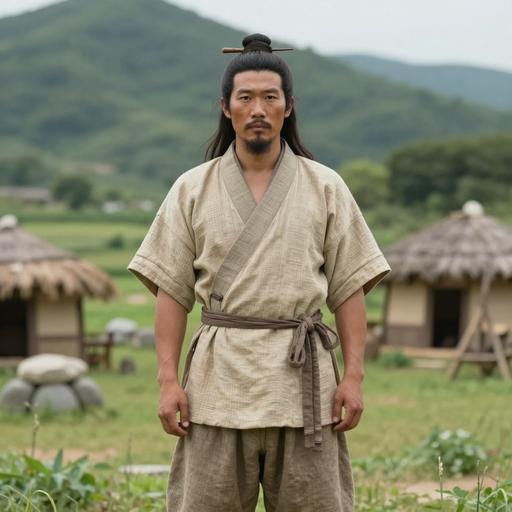
AI portrait reconstruction for A man buried in South Korea in the Iron Age era
AI-generated artistic reconstruction, not a photograph of the individual.
Record

Sample details

Recorded details and available lineage markers.

Individual

Republicof Korea Taejungni individual, South Korea

Sample ID: DAJ001

Date Range

768 BCE - 542 BCE

Cultural Period

Iron Age Korea

Biological Sex

Male

mtDNA Haplogroup

Not available

Y-DNA Haplogroup

CT

Social Role

Farmer (AI estimate, era-typical)

Geography

Location

Where this individual was discovered

Country South Korea
Locality Taejungni
Chronology

Date range

When this individual lived in the broader context of human history

Republicof Korea Taejungni individual, South Korea 768 BCE - 542 BCE
Context

Historical context

Background information associated with the reference record.

The Iron Age in Korea, which roughly spanned from the 4th century BCE to the 4th century CE, was a transformative period characterized by significant cultural, technological, and political developments. During this time, various tribal states emerged, eventually coalescing into the Three Kingdoms of Korea: Goguryeo, Baekje, and Silla. These developments coincided with and were influenced by exchanges with neighboring China and the broader East Asian region, leading to profound cultural and technological impacts.

Technological and Economic Developments

Iron Use and Metallurgy:

  • The introduction and widespread use of iron tools and weapons was a defining feature of the Iron Age in Korea. Iron tools were more durable and effective than their bronze counterparts, revolutionizing agricultural practices, increasing productivity, and subsequently supporting population growth.
  • Advanced iron smelting techniques were developed, and iron-making became a specialized industry. Iron tools included plows, sickles, axes, and other implements that dramatically improved agricultural efficiency.

Agriculture:

  • With the enhancement of agricultural tools, rice and millet farming became more productive, forming the staple diet of Korean societies.
  • The ability to cultivate more land led to the establishment of permanent settlements and contributed to urban development.

Cultural and Social Aspects

Social Structure and Tribal Confederations:

  • The Iron Age saw the formation of various tribal confederations, the most notable being the Samhan: Mahan, Jinhan, and Byeonhan. These confederations were organized into hundreds of small polities, each with its own leaders and social structures.
  • Social hierarchies became more pronounced, with chieftains or kings ruling over tribal communities. These leaders often derived their power from controlling trade and surplus resources, as well as from martial prowess.

Religion and Belief Systems:

  • Shamanistic practices were prevalent, with a strong emphasis on nature worship and ancestor veneration. Shamans played a vital role in mediating between the spiritual and physical worlds.
  • Over time, the influence of Chinese religions like Confucianism, Daoism, and later Buddhism began to permeate Korean society, although indigenous beliefs remained strong.

Art and Artifacts:

  • Artifacts from this era include a variety of pottery, iron weapons, and agricultural tools. Bronze mirrors and ornaments have also been discovered, indicating both local craftsmanship and trade connections.
  • Burial practices included stone cists, dolmens, and earthen pit tombs, often accompanied by grave goods, reflecting beliefs in an afterlife and the social status of the deceased.

Political and Military Context

Emergence of Early States:

  • The increased organization and centralization led to the formation of early states like Goguryeo in the north and the various Han states in the south.
  • The political landscape was characterized by frequent conflicts and alliances among tribal states, driven by the desire to control more land and resources.

Military Aspects:

  • With iron providing superior weaponry, military capabilities expanded significantly. This included the development of iron swords, spears, and armor, facilitating more effective warfare.
  • Defense strategies evolved with the construction of fortresses and fortified cities, particularly in strategic locations such as river valleys and mountain passes.

Interaction with Neighboring Cultures

Trade and Diplomacy:

  • Korea's Iron Age cultures engaged in extensive trade with neighboring regions, including China and Japan. The trade networks facilitated the exchange of goods such as silk, ceramics, and metals, as well as cultural and technological innovations.
  • Diplomatic relations were established with Chinese dynasties like the Han and later the Wei, Jin, and others, influencing Korean political and cultural developments.

Cultural Exchange:

  • The flow of ideas and technologies from China, including Chinese script, which eventually led to the creation of Korea's own writing systems, significantly impacted Korean society.
  • Korean craftsmen and scribes adopted Chinese artistic styles, techniques, and materials, which were adapted and integrated into local traditions.

In summary, the Iron Age in Korea was a period of profound transformation that laid the foundations for the development of the Korean civilization. It was marked by advancements in technology and agriculture, the emergence of significant social and political structures, and increased cultural exchange and influence with neighboring regions, particularly China. This era set the stage for the ensuing formation of the Three Kingdoms and Korea's further historical evolution.

Analysis

Genetic comparisons

These comparisons show genetic similarity, not identity or origin. The populations listed are those whose genomes show statistical alignment to this ancient individual.

Similarity reflects shared history, not shared identity. These are analytical comparisons, not claims about who this person was.

Modern Genetic Admixture

This analysis compares the DNA profile with present-day reference populations, showing statistical similarity to modern reference populations from different regions. The excavation site records where this individual was found, not a fixed modern genetic identity.

Asia 65.8%
Japanese & Korean 49.1%
Japanese 49.1%
Northern Asian 10.6%
Mongolian 8.3%
Siberian 2.3%
Chinese & Southeast Asian 6.1%
Chinese 6.1%
Europe 28.7%
Northwestern European 27.4%
English 20.8%
Northwestern European 6.6%
Southern European 1.3%
Sardinian 1.3%
Africa 5.5%
North African 2.6%
North African 2.6%
West African 2.2%
Nigerian 2.2%
African Hunter-Gatherer 0.8%

Closest Modern Populations

These are the modern populations showing the closest statistical alignment to A man buried in South Korea in the Iron Age era, ranked by genetic distance. Lower distance values indicate closer statistical similarity. Cross-region similarity can reflect shared ancestry, population movement, continuity, or later admixture.

1
Kirghiz China
8.9431
2
Kazakh Xinjiang
9.1553
3
Kirghiz
9.1986
4
Kirghiz Tajikistan Pamir
9.3341
5
Kazakh
9.3662
6
Kazakh China
9.5745
7
Buryat O
10.7163
8
Karakalpak
10.9139
9
Hazara
11.2991
10
Uygur
11.3543
Context

Related Samples

This individual exists within a broader network of ancient samples. No ancient genome stands alone.

Individual Culture/Period Date Location Action
Republicof Korea individual, South Korea Ancient Korea 6,300-3,000 BCE Ando, South Korea View
Republicof Korea Taejungni individual, South Korea Iron Age Korea 768-542 BCE Taejungni, South Korea View
Republicof Korea Changhang individual, South Korea The Changhang Culture of Korea 4,696-4,505 BCE Changhang, South Korea View
Republicof Korea Changhang individual, South Korea The Changhang Culture of Korea 4,706-4,542 BCE Changhang, South Korea View
Nagabaka Historic individual, Japan Historical Japan 900-1 BCE Nagabaka, Japan View
Nagabaka individual, Japan Nagabaka 2800BP 900-1 BCE Nagabaka, Japan View
Nagabaka individual, Japan Bronze Age Japan 100 BCE-50 CE Nagabaka, Japan View
Nagabaka individual, Japan Nagabaka 2800BP 796-560 BCE Nagabaka, Japan View
Nagabaka individual, Japan Nagabaka 2800BP 900-1 BCE Nagabaka, Japan View
Nagabaka individual, Japan Nagabaka 2800BP 821-794 BCE Nagabaka, Japan View
Republicof Korea Yondaedo-1 individual, South Korea Yondaedo Culture 1, Korea 5,500-4,500 BCE Yŏndaedo, South Korea View
Republicof Korea Yondaedo-2 individual, South Korea Yondaedo Culture 2, Korea 5,500-4,500 BCE Yŏndaedo, South Korea View
Republicof Korea Yokchido individual, South Korea Bronze Age Korea 2,500-1,500 BCE Yokchido, South Korea View
Yayoi individual, Japan The Yayoi Period 200-100 BCE Kuma−Nishioda, Japan View
Page 1
Individual Culture/Period Date Location Action
Republicof Korea Taejungni individual, South Korea Iron Age Korea 768-542 BCE Taejungni, South Korea View
Page 1
Sources

References

Scientific publications and genetic data that inform this profile.

G25 Coordinates

These coordinates represent a position in genetic space, a tool for comparison, not a conclusion. You can use these to perform custom admixture analysis in G25 Studio.

DAJ001,0.04701914,-0.24686414,0.03263114,-0.01576522,0.03112068,0.0127283,-0.00350512,-0.00256642,-0.00210558,0.00266544,-0.04278892,-0.0021398,0.00757618,-0.0092454,-0.00233376,-0.00179954,-0.00332958,5.26E-06,0.00263372,-0.0022091,0.01272498,-0.00722656,0.00220194,0.00622748,-0.01732574
Continue in G25 Studio

Our analyses use reference samples for comparison. A sample’s place, period and source help explain how to interpret a match.
Use code for 35% off • Expires Nov 30