A man buried in Spain in the era

Download PDF creates a visual, rasterized copy. Use Print for selectable text and better assistive-technology support.

Loading Report

Preparing your ancestry journey

Preparing the available report content...

Your report will open automatically.

Skip to main content
Reference library / Sample profile

A man buried in Spain in the era

Explore the recorded context, genetic comparisons and research behind this reference sample.

SpainThe Chalcolithic Period

A reference profile describes this sample. It does not establish a personal or family relationship.

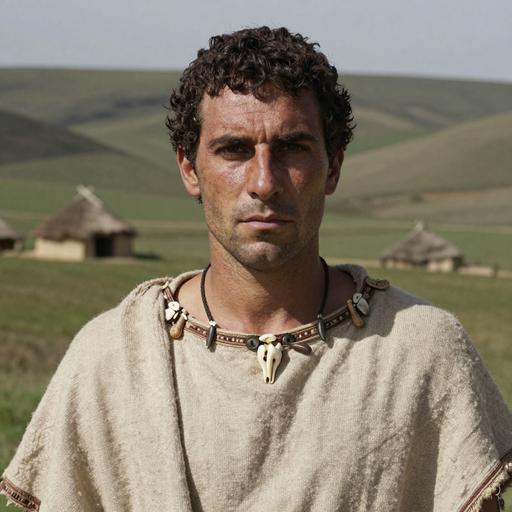
AI portrait reconstruction for A man buried in Spain in the  era
AI-generated artistic reconstruction, not a photograph of the individual.
Record

Sample details

Recorded details and available lineage markers.

Individual

Chalcolithic individual, Spain

Sample ID: atp12-1420

Date Range

3011 BCE - 2881 BCE

Cultural Period

The Chalcolithic Period

Biological Sex

Male

mtDNA Haplogroup

Not available

Y-DNA Haplogroup

Not available

Social Role

Pastoralist (AI estimate, era-typical)

Geography

Location

Where this individual was discovered

Country Spain
Locality Atapuerca. El Portalón

A location map is not available for this record.

Chronology

Date range

When this individual lived in the broader context of human history

Chalcolithic individual, Spain 3011 BCE - 2881 BCE
Context

Historical context

Background information associated with the reference record.

Overview

The Chalcolithic (“Copper–Stone Age”) represents a broad prehistoric phase in which copper-working begins to appear alongside long-standing stone-based technologies. It is defined less by a single culture than by shared trends in metal use and social change.

Region & Environment

The Chalcolithic is not uniform in time or character across regions. It is documented from river valleys and fertile plains to steppe margins and mountain foothills, where agriculture supported growing settlements and where copper sources (and trade routes to them) shaped regional development.

Historical Context

In many areas, the Chalcolithic follows long Neolithic lifeways and precedes later Bronze Age developments. Communities increasingly produced and circulated valued raw materials and finished goods, while some regions also show intensifying craft specialization, larger or more defensible settlements, and more elaborate mortuary practices.

Populations & Lifeways

Populations were typically sedentary agriculturalists, alongside pastoralists and mixed subsistence strategies in ecologically varied zones. Daily life centered on farming, herding, and household craft production, with specialized activities emerging where metalworking and durable craft goods were significant.

Archaeology & Material Culture

Chalcolithic assemblages commonly include:

  • evidence for copper/bronze or metalworking (ore processing residues, smelting related finds, or metal objects, depending on the region)
  • continuing use of stone tools and polished stone implements
  • pottery styles that vary by locality, often accompanied by decoration and vessel standardization
  • distinctive personal ornaments and prestige items, reflecting exchange and social differentiation

Culture & Society

Differences in settlement size, architecture (where preserved), and burial treatment suggest changing social organization. Craft knowledge related to metallurgy and the management of valuables likely played roles in local hierarchies and inter-community contacts.

Legacy & Transition

Where the Chalcolithic is best documented, it forms a bridge to later Bronze Age societies: experimentation with metals, technologies for acquiring raw materials, and networks for distributing prestige goods helped set conditions for more intensive metallurgy, larger-scale production, and complex political and economic systems.

Analysis

Genetic comparisons

These comparisons show genetic similarity, not identity or origin. The populations listed are those whose genomes show statistical alignment to this ancient individual.

Similarity reflects shared history, not shared identity. These are analytical comparisons, not claims about who this person was.

Modern Genetic Admixture

This analysis compares the DNA profile with present-day reference populations, showing statistical similarity to modern reference populations from different regions. The excavation site records where this individual was found, not a fixed modern genetic identity.

Europe 97.7%
Southern European 95.6%
Iberian 63.8%
Sardinian 29.8%
Italian 1.9%
Northwestern European 2.1%
Africa 1.5%
North African 1.5%
North African 1.5%
Asia 0.5%
Chinese & Southeast Asian 0.5%
Chinese 0.5%

Closest Modern Populations

These are the modern populations showing the closest statistical alignment to A man buried in Spain in the era, ranked by genetic distance. Lower distance values indicate closer statistical similarity. Cross-region similarity can reflect shared ancestry, population movement, continuity, or later admixture.

1
Sardinian
3.3040
2
French Corsica
5.4360
3
Spanish La Rioja
5.5180
4
Spanish Castilla La Mancha
5.8239
5
Spanish Castello
5.8829
6
Spanish Pirineu
5.9039
7
Spanish Aragon
5.9353
8
Spanish Menorca
5.9527
9
Spanish Cantabria
5.9600
10
Spanish Navarra
5.9656
Context

Related Samples

This individual exists within a broader network of ancient samples. No ancient genome stands alone.

Individual Culture/Period Date Location Action
Iberian Chalcolithic individual, Spain Chalcolithic Spain 3265 BCE Atapuerca. El Portalón, Spain View
Iberian Chalcolithic individual, Spain Chalcolithic Spain 2900 BCE Atapuerca. El Portalón, Spain View
Western European Neolithic individual, Spain Early Neolithic Spain 5299 BCE Andalusia. Murciélagos de Zuheros, Spain View
Iberian Chalcolithic individual, Spain Chalcolithic Spain 3011 BCE Atapuerca. El Portalón, Spain View
Iberian individual, Spain Bronze Age Spain 1600 BCE La Rioja. Cueva de los Lagos, Spain View
Iberian Chalcolithic individual, Spain Chalcolithic Spain 3336 BCE Atapuerca. El Portalón, Spain View
Prehistoric Iberian individual, Spain Late Neolithic Spain 3765 BCE Andalusia. Cueva de los Cuarenta, Spain View
Iberian individual, Spain Bronze Age Spain 2100 BCE Andalusia. Priego de Córdoba, Spain View
Prehistoric Iberian individual, Spain Late Neolithic Spain 3779 BCE Basque country. San Quílez, Spain View
Iberian Chalcolithic individual, Spain Chalcolithic Spain 3096 BCE Atapuerca. El Portalón, Spain View
Western European Neolithic individual, Spain Early Neolithic Spain 5214 BCE Atapuerca. El Portalón, Spain View
Iberia Ca individual, Spain 2900 BCE Atapuerca. El Portalón, Spain View
Iberia En individual, Spain 5214 BCE Atapuerca. El Portalón, Spain View
Iberia Ca individual, Spain 3265 BCE Atapuerca. El Portalón, Spain View
Chalcolithic individual, Spain 3011 BCE Atapuerca. El Portalón, Spain View
Iberia Ln individual, Spain 3765 BCE Andalusia. Cueva de los Cuarenta, Spain View
Iberia Ba individual, Spain 1600 BCE La Rioja. Cueva de los Lagos, Spain View
Iberia N individual, Spain 5299 BCE Andalusia. Murciélagos de Zuheros, Spain View
Iberia Ia individual, Spain 2100 BCE Andalusia. Priego de Córdoba, Spain View
Iberia Ca individual, Spain 3336 BCE Atapuerca. El Portalón, Spain View
Iberia Ca individual, Spain 3096 BCE Atapuerca. El Portalón, Spain View
Iberia Ln individual, Spain 3779 BCE Basque country. San Quílez, Spain View
Page 1
Individual Culture/Period Date Location Action
Chalcolithic individual, Spain 3011 BCE Atapuerca. El Portalón, Spain View
Page 1
Sources

References

Scientific publications and genetic data that inform this profile.

G25 Coordinates

These coordinates represent a position in genetic space, a tool for comparison, not a conclusion. You can use these to perform custom admixture analysis in G25 Studio.

atp12-1420,0.1204446,0.160387,0.0315555,-0.0308059,0.057474,-0.0161012,-0.0018754,0.0061252,0.0371602,0.0640495,-0.0055149,0.014486,-0.0257216,-0.0128986,-0.005245,0.0038452,0.0052957,-0.0007051,-0.0008635,-0.0032769,0.0017085,0.0051767,-0.0119626,-0.0180195,0.0042017
Continue in G25 Studio
Use code for 30% off • Expires Nov 16