Menu
Store
Blog
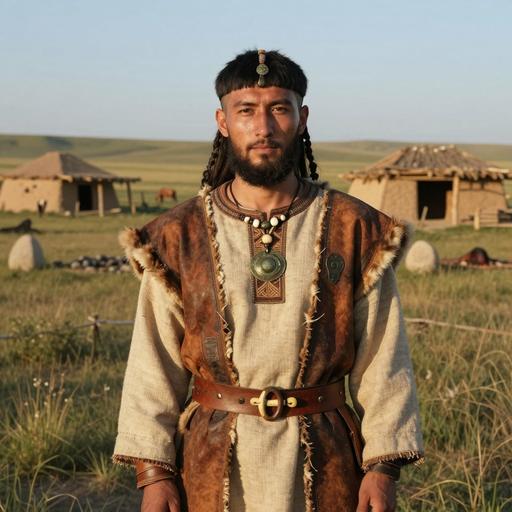
Portrait reconstruction of I10112
Ancient Individual

A man buried in Kazakhstan in the Middle Late Bronze Age era

I10112
1613 BCE - 1503 BCE
Male
Mid-Late Bronze Shoendykol Fedorovo
Kazakhstan
Scroll to begin
Chapter I

Identity

The biological and cultural markers that define this ancient individual

Sample ID

I10112

Date Range

1613 BCE - 1503 BCE

Biological Sex

Male

mtDNA Haplogroup

H2a1a

Y-DNA Haplogroup

R-Z2122

Cultural Period

Mid-Late Bronze Shoendykol Fedorovo

Chapter II

Place

Where this individual was discovered

Country Kazakhstan
Locality Shoendykol
Coordinates 50.8200, 75.6000
Chapter III

Time

When this individual lived in the broader context of human history

I10112 1613 BCE - 1503 BCE
Chapter IV

Story

The narrative of this ancient life

The Mid-Late Bronze Age Shoendykol culture, specifically the Fedorovo variant, is a part of the broader Andronovo cultural complex, which flourished across the Eurasian steppe during the 2nd millennium BCE. This culture is integral to understanding the development of trans-continental interactions, technological advancements, and societal structures in Central Asia during the Bronze Age.

Geographical Context

The Andronovo cultural horizon covered vast territories stretching across what is now Kazakhstan, Russia, and parts of Central Asia. The Shoendykol variant, and more specifically the Fedorovo phase, is predominantly found in the northern and eastern regions of Kazakhstan, particularly along river basins like the Irtysh and Tobol, which offered fertile grounds for agriculture and pasturage, essential for sustaining the population.

Chronology

The Mid-Late Bronze Age Fedorovo phase dates from approximately 1900 to 1400 BCE. It represents the latter part of the Andronovo horizon, showcasing a continuation and evolution of cultural practices established in earlier phases, such as Sintashta and Petrovka.

Cultural Characteristics

  1. Settlements and Architecture:

    • Settlements during the Fedorovo phase were typically small, comprising clustered dwellings or small fortified enclosures.
    • Houses were predominantly rectangular, built with timber-framework or adobe bricks, reflecting adaptations to the climatic conditions of the steppe.
    • Evidence of granaries and pits for storing grain and other produce indicates a degree of sedentism and agricultural proficiency.
  2. Economy and Subsistence:

    • The economy was a mixed strategy of agriculture and pastoralism, with evidence of crop cultivation, including wheat and barley, along with the herding of cattle, sheep, goats, and horses.
    • The domestication and use of horses were particularly significant, facilitating not only transportation but also communication and trade across large distances.
  3. Technology and Craftsmanship:

    • The Fedorovo people are noted for their advanced metallurgical skills, producing a range of bronze implements and weapons.
    • Pottery from this phase shows refinement, often decorated with intricate geometric patterns, suggestive of a complex symbolic system or artistic tradition.
  4. Burial Practices and Religion:

    • Burial mounds, or kurgans, were a notable feature, often containing individual or collective burials accompanied by personal belongings and pottery, indicating beliefs in an afterlife.
    • Burial orientations and grave goods such as horse gear, weapons, and ornaments suggest a warrior elite or a class-based society with distinct social roles.
    • Possible religious sites, identified as sanctuaries or ritual areas, suggest complex spiritual and ritualistic practices, possibly involving ancestor worship or shamanistic traditions.
  5. Social Structure:

    • The presence of fortified settlements and elite graves implies a hierarchical society with emerging leadership roles possibly based on military prowess or control of trade networks.
    • The organization of labor for metal production and agricultural activities also suggests a level of social stratification and community organization.
  6. Trade and Interaction:

    • The Shoendykol Fedorovo phase benefited from and contributed to the extensive trade networks that spanned the Central Asian steppes, reflected in the variety of materials and influences seen in archaeological contexts.
    • Trading networks facilitated not just the exchange of goods but also ideas, leading to technological and cultural exchanges with neighboring cultures such as the Bactria-Margiana Archaeological Complex to the south.

Legacy and Influence

The Shoendykol Fedorovo culture, as part of the Andronovo horizon, is significant for its contributions to the cultural and genetic makeup of later Eurasian nomadic groups. It paved the way for subsequent cultures, including the Scythians and the historical nomads of the Eurasian steppes. Furthermore, the innovations in metallurgy, domestication, and trans-continental trade systems established during this period had profound and lasting impacts on Eurasian history.

Chapter V

Genetics

The genetic ancestry of this ancient individual

Ancient Genetic Admixture

This analysis compares the DNA profile of I10112 with ancient reference populations, showing the genetic composition in terms of prehistoric ancestral groups.

Western Steppe Pastoralists 43.2%
European Hunter-Gatherers 31.0%
Neolithic Farmers 18.0%
Ancient Asians 7.8%

Modern Genetic Admixture

This analysis compares the DNA profile with present-day reference populations, showing what percentage of genetic makeup resembles modern populations from different regions.

Europe 75.0%
Northwestern European 41.9%
English 27.9%
Scandinavian 8.1%
Finnish 4.2%
Northwestern European 1.7%
Eastern European 33.1%
Asia 22.9%
Northern West Asian 11.7%
Caucasian 11.7%
Central Asian, Northern Indian & Pakistani 11.3%
Pakistan 10.7%
Indian 0.6%
America 1.9%
America 1.9%
Native American 1.9%

Closest Modern Populations

These are the modern populations showing the closest statistical alignment to A man buried in Kazakhstan in the Middle Late Bronze Age era, ranked by genetic distance. Lower distance values indicate closer statistical similarity.

1
Tatar Mishar
6.0206
2
Moksha
6.8205
3
Mordovian
6.9198
4
Finnish Southwest
7.0241
5
Erzya
7.0351
6
Finnish Central
7.1390
7
Russian Kostroma
7.1438
8
Russian Krasnoborsky
7.1862
9
Finnish North
7.3526
10
Afrikaner
7.4766
Chapter VI

Context

Other ancient individuals connected to this sample

Sources

References

Scientific publications and genetic data

Scientific Publication

The formation of human populations in South and Central Asia

Authors Narasimhan VM, Patterson N, Moorjani P
Abstract

By sequencing 523 ancient humans, we show that the primary source of ancestry in modern South Asians is a prehistoric genetic gradient between people related to early hunter-gatherers of Iran and Southeast Asia. After the Indus Valley Civilization's decline, its people mixed with individuals in the southeast to form one of the two main ancestral populations of South Asia, whose direct descendants live in southern India. Simultaneously, they mixed with descendants of Steppe pastoralists who, starting around 4000 years ago, spread via Central Asia to form the other main ancestral population. The Steppe ancestry in South Asia has the same profile as that in Bronze Age Eastern Europe, tracking a movement of people that affected both regions and that likely spread the distinctive features shared between Indo-Iranian and Balto-Slavic languages.

G25 Coordinates

The G25 coordinates for sample I10112 can be used for detailed admixture analysis in our G25 Studio tool.

I10112,0.1199371,0.07427782,0.0531131,0.0502339,0.00726818,0.01100684,0.00160026,0.00082368,-0.00725212,-0.01328946,0.00355458,0.0034013,0.00062006,-0.01664404,0.01619378,-0.00702924,-0.01578378,-0.0019356,-0.00645534,-0.0092557,0.00552616,0.00250208,-0.01193942,0.00803344,-0.00526455
Analyze in G25 Studio
Use code for 40% off Expires Feb 26