Menu
Store
Blog
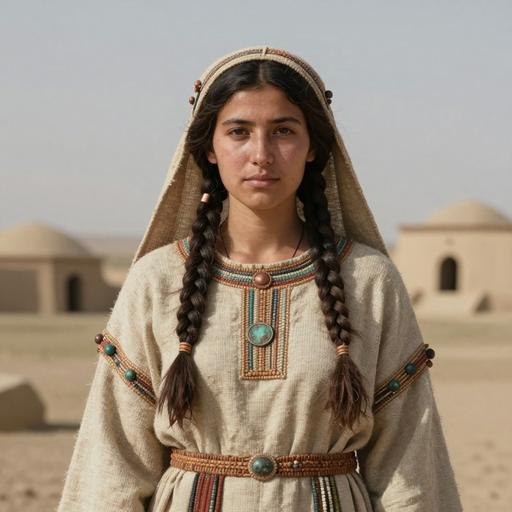
Portrait reconstruction of I11538
Ancient Individual

A woman buried in Kazakhstan in the Middle Bronze Age era

I11538
1741 BCE - 1613 BCE
Female
Middle Bronze Chanchar
Kazakhstan
Scroll to begin
Chapter I

Identity

The biological and cultural markers that define this ancient individual

Sample ID

I11538

Date Range

1741 BCE - 1613 BCE

Biological Sex

Female

mtDNA Haplogroup

U5b2b

Cultural Period

Middle Bronze Chanchar

Chapter II

Place

Where this individual was discovered

Country Kazakhstan
Locality Chanchar
Coordinates 50.6687, 57.7186
Chapter III

Time

When this individual lived in the broader context of human history

I11538 1741 BCE - 1613 BCE
Chapter IV

Story

The narrative of this ancient life

The Middle Bronze Age Chanchar phase of the Andronovo culture represents a significant period in the prehistoric Eurasian steppes, particularly within the area that is now Kazakhstan. This era, typically dated between approximately 2000 and 1500 BCE, showcases a fascinating amalgamation of pastoral nomadism, burgeoning metallurgical skills, and early forms of settled life.

Geography and Environment

The region encompassing the Chanchar phase was primarily defined by its expansive steppes, interspersed with riverine valleys and bordered by mountains. The terrain supported a mixed economy that relied on both pastoralism and agriculture, influenced by the climatic conditions of moderate summers and cold, harsh winters.

Social Structure

The social structure of the Chanchar people was likely clan-based, with extended families living together in kinship units. Social differentiation may have been emerging during this period, suggested by variations in burial practices and grave goods. Each clan or tribe was led by chieftains, figures who wielded significant control over both economic resources and spiritual matters, often serving as intermediaries with the divine.

Economy and Daily Life

Economically, the Chanchar phase was characterized by a mixed subsistence strategy. Herding of cattle, sheep, and horses formed the backbone of their way of life. The mobility afforded by horse domestication expanded their grazing range and facilitated trade with neighboring regions. Additionally, small-scale agriculture was practiced, including the cultivation of wheat, barley, and millet.

Settlements from this era, though largely ephemeral, indicate a blend of mobile and semi-permanent living structures. Circular houses with sunken floors and thatched roofs were typical, reflecting both a response to climatic conditions and the practical needs of a semi-nomadic lifestyle.

Technology and Craftsmanship

The Chanchar phase is notable for advancements in metallurgy. Bronze tools and weapons became more sophisticated, with techniques improving in the smelting and alloying of copper and tin. Artifacts such as axes, knives, and ornaments demonstrate both utility and artistry. Pottery from this culture, often decorated with intricate geometric patterns, displays a high degree of sophistication and serves as a hallmark for identifying Chanchar sites.

Religion and Rituals

Religious beliefs in the Chanchar era were deeply intertwined with nature and the cycles of life and death. Evidence from burial sites suggests a rich spiritual life, with graves often containing multiple individuals, alongside tools, weapons, and decorative items. This indicates a belief in an afterlife where such items would be needed. Ritual sites, possibly used for communal gatherings, feasts, and ceremonies, have also been identified, reflecting the importance of religious practices in maintaining social cohesion.

Interaction and Influence

The Chanchar phase of the Andronovo culture was not isolated. There is substantial evidence of interaction with neighboring cultures, both through trade and migration. These interactions facilitated the exchange of goods, ideas, and technologies, contributing to cultural dynamism in the region. The spread of technology, particularly horse domestication and metallurgy, is seen as influencing adjacent cultures in Central Asia and beyond.

Legacy

The legacy of the Chanchar phase lies in its role as a precursor to later cultural developments in the Eurasian steppes. As part of the broader Andronovo cultural horizon, it provided a foundation for the evolution of more complex societies, paved the way for increased mobility through horse breeding, and contributed to the cultural and technological exchanges that shaped the history of the region.

In summary, the Middle Bronze Age Chanchar phase of the Andronovo culture embodies a period marked by innovation, adaptation, and interaction. It reflects a society at a crossroads between mobility and settlement, underscored by advancements in technology and enduring spiritual beliefs, set against the backdrop of the majestic Eurasian steppes.

Chapter V

Genetics

The genetic ancestry of this ancient individual

Ancient Genetic Admixture

This analysis compares the DNA profile of I11538 with ancient reference populations, showing the genetic composition in terms of prehistoric ancestral groups.

Western Steppe Pastoralists 45.2%
European Hunter-Gatherers 33.3%
Neolithic Farmers 15.3%
Ancient Asians 6.1%

Modern Genetic Admixture

This analysis compares the DNA profile with present-day reference populations, showing what percentage of genetic makeup resembles modern populations from different regions.

Europe 93.0%
Northwestern European 68.0%
English 29.4%
Scandinavian 20.7%
Northwestern European 11.8%
Finnish 6.1%
Eastern European 25.1%
Asia 6.5%
Central Asian, Northern Indian & Pakistani 6.5%
Pakistan 6.5%
Africa 0.5%

Closest Modern Populations

These are the modern populations showing the closest statistical alignment to A woman buried in Kazakhstan in the Middle Bronze Age era, ranked by genetic distance. Lower distance values indicate closer statistical similarity.

1
Moldovan O
4.0682
2
Czech
4.3093
3
Russian Ryazan
4.3346
4
Swedish
4.3679
5
German Hamburg
4.4541
6
Ukrainian Dnipro
4.4575
7
Moksha
4.5011
8
Russian Kursk
4.5369
9
Ukrainian Zakarpattia
4.5388
10
Russian Orel
4.6238
Chapter VI

Context

Other ancient individuals connected to this sample

Sources

References

Scientific publications and genetic data

Scientific Publication

The formation of human populations in South and Central Asia

Authors Narasimhan VM, Patterson N, Moorjani P
Abstract

By sequencing 523 ancient humans, we show that the primary source of ancestry in modern South Asians is a prehistoric genetic gradient between people related to early hunter-gatherers of Iran and Southeast Asia. After the Indus Valley Civilization's decline, its people mixed with individuals in the southeast to form one of the two main ancestral populations of South Asia, whose direct descendants live in southern India. Simultaneously, they mixed with descendants of Steppe pastoralists who, starting around 4000 years ago, spread via Central Asia to form the other main ancestral population. The Steppe ancestry in South Asia has the same profile as that in Bronze Age Eastern Europe, tracking a movement of people that affected both regions and that likely spread the distinctive features shared between Indo-Iranian and Balto-Slavic languages.

G25 Coordinates

The G25 coordinates for sample I11538 can be used for detailed admixture analysis in our G25 Studio tool.

I11538,0.12550398,0.10981936,0.05064502,0.06083776,0.0207298,0.02910238,0.00695044,0.0100879,-0.00728466,-0.0235947,-0.00301974,-0.00044494,0.00525356,0.0023512,0.00767004,0.00202074,-0.00370232,-0.00105346,0.0015582,-0.00116204,0.00281302,-0.00118404,-0.00116658,0.00864892,9.025E-05
Analyze in G25 Studio
Use code for 40% off Expires Feb 26