Menu
Store
Blog
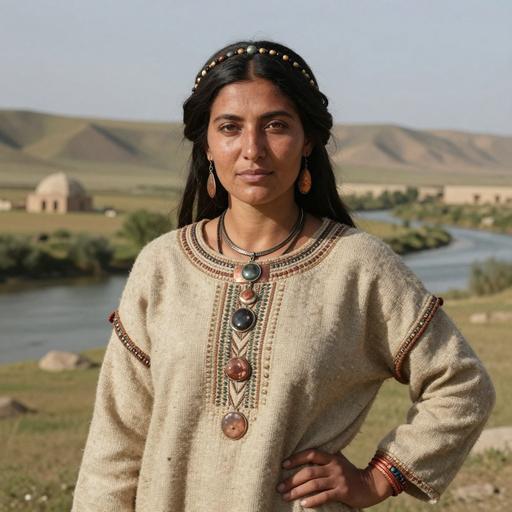
Portrait reconstruction of I4910
Ancient Individual

A woman buried in Tajikistan in the Copper Age era

I4910
3634 BCE - 3522 BCE
Female
Chalcolithic Sarazm
Tajikistan
Scroll to begin
Chapter I

Identity

The biological and cultural markers that define this ancient individual

Sample ID

I4910

Date Range

3634 BCE - 3522 BCE

Biological Sex

Female

mtDNA Haplogroup

J1d9*

Cultural Period

Chalcolithic Sarazm

Chapter II

Place

Where this individual was discovered

Country Tajikistan
Locality Sarazm
Coordinates 39.5072, 67.4608
Chapter III

Time

When this individual lived in the broader context of human history

I4910 3634 BCE - 3522 BCE
Chapter IV

Story

The narrative of this ancient life

The Chalcolithic Sarazm culture is an intriguing and pivotal era within the broader tapestry of Central Asian civilization, primarily centered around the ancient site of Sarazm in western Tajikistan. Dating back to approximately the 4th millennium BCE, this culture marks a transitional period between the Neolithic and the Bronze Age, where the use of copper began to complement the traditional stone tools, hence the name 'Chalcolithic' or 'Copper Age.'

Geographical Context: Sarazm is strategically located in the Zarafshan Valley, an area that historically provided fertile lands and a climate suitable for early agricultural practices. This location served as a critical crossroad for various trade routes, facilitating cultural and technological exchanges between different regions, including what are now known as the Iranian Plateau, Central Asia, and South Asia.

Archaeological Significance: The archaeological site of Sarazm, a UNESCO World Heritage Site since 2010, provides extensive material evidence of its significance as a prehistoric settlement. The site covers an area of over 100 hectares, making it one of the largest known early settlements in Central Asia. Excavations reveal a complex urban structure with distinct residential, craft production, and possibly religious areas, indicative of an advanced socio-economic organization.

Economy and Craftsmanship: Sarazm's economy was likely rooted in agriculture, with evidence of wheat and barley cultivation complementing animal husbandry practices. The region’s proximity to copper ore sources enabled the community to exploit metallurgical techniques, marking an essential step towards more sophisticated metalworking processes, which would later characterize the Bronze Age. Artifacts such as copper tools, ornaments, and pottery highlight the community's craftsmanship and their engagement in long-distance trade. Items like lapis lazuli from Afghanistan and shells from the Arabian Sea suggest extensive trade networks.

Cultural and Societal Structure: The cultural practices of Sarazm residents indicate a society with a high degree of social organization. The presence of distinct architectural features, such as large multi-room houses and possible public or ceremonial buildings, suggests organized community living and possibly hierarchical social stratification. The discovery of burial sites with grave goods implies belief systems surrounding death and an understanding of social status.

Technological Innovation: The introduction and use of copper tools and artifacts mark Sarazm as a critical site for technological innovation in the region. This period saw the gradual shift from stone to metal, facilitating advancements in agriculture, craftsmanship, and potentially warfare or hunting practices. This innovation would set the stage for further technological developments during the subsequent Bronze Age.

Art and Symbolism: Artistic expressions in Sarazm are evident in pottery designs and small carved figurines. Pottery, often skillfully decorated with geometric patterns, reflects both utilitarian and aesthetic advances. Such artifacts provide insight into the symbolic and communicative aspects of Sarazm’s culture, potentially indicating ritualistic or religious practices.

Legacy and Influence: Sarazm’s significance extends beyond its immediate geographical area. As a cultural and economic hub, it played a crucial role in the dissemination of technological and cultural innovations throughout Central Asia and beyond. The technological and cultural practices established during the Sarazm era laid foundational groundwork for subsequent civilizations in the region.

In summary, the Chalcolithic Sarazm culture represents a seminal phase in the prehistoric development of Central Asia. Its advances in metallurgy, architecture, and social organization highlight an advanced society capable of influencing broader cultural and technological currents across the ancient world. The archaeological findings at Sarazm offer vital glimpses into the lives of a people at the cusp of the Bronze Age, reflecting a complex society deeply interconnected with its environment and neighboring cultures.

Chapter V

Genetics

The genetic ancestry of this ancient individual

Ancient Genetic Admixture

This analysis compares the DNA profile of I4910 with ancient reference populations, showing the genetic composition in terms of prehistoric ancestral groups.

Neolithic Farmers 55.3%
Ancient Asians 20.7%
Western Steppe Pastoralists 14.2%
European Hunter-Gatherers 9.8%

Modern Genetic Admixture

This analysis compares the DNA profile with present-day reference populations, showing what percentage of genetic makeup resembles modern populations from different regions.

Asia 100.0%
Central Asian, Northern Indian & Pakistani 60.6%
Pakistan 54.8%
Indian 5.8%
Northern West Asian 39.4%
Caucasian 30.4%
Mesopotamian 9.1%

Closest Modern Populations

These are the modern populations showing the closest statistical alignment to A woman buried in Tajikistan in the Copper Age era, ranked by genetic distance. Lower distance values indicate closer statistical similarity.

1
Pashtun Afghanistan
4.6273
2
Pashtun Afghanistan Paktia
4.8682
3
Iranian Persian Khorasan
4.9839
4
Pashtun Afghanistan North
5.2025
5
Pashtun Pakistan Bettani
5.2234
6
Tajik Yaghnobi
5.6105
7
Parsi Pakistan
5.8012
8
Parsi India
5.9750
9
Tajik Tajikistan Kulob
6.0450
10
Pashtun Pakistan Khattak Nowshera
6.1183
Chapter VI

Context

Other ancient individuals connected to this sample

Sources

References

Scientific publications and genetic data

Scientific Publication

The formation of human populations in South and Central Asia

Authors Narasimhan VM, Patterson N, Moorjani P
Abstract

By sequencing 523 ancient humans, we show that the primary source of ancestry in modern South Asians is a prehistoric genetic gradient between people related to early hunter-gatherers of Iran and Southeast Asia. After the Indus Valley Civilization's decline, its people mixed with individuals in the southeast to form one of the two main ancestral populations of South Asia, whose direct descendants live in southern India. Simultaneously, they mixed with descendants of Steppe pastoralists who, starting around 4000 years ago, spread via Central Asia to form the other main ancestral population. The Steppe ancestry in South Asia has the same profile as that in Bronze Age Eastern Europe, tracking a movement of people that affected both regions and that likely spread the distinctive features shared between Indo-Iranian and Balto-Slavic languages.

G25 Coordinates

The G25 coordinates for sample I4910 can be used for detailed admixture analysis in our G25 Studio tool.

I4910,0.09127294,0.06051418,-0.06872662,0.02371798,-0.06530164,0.01983412,0.0090154,0.00020876,-0.04033632,-0.02781708,-0.00591572,0.00264442,-0.01060054,-0.00363072,0.01220778,-0.00303458,0.00255168,-0.0052704,-0.00645844,-0.00084068,0.00069922,-0.00189968,0.00307698,-0.00437134,-0.00547571
Analyze in G25 Studio
Use code for 40% off Expires Feb 26