Menu
Store
Blog
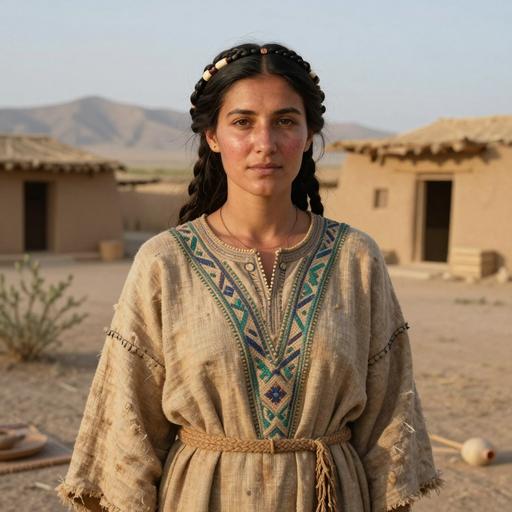
Portrait reconstruction of I6671
Ancient Individual

A woman buried in Turkmenistan in the Early Bronze Age era

I6671
3000 BCE - 2200 BCE
Female
Early Bronze Parkhai
Turkmenistan
Scroll to begin
Chapter I

Identity

The biological and cultural markers that define this ancient individual

Sample ID

I6671

Date Range

3000 BCE - 2200 BCE

Biological Sex

Female

mtDNA Haplogroup

HV14

Cultural Period

Early Bronze Parkhai

Chapter II

Place

Where this individual was discovered

Country Turkmenistan
Locality Parkhai II
Coordinates 38.3480, 56.2454
Chapter III

Time

When this individual lived in the broader context of human history

I6671 3000 BCE - 2200 BCE
Chapter IV

Story

The narrative of this ancient life

The Early Bronze Age (EBA) Parkhai culture is part of the larger Oxus Civilization, also known as the Bactria-Margiana Archaeological Complex (BMAC), which flourished in Central Asia during the late 3rd and early 2nd millennia BCE. The Parkhai variant provides us with a fascinating glimpse into the ancient socio-cultural and technological adaptations within this region.

Geographic and Chronological Context

The Parkhai culture is primarily situated within the modern boundaries of Turkmenistan, although the broader Oxus Civilization extends across parts of present-day Afghanistan, Uzbekistan, and Tajikistan. This region, characterized by its proximity to the Oxus (Amu Darya) River, was crucial for agriculture and trade during the EBA. Parkhai settlements are known to have developed around oasis environments, which allowed for sustainable habitation amidst an otherwise arid landscape.

Settlement Patterns and Architecture

Archaeological findings indicate that the Parkhai sites consisted of well-organized settlements with a range of structural forms. Architecture was dominated by mud-brick constructions, which were suitable for the arid climate. These were often arranged into complex compounds suggesting both domestic and communal areas. The presence of both small villages and larger urban centers indicates a hierarchical social organization. Fortified walls at some sites suggest the necessity of protection against both natural elements and social conflicts.

Economy and Subsistence

The Parkhai people likely practiced mixed farming, with evidence of both agriculture and animal husbandry. Irrigation techniques would have been crucial, leveraging the seasonal waters of the Oxus and surrounding canals. Typical crops included wheat and barley, while animal remains show the domestication of cattle, sheep, and goats. Furthermore, the region’s location along key trade routes facilitated the exchange of goods, which included metals, semi-precious stones, and crafted items, both sustaining and enhancing the local economy.

Craftsmanship and Technology

One of the most remarkable aspects of the Parkhai culture, and the Oxus Civilization more generally, was its advanced craftsmanship. Artisans produced pottery, metal tools, and ornaments, the latter often composed of gold, silver, and copper. Elaborate ceramic designs and metallurgy reflect both practical and decorative artistry. Seals and amulets found at Parkhai sites indicate a complex symbolic culture, possibly with administrative or ritual significance.

Social Structure and Lifestyle

The artifacts and burial practices of the Parkhai people provide substantial evidence of a stratified society. Grave goods, varying significantly in quantity and elaboration, suggest distinctions in social status. The diversity in burial practices, including differences in orientation, grave goods, and tomb construction, might illustrate distinct social roles or beliefs about the afterlife. The society’s organization would have included a ruling elite, specialized artisans, and traders, with a probable division of labor and responsibilities.

Cultural and Religious Aspects

Parkhai's cultural dynamics mimicked those of the broader Oxus Civilization, characterized by shared religious and symbolic motifs, including animal and anthropomorphic figures. These might have represented deities or ancestral spirits, indicative of a polytheistic belief system. Ritual spaces and artifacts, such as altars or figurines, suggest a complex spiritual life with possible connections to later Zoroastrian or Indo-Iranian traditions.

Interaction and Influence

The Parkhai settlements interacted extensively with neighboring cultures and regions, as evidenced by the diffusion of goods and stylistic influences in art and toolmaking. This interaction was fostered by the Silk Road’s prehistory, serving not merely as a conduit for trade but also for cultural and technological exchange. The exchange across these networks helped shape the subsequent development of civilizations across the Iranian Plateau and the Indus Valley.

Conclusion

The EBA Parkhai culture, as a subset of the Oxus Civilization, represents an important chapter in the prehistoric developments of Central Asia. Its strategic location, resource management, and advanced crafting techniques underscore its significance in the broader narrative of Bronze Age societies. The integration of economic, social, and technological facets demonstrates a complex and adaptive society whose legacy influences later cultural developments across Eurasia.

Chapter V

Genetics

The genetic ancestry of this ancient individual

Ancient Genetic Admixture

This analysis compares the DNA profile of I6671 with ancient reference populations, showing the genetic composition in terms of prehistoric ancestral groups.

Neolithic Farmers 68.3%
Ancient Asians 16.3%
European Hunter-Gatherers 9.9%
Western Steppe Pastoralists 5.5%

Modern Genetic Admixture

This analysis compares the DNA profile with present-day reference populations, showing what percentage of genetic makeup resembles modern populations from different regions.

Asia 100.0%
Central Asian, Northern Indian & Pakistani 66.0%
Pakistan 45.1%
Indian 20.9%
Northern West Asian 34.0%
Mesopotamian 23.6%
Caucasian 10.4%

Closest Modern Populations

These are the modern populations showing the closest statistical alignment to A woman buried in Turkmenistan in the Early Bronze Age era, ranked by genetic distance. Lower distance values indicate closer statistical similarity.

1
Karachay
5.6257
2
Iranian Mazandarani O
5.6560
3
North Ossetian
5.6875
4
Azerbaijani Dagestan
5.7972
5
Iranian Persian Khorasan
5.9001
6
Abazin
5.9699
7
Ossetian
5.9866
8
Tat Dagestan Nyugdi
6.0201
9
Turkmen O
6.0423
10
Kumyk
6.0678
Chapter VI

Context

Other ancient individuals connected to this sample

Sources

References

Scientific publications and genetic data

Scientific Publication

The formation of human populations in South and Central Asia

Authors Narasimhan VM, Patterson N, Moorjani P
Abstract

By sequencing 523 ancient humans, we show that the primary source of ancestry in modern South Asians is a prehistoric genetic gradient between people related to early hunter-gatherers of Iran and Southeast Asia. After the Indus Valley Civilization's decline, its people mixed with individuals in the southeast to form one of the two main ancestral populations of South Asia, whose direct descendants live in southern India. Simultaneously, they mixed with descendants of Steppe pastoralists who, starting around 4000 years ago, spread via Central Asia to form the other main ancestral population. The Steppe ancestry in South Asia has the same profile as that in Bronze Age Eastern Europe, tracking a movement of people that affected both regions and that likely spread the distinctive features shared between Indo-Iranian and Balto-Slavic languages.

G25 Coordinates

The G25 coordinates for sample I6671 can be used for detailed admixture analysis in our G25 Studio tool.

I6671,0.09492932,0.0758842,-0.07292482,-0.0084808,-0.05452686,0.00440874,0.00909834,-0.00261038,-0.04349856,-0.01934954,-0.00413472,0.00607274,-0.01631166,0.00524132,0.00740326,-0.01486014,0.01674324,-0.00511496,-0.00703384,0.01236432,0.01117526,-0.00044958,0.00708734,-0.00684058,-0.0060263
Analyze in G25 Studio
Use code for 40% off Expires Feb 26