Menu
Store
Blog
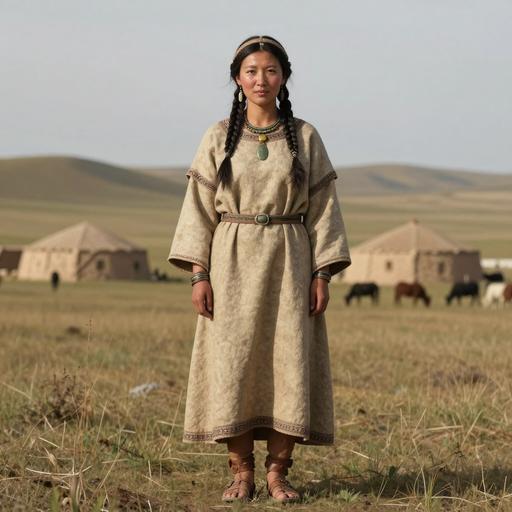
Portrait reconstruction of I6709
Ancient Individual

A woman buried in Kazakhstan in the Late Bronze Age era

I6709
1391 BCE - 1200 BCE
Female
Late Bronze Age
Kazakhstan
Scroll to begin
Chapter I

Identity

The biological and cultural markers that define this ancient individual

Sample ID

I6709

Date Range

1391 BCE - 1200 BCE

Biological Sex

Female

mtDNA Haplogroup

U5a1g1

Cultural Period

Late Bronze Age

Chapter II

Place

Where this individual was discovered

Country Kazakhstan
Locality East Kazakhstan region. Katon Karagai district. Ul’ken Narym. Malaya Krasnoyarka
Coordinates 49.1244, 84.3041
Chapter III

Time

When this individual lived in the broader context of human history

I6709 1391 BCE - 1200 BCE
Chapter IV

Story

The narrative of this ancient life

The Late Bronze Age of the Andronovo culture, which flourished approximately between 2000 BCE and 900 BCE, represents a significant era in the prehistoric archaeology of Central Asia, specifically in the regions that are part of modern-day Kazakhstan, southern Russia, and parts of Western Siberia. This culture is considered one of the most influential and widespread of the Eurasian Bronze Age, known for its advancements in metallurgy, agriculture, and pastoralism.

Geographical and Environmental Context

The Andronovo culture covered a vast territory characterized by diverse environments, ranging from steppes and semi-deserts to forest-steppe regions. This diversity in landscapes supported a variety of subsistence practices that were crucial for the survival and development of the people in this culture. The availability of rich pastures facilitated pastoralism, which was a dominant aspect of their economy, while river valleys and more fertile areas supported agricultural activities.

Society and Social Organization

The Andronovo societies were predominantly composed of semi-nomadic pastoralists who also engaged in agriculture. They lived in small, family-based units or clans, which typically formed larger tribal coalitions. Settlements during this period varied in size, comprising both seasonal camps and more permanent villages located near water sources. The societal structure is inferred to have been organized hierarchically, with evidence suggesting a class of elites or chieftains who oversaw communal activities and possibly served religious functions.

Economy and Subsistence

Economically, the Late Bronze Age Andronovo culture was marked by a mixed subsistence strategy. Cattle, sheep, goats, and horses were the primary livestock, herded across vast swathes of the steppe. The importance of horses not only facilitated mobility but also played a significant role in trade and warfare. Additionally, archaeological findings indicate the cultivation of wheat, barley, and millet, illustrating their agricultural practices.

The Andronovo people are credited with advancements in metallurgy, particularly in bronze-making techniques, combining copper with tin to produce stronger tools and weapons. This technological expertise not only enhanced agricultural productivity but also contributed to their military capabilities, which were crucial for defending territories and participating in trade networks.

Material Culture and Artifacts

Andronovo material culture is distinguished by its pottery, metalwork, and burial practices. Pottery from this era is typically well-fired and decorated with intricate geometric patterns achieved through techniques like cord-imprinting and incision. Metal artifacts, including weapons such as daggers, spearheads, and arrowheads, as well as ornamental items like bracelets and pendants, showcase their metallurgical skills.

Graves and burial mounds (kurgans) provide significant insights into their societal and religious beliefs. Burials often included goods such as pottery, tools, and ornaments, indicating beliefs in an afterlife and the significance of ensuring the dead were equipped for the journey.

Religion and Beliefs

The religious life of the Andronovo culture, as reflected in their burial practices, suggests the presence of ritualistic traditions and the worship of possibly animistic deities. The presence of fire altars and the emphasis on burial rites hint at a complex belief system that may have included ancestor worship and rituals connected to agriculture and the changing seasons.

Interaction and Influence

The Andronovo culture played a crucial role in the exchange networks of the Eurasian steppe belt. They were likely intermediaries in the trade of goods such as tin, which was essential for bronze production, and may have been involved in the early development of the Silk Road. Their interactions with neighboring cultures like the Bactria-Margiana Archaeological Complex (BMAC) facilitated cultural exchanges that influenced practices in metallurgy, ceramics, and possibly linguistic development.

Conclusion

In summary, the Late Bronze Age of the Andronovo culture was a pivotal period characterized by advancements in metallurgy, mixed subsistence strategies, and complex societal and religious structures. Its extensive reach and influence across the Eurasian steppes laid foundational elements for subsequent cultural developments, including the emergence of early Indo-Iranian societies. The legacy of this era can be traced through various archaeological and linguistic lines, highlighting its importance in the history of Central Asia and beyond.

Chapter V

Genetics

The genetic ancestry of this ancient individual

Ancient Genetic Admixture

This analysis compares the DNA profile of I6709 with ancient reference populations, showing the genetic composition in terms of prehistoric ancestral groups.

Western Steppe Pastoralists 38.6%
Neolithic Farmers 29.1%
European Hunter-Gatherers 23.1%
Ancient Asians 9.3%

Modern Genetic Admixture

This analysis compares the DNA profile with present-day reference populations, showing what percentage of genetic makeup resembles modern populations from different regions.

Europe 56.0%
Northwestern European 36.7%
Scandinavian 12.0%
Northwestern European 10.8%
Finnish 8.2%
English 5.7%
Eastern European 19.3%
Asia 43.7%
Northern West Asian 27.8%
Caucasian 27.8%
Central Asian, Northern Indian & Pakistani 15.9%
Pakistan 15.9%

Closest Modern Populations

These are the modern populations showing the closest statistical alignment to A woman buried in Kazakhstan in the Late Bronze Age era, ranked by genetic distance. Lower distance values indicate closer statistical similarity.

1
Turkish Deliorman
6.7613
2
Tajik Yaghnobi
6.8899
3
Pamiri Rushan
7.0263
4
Lezgin
7.2186
5
Kaitag
7.3305
6
Turkish Rumeli
7.3514
7
Andian B
7.4076
8
Tabasaran
7.5774
9
Darginian
7.6157
10
Avar
7.6423
Chapter VI

Context

Other ancient individuals connected to this sample

Sources

References

Scientific publications and genetic data

Scientific Publication

The formation of human populations in South and Central Asia

Authors Narasimhan VM, Patterson N, Moorjani P
Abstract

By sequencing 523 ancient humans, we show that the primary source of ancestry in modern South Asians is a prehistoric genetic gradient between people related to early hunter-gatherers of Iran and Southeast Asia. After the Indus Valley Civilization's decline, its people mixed with individuals in the southeast to form one of the two main ancestral populations of South Asia, whose direct descendants live in southern India. Simultaneously, they mixed with descendants of Steppe pastoralists who, starting around 4000 years ago, spread via Central Asia to form the other main ancestral population. The Steppe ancestry in South Asia has the same profile as that in Bronze Age Eastern Europe, tracking a movement of people that affected both regions and that likely spread the distinctive features shared between Indo-Iranian and Balto-Slavic languages.

G25 Coordinates

The G25 coordinates for sample I6709 can be used for detailed admixture analysis in our G25 Studio tool.

I6709,0.1125359,0.07704528,0.01660744,0.03767148,-0.01290842,0.0136153,0.00772008,0.00111696,-0.02418722,-0.02405942,0.00040014,0.00171646,-0.00109498,-0.00615506,0.00946422,-0.0038755,-0.010581,4.524E-05,-0.00274662,-0.00627834,-0.0008084,0.00229886,-0.00190338,0.00722076,-0.00338179
Analyze in G25 Studio
Use code for 40% off Expires Feb 26