Menu
Store
Blog
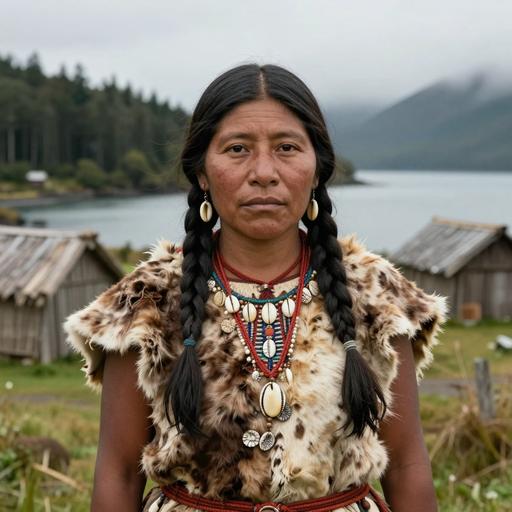
Portrait reconstruction of Yaghan894
Ancient Individual

A woman buried in Argentina in the Pre-Columbian South America era

Yaghan894
1800 CE - 1900 CE
Female
Beagle Channel Yamana Culture 100 Years Ago
Argentina
Scroll to begin
Chapter I

Identity

The biological and cultural markers that define this ancient individual

Sample ID

Yaghan894

Date Range

1800 CE - 1900 CE

Biological Sex

Female

mtDNA Haplogroup

D4h3a

Cultural Period

Beagle Channel Yamana Culture 100 Years Ago

Chapter II

Place

Where this individual was discovered

Country Argentina
Locality Beagle Channel. Tierra del Fuego
Chapter III

Time

When this individual lived in the broader context of human history

Yaghan894 1800 CE - 1900 CE
Chapter IV

Story

The narrative of this ancient life

The Yamana (or Yaghan) people are one of the indigenous groups native to the extreme southern regions of South America, particularly around the Beagle Channel, which is situated at the southern tip of present-day Argentina and Chile. Though the request specifies a focus on \100 years ago," which would place us in the early 20th century, it is essential to understand that the culture observed at this time was already significantly influenced by contact with European explorers and settlers from the preceding centuries. Here's a detailed description of the Yamana culture as it stood around that time, drawing on their rich and ancient traditions:

Geography and Environment

Location and Climate: The Beagle Channel is a strait in the Tierra del Fuego archipelago, characterized by its cold, harsh climate with strong winds and frequent precipitation. The channel itself is surrounded by rugged terrain, including mountains, forests, and a rugged coastline with many inlets and islands. This geography profoundly influenced the Yamana way of life, as they had to adapt to the cold maritime environment.

Social Structure and Lifestyle

Community and Organization: The Yamana were traditionally organized into small, nomadic groups, often consisting of extended family units. Their social structure was relatively egalitarian, with leadership typically based on age and experience rather than rigid hierarchies. Decision-making was collaborative, and roles within the community were clearly defined yet flexible depending on the needs and circumstances.

Housing and Transportation: The Yamana lived in simple, temporary shelters known as "toldos," made from wood and animal skins. These structures could be easily assembled and disassembled as they moved between seasonal camps. Transportation was primarily reliant on canoes, expertly crafted from bark or logs, which allowed them to traverse the waters of the Beagle Channel effectively.

Subsistence and Economy

Hunting and Gathering: The Yamana were adept hunters and gatherers, relying on the abundant marine resources available in their environment. They hunted seals, sea lions, and birds, and gathered shellfish, fish, and plants. Their diet was rich in protein and fat, necessary for survival in the cold climate.

Tools and Technology: The Yamana crafted tools and weapons from bone, stone, and wood. Harpoons and spears were common for hunting, while simple nets and lines were used for fishing. Their technological adaptations were impressive given the limited resources available in their environment.

Language and Communication

The Yamana spoke the Yaghan language, which is notable for its rich vocabulary related to the natural environment. It was an oral language without a written form, and storytelling was a crucial means of preserving history and imparting knowledge. Unfortunately, by the early 20th century, the number of fluent speakers had drastically declined due to the impacts of colonization and cultural assimilation.

Beliefs and Spiritual Practices

Worldview: The Yamana worldview was deeply connected to the natural environment. They believed in a spiritual interconnection between humans, animals, and the landscape, with many elements of nature having their own spirits or essences. This belief system guided their respectful and sustainable use of resources.

Rituals and Ceremonies: Rituals and ceremonies were integral to Yamana life. These included rites of passage, which marked the transition between different stages of life, and ceremonial gatherings during hunting expeditions or seasonal changes. These gatherings often involved music, dance, and storytelling, serving both social and spiritual purposes.

Cultural Challenges

By the early 20th century, the Yamana population had already experienced significant disruption due to European colonization. Diseases, land dispossession, and cultural assimilation led to a drastic reduction in their numbers and a weakening of their traditional ways of life. Missionary activities further impacted their spiritual practices and language, aiming to convert them to Christianity and integrate them into Western society.

Legacy and Preservation

Despite these challenges, the Yamana culture has persisted, albeit in a diminished form. Efforts have been made to document and preserve their language, traditions, and history. Today, the Yamana are recognized as an essential part of the cultural heritage of the region, and there are ongoing initiatives to revive and celebrate their unique contributions to the cultural mosaic of South America.

In summary, the Yamana of the Beagle Channel, 100 years ago, represented a resilient, adaptive culture deeply connected to their environment, though their traditional way of life was under significant threat due to external influences."

Chapter V

Genetics

The genetic ancestry of this ancient individual

Ancient Genetic Admixture

This analysis compares the DNA profile of Yaghan894 with ancient reference populations, showing the genetic composition in terms of prehistoric ancestral groups.

Ancient Native Americans 77.9%
Ancient Asians 22.1%

Modern Genetic Admixture

This analysis compares the DNA profile with present-day reference populations, showing what percentage of genetic makeup resembles modern populations from different regions.

America 79.0%
America 79.0%
Native American 79.0%
Asia 21.0%
Northern West Asian 10.8%
Anatolian 10.8%
Northern Asian 10.1%
Siberian 10.1%

Closest Modern Populations

These are the modern populations showing the closest statistical alignment to A woman buried in Argentina in the Pre-Columbian South America era, ranked by genetic distance. Lower distance values indicate closer statistical similarity.

1
Aymara
2.0371
2
Piapoco
2.2402
3
Wichi
2.5430
4
Yukpa
2.6709
5
Bolivian Lapaz
2.8558
6
Colla
3.4707
7
Mixe
3.6319
8
Cachi
3.8362
9
Karitiana
4.1859
10
Huichol
4.6734
Chapter VI

Context

Other ancient individuals connected to this sample

Sources

References

Scientific publications and genetic data

Scientific Publication

POPULATION GENETICS. Genomic evidence for the Pleistocene and recent population history of Native Americans

Authors Raghavan M, Steinrücken M, Harris K
Abstract

How and when the Americas were populated remains contentious. Using ancient and modern genome-wide data, we found that the ancestors of all present-day Native Americans, including Athabascans and Amerindians, entered the Americas as a single migration wave from Siberia no earlier than 23 thousand years ago (ka) and after no more than an 8000-year isolation period in Beringia. After their arrival to the Americas, ancestral Native Americans diversified into two basal genetic branches around 13 ka, one that is now dispersed across North and South America and the other restricted to North America. Subsequent gene flow resulted in some Native Americans sharing ancestry with present-day East Asians (including Siberians) and, more distantly, Australo-Melanesians. Putative "Paleoamerican" relict populations, including the historical Mexican Pericúes and South American Fuego-Patagonians, are not directly related to modern Australo-Melanesians as suggested by the Paleoamerican Model.

G25 Coordinates

The G25 coordinates for sample Yaghan894 can be used for detailed admixture analysis in our G25 Studio tool.

Yaghan894,0.05613676,-0.31997996,0.113784,0.09882768,-0.11787414,-0.01284186,-0.29971454,-0.35220956,-0.01383846,-0.01621612,0.00280292,-0.00071418,-0.00138646,0.02506164,-0.0062164,-0.0009117,0.00593944,0.00358824,0.0017416,-0.00125176,0.00051162,0.0063039,-0.00238826,-0.00470684,-0.00497845
Analyze in G25 Studio
Use code for 40% off Expires Feb 26