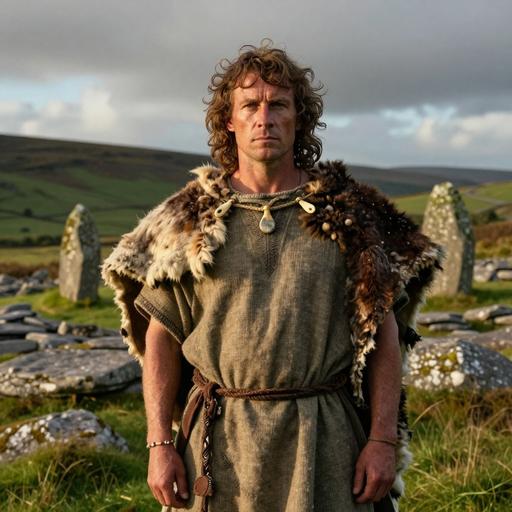
The Late Neolithic period in Ireland, spanning roughly from 3000 to 2500 BCE, represents a time of significant transition and cultural evolution. This era pre-dates the arrival of the Celts, who are believed to have reached Ireland much later, during the Iron Age. While Celtic influences are absent during the Late Neolithic, this period is notable for its own distinct characteristics and developments.
Society and Lifestyle
The people of Late Neolithic Ireland were primarily agrarian, engaging in both farming and pastoral activities. They cultivated wheat and barley and raised domesticated animals such as cattle, sheep, and pigs. The society was likely organized into tribal or clan-based groups, with social structures that facilitated communal living and shared responsibilities. Evidence suggests these communities had complex social networks, possibly involving trade and exchange of goods, ideas, and technologies with neighboring regions.
Settlements and Architecture
Settlements of this era were typically composed of small, scattered farmsteads rather than large, centralized towns. Houses were generally round or rectangular structures built using timber frames and wattle and daub, with thatched or sod roofs. The arrangement of dwellings and ancillary structures like storage pits and enclosure ditches indicates a keen understanding of agricultural practices and domestic needs.
A key feature of Late Neolithic architecture in Ireland is the construction of monumental tombs, primarily megalithic structures such as passage tombs, court tombs, and wedge tombs. Notable examples include Newgrange, Knowth, and Dowth in the Boyne Valley, which are part of the Brú na Bóinne UNESCO World Heritage Site. These tombs often served as ceremonial and communal burial sites and are remarkable for their engineering, artwork, and astronomical alignments.
Art and Symbolism
Art from the Late Neolithic period is predominantly seen in the carvings and decorations found on megalithic tombs. Motifs such as spirals, lozenges, and concentric circles are common, often interpreted as expressions of cosmological beliefs or rituals. These designs may hold symbolic meanings related to life, death, and rebirth, reflecting an intricate spiritual or religious belief system.
Technology and Tools
The technological advancements of Late Neolithic Ireland are evident in the stone tools and implements discovered from this period. The Neolithic people were skilled in flint knapping, producing a variety of tools including axes, scrapers, and arrowheads. Grinding stones and querns found at archaeological sites indicate advanced practices in food processing, particularly in cereal grinding.
Rituals and Beliefs
The construction and use of monumental tombs suggest a deep spiritual or religious significance, with rituals likely centered around ancestor worship or the veneration of deities linked to nature and the cycles of the sun and moon. The alignment of some tombs with astronomical events, such as the winter solstice at Newgrange, indicates an advanced understanding of celestial cycles and their incorporation into spiritual practices.
Conclusion
The Late Neolithic period in Ireland was a dynamic time marked by significant developments in agriculture, social organization, and monumental architecture. While the Celts had not yet arrived, this era laid the foundations for later cultural and societal changes. The legacy of the Late Neolithic is particularly embodied in Ireland's megalithic monuments, which continue to be celebrated as masterpieces of prehistoric engineering and artistry.