A man buried in Canada in the Pre-Columbian North America era

Download PDF creates a visual, rasterized copy. Use Print for selectable text and better assistive-technology support.

Loading Report

Preparing your ancestry journey

Preparing the available report content...

Your report will open automatically.

Skip to main content
Reference library / Sample profile

A man buried in Canada in the Pre-Columbian North America era

Explore the recorded context, genetic comparisons and research behind this reference sample.

CanadaCanada 700BP

A reference profile describes this sample. It does not establish a personal or family relationship.

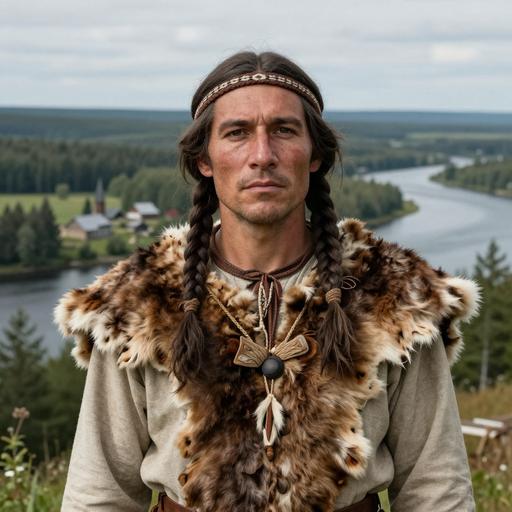
AI portrait reconstruction for A man buried in Canada in the Pre-Columbian North America era
AI-generated artistic reconstruction, not a photograph of the individual.
Record

Sample details

Recorded details and available lineage markers.

Individual

Eastern Woodlands individual, Canada

Sample ID: MARC1492

Date Range

1231 CE - 1295 CE

Cultural Period

Canada 700BP

Biological Sex

Male

mtDNA Haplogroup

A2-a

Y-DNA Haplogroup

Not available

Social Role

Hunter (AI estimate, era-typical)

Geography

Location

Where this individual was discovered

Country Canada
Locality Old Mission Point. Restigouche River. Atholville. prehistory Tjigog. New Brunswick
Chronology

Date range

When this individual lived in the broader context of human history

Eastern Woodlands individual, Canada 1231 CE - 1295 CE
Context

Historical context

Background information associated with the reference record.

Region & Environment

In and around Canada’s forested and northern regions, lakes, rivers, and seasonal animal distributions supported repeated cycles of movement and subsistence. Environmental conditions shaped where people could hunt, fish, and gather, and therefore where archaeological sites appear.

Historical Context

The period around 1300 CE falls in the Late Prehistoric era of Canadian archaeology, after the earlier Archaic and before the full impacts of European contact became historically documented. Archaeological categories for this time—such as Late Prehistoric Canadian and Northern Plains Complex-style connections—highlight regional patterns in technology and site use.

Populations & Lifeways

Indigenous communities in this period were organized around seasonal availability of key resources. Lifeways likely combined hunting, fishing, and plant gathering, with group movement responding to weather and animal migrations. Settlement could involve short-term camps used repeatedly across the year.

Archaeology & Material Culture

Late Prehistoric Canadian archaeology often rests on distinctive chipped-stone and associated tool types, including projectiles and cutting implements used in hunting and processing. Ceramic evidence may be present in some regions, but the overall archaeological picture commonly emphasizes lithic technology and site activity areas rather than permanent built architecture.

Culture & Society

Cultural labels in this timeframe are archaeological groupings based on recurring materials and patterns of landscape use. Social organization would have been influenced by kinship, shared seasonal knowledge, and the coordination needed to procure resources at different times. Where regional networks existed, they may be reflected in similarities of tool traditions across broad areas.

Legacy & Transition

The late-prehistoric centuries set the stage for later historical developments across Canada. Archaeological continuities—seasonal land-use strategies and regionally adapted technologies—help connect earlier prehistoric patterns to the changing circumstances that followed contact.

Analysis

Genetic comparisons

These comparisons show genetic similarity, not identity or origin. The populations listed are those whose genomes show statistical alignment to this ancient individual.

Similarity reflects shared history, not shared identity. These are analytical comparisons, not claims about who this person was.

Modern Genetic Admixture

This analysis compares the DNA profile with present-day reference populations, showing statistical similarity to modern reference populations from different regions. The excavation site records where this individual was found, not a fixed modern genetic identity.

America 69.5%
America 69.5%
Native American 69.5%
Asia 26.9%
Northern Asian 25.8%
Siberian 17.4%
Mongolian 8.4%
Chinese & Southeast Asian 1.1%
Indonesian Khmer Thai Myanma 0.7%
Europe 3.0%
Northwestern European 3.0%
Finnish 3.0%
Africa 0.7%
Congolese & Southern East African 0.7%
South East African 0.7%

Closest Modern Populations

These are the modern populations showing the closest statistical alignment to A man buried in Canada in the Pre-Columbian North America era, ranked by genetic distance. Lower distance values indicate closer statistical similarity. Cross-region similarity can reflect shared ancestry, population movement, continuity, or later admixture.

1
Amerindian North
4.5885
2
Chipewyan
6.5572
Context

Related Samples

This individual exists within a broader network of ancient samples. No ancient genome stands alone.

Individual Culture/Period Date Location Action
Medieval individual, Mexico Pre-Columbian Mexico 4000 BCE Sierra Tarahumara, Mexico View
Mesoamerican Civilizations individual, Mexico Pre-Columbian Mexico 4000 BCE Sierra Tarahumara, Mexico View
Andean Civilizations individual, Chile Late Archaic Chinchorro Culture, Chile 4354 BCE Arica. Maderas. Enco C2, Chile View
Northwest Coast Cultures individual, Canada Canada 6,500 Years Ago 4678 BCE Lucy Islands. British Columbia. Chatham Sound, Canada View
Eastern Woodlands individual, Canada Canada 700 Years Ago 1231 CE Old Mission Point. Restigouche River. Atholville. prehistory Tjigog. New Brunswick, Canada View
Pre-Columbian Indigenous Cultures individual, Brazil Hunter-Gatherer Enoque, Brazil 1681 BCE Toca do Enoque Cave. Serra da Capivara. Piaui, Brazil View
America North Ancient individual, Canada 4678 BCE Lucy Islands. British Columbia. Chatham Sound, Canada View
America South Ancient individual, Chile 4354 BCE Arica. Maderas. Enco C2, Chile View
America South Pre Columbian individual, Brazil 1681 BCE Toca do Enoque Cave. Serra da Capivara. Piaui, Brazil View
America Central Pre Columbian individual, Mexico 4000 BCE Sierra Tarahumara, Mexico View
America North Recent individual, Canada 1231 CE Old Mission Point. Restigouche River. Atholville. prehistory Tjigog. New Brunswick, Canada View
Page 1
Individual Culture/Period Date Location Action
Eastern Woodlands individual, Canada Canada 700 Years Ago 1231 CE Old Mission Point. Restigouche River. Atholville. prehistory Tjigog. New Brunswick, Canada View
Page 1
Sources

References

Scientific publications and genetic data that inform this profile.

G25 Coordinates

These coordinates represent a position in genetic space, a tool for comparison, not a conclusion. You can use these to perform custom admixture analysis in G25 Studio.

MARC1492,0.05761102,-0.30653916,0.10828654,0.0734325,-0.10238622,-0.01793316,-0.21899782,-0.25761932,-0.00707724,-0.01114446,0.00472474,-0.00020248,-0.00100596,0.01508596,-0.00840456,-0.00281864,0.00216356,0.00752924,0.00789956,0.00198684,0.00471084,-0.00339358,-0.00182966,0.00254884,0.00370102
Continue in G25 Studio
Use code for 30% off • Expires Nov 16