A man buried in Canada in the era

Download PDF creates a visual, rasterized copy. Use Print for selectable text and better assistive-technology support.

Loading Report

Preparing your ancestry journey

Preparing the available report content...

Your report will open automatically.

Skip to main content
Reference library / Sample profile

A man buried in Canada in the era

Explore the recorded context, genetic comparisons and research behind this reference sample.

CanadaNorth America Colonial Era

A reference profile describes this sample. It does not establish a personal or family relationship.

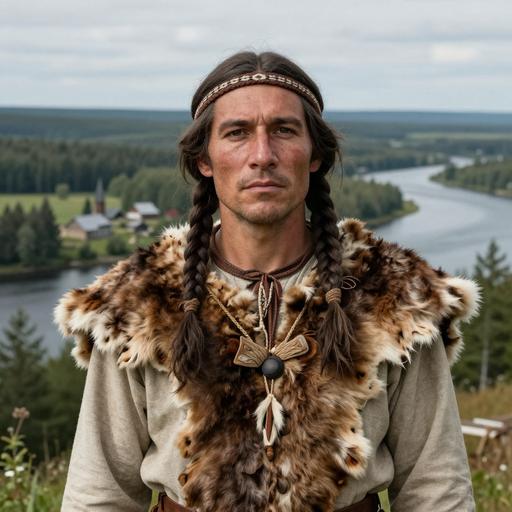
AI portrait reconstruction for A man buried in Canada in the  era
AI-generated artistic reconstruction, not a photograph of the individual.
Record

Sample details

Recorded details and available lineage markers.

Individual

America North Recent individual, Canada

Sample ID: MARC1492

Date Range

1231 CE - 1295 CE

Cultural Period

North America Colonial Era

Biological Sex

Male

mtDNA Haplogroup

A2-a

Y-DNA Haplogroup

Not available

Social Role

Laborer (AI estimate, era-typical)

Geography

Location

Where this individual was discovered

Country Canada
Locality Old Mission Point. Restigouche River. Atholville. prehistory Tjigog. New Brunswick

A location map is not available for this record.

Chronology

Date range

When this individual lived in the broader context of human history

America North Recent individual, Canada 1231 CE - 1295 CE
Context

Historical context

Background information associated with the reference record.

Region & Environment

The colonial-era transition in North America occurred across many environments, including coastal zones, river valleys, and interior regions. Ecological differences continued to shape subsistence and settlement patterns, even as European trade and settlement expanded in some regions.

Historical Context

This period overlaps with growing European maritime activity and exploration, leading to increased interaction with Indigenous societies. The era is best understood through archaeological and historical evidence of changing trade networks, new technologies, and, in some regions, the emergence of colonial institutions alongside Indigenous political realities.

Populations & Lifeways

Indigenous communities continued many established subsistence practices, including hunting, fishing, farming where practiced locally, and gathering. At the same time, contact-driven changes—such as participation in new exchange systems, adoption of certain introduced items, and movement associated with alliances or disruptions—could alter day-to-day lifeways.

Archaeology & Material Culture

Archaeological signatures may include European-manufactured goods appearing alongside local artifact traditions, changes in settlement organization near interaction zones, and shifts in consumption patterns reflected in faunal and artifact assemblages. In some areas, documentary records can complement archaeology, but details vary by region and by how thoroughly deposits are studied.

Culture & Society

Societies interacted through trade, diplomacy, and conflict, with alliances forming and breaking over time. Evidence for social change can appear through new household assemblages, altered burial practices, and the reorganization of communities around changing economic and political opportunities.

Legacy & Transition

The colonial era laid foundations for more sustained colonial rule in many areas and for long-term transformations in demographic patterns, economies, and material cultures. Archaeologically and historically, it marks a shift from earlier pre-contact regional trajectories toward contact-influenced developments that shaped the following centuries.

Analysis

Genetic comparisons

These comparisons show genetic similarity, not identity or origin. The populations listed are those whose genomes show statistical alignment to this ancient individual.

Similarity reflects shared history, not shared identity. These are analytical comparisons, not claims about who this person was.

Modern Genetic Admixture

This analysis compares the DNA profile with present-day reference populations, showing statistical similarity to modern reference populations from different regions. The excavation site records where this individual was found, not a fixed modern genetic identity.

America 69.5%
America 69.5%
Native American 69.5%
Asia 26.9%
Northern Asian 25.8%
Siberian 17.4%
Mongolian 8.4%
Chinese & Southeast Asian 1.1%
Indonesian Khmer Thai Myanma 0.7%
Europe 3.0%
Northwestern European 3.0%
Finnish 3.0%
Africa 0.7%
Congolese & Southern East African 0.7%
South East African 0.7%

Closest Modern Populations

These are the modern populations showing the closest statistical alignment to A man buried in Canada in the era, ranked by genetic distance. Lower distance values indicate closer statistical similarity. Cross-region similarity can reflect shared ancestry, population movement, continuity, or later admixture.

1
Amerindian North
4.5885
2
Chipewyan
6.5572
Context

Related Samples

This individual exists within a broader network of ancient samples. No ancient genome stands alone.

Individual Culture/Period Date Location Action
Medieval individual, Mexico Pre-Columbian Mexico 4000 BCE Sierra Tarahumara, Mexico View
Mesoamerican Civilizations individual, Mexico Pre-Columbian Mexico 4000 BCE Sierra Tarahumara, Mexico View
Andean Civilizations individual, Chile Late Archaic Chinchorro Culture, Chile 4354 BCE Arica. Maderas. Enco C2, Chile View
Northwest Coast Cultures individual, Canada Canada 6,500 Years Ago 4678 BCE Lucy Islands. British Columbia. Chatham Sound, Canada View
Eastern Woodlands individual, Canada Canada 700 Years Ago 1231 CE Old Mission Point. Restigouche River. Atholville. prehistory Tjigog. New Brunswick, Canada View
Pre-Columbian Indigenous Cultures individual, Brazil Hunter-Gatherer Enoque, Brazil 1681 BCE Toca do Enoque Cave. Serra da Capivara. Piaui, Brazil View
America North Ancient individual, Canada 4678 BCE Lucy Islands. British Columbia. Chatham Sound, Canada View
America South Ancient individual, Chile 4354 BCE Arica. Maderas. Enco C2, Chile View
America South Pre Columbian individual, Brazil 1681 BCE Toca do Enoque Cave. Serra da Capivara. Piaui, Brazil View
America Central Pre Columbian individual, Mexico 4000 BCE Sierra Tarahumara, Mexico View
America North Recent individual, Canada 1231 CE Old Mission Point. Restigouche River. Atholville. prehistory Tjigog. New Brunswick, Canada View
Page 1
Individual Culture/Period Date Location Action
America North Recent individual, Canada 1231 CE Old Mission Point. Restigouche River. Atholville. prehistory Tjigog. New Brunswick, Canada View
Page 1
Sources

References

Scientific publications and genetic data that inform this profile.

G25 Coordinates

These coordinates represent a position in genetic space, a tool for comparison, not a conclusion. You can use these to perform custom admixture analysis in G25 Studio.

MARC1492,0.05761102,-0.30653916,0.10828654,0.0734325,-0.10238622,-0.01793316,-0.21899782,-0.25761932,-0.00707724,-0.01114446,0.00472474,-0.00020248,-0.00100596,0.01508596,-0.00840456,-0.00281864,0.00216356,0.00752924,0.00789956,0.00198684,0.00471084,-0.00339358,-0.00182966,0.00254884,0.00370102
Continue in G25 Studio
Use code for 30% off • Expires Nov 16