Menu
Store
Blog
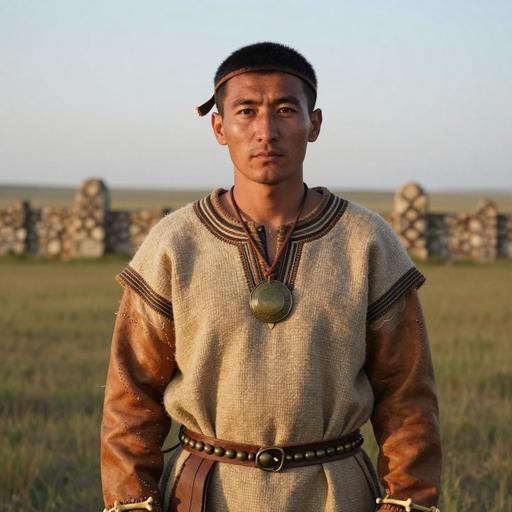
Portrait reconstruction of I3770
Ancient Individual

A man buried in Kazakhstan in the Bronze Age era

I3770
2134 BCE - 1936 BCE
Male
Bronze Age Zevakinskiy
Kazakhstan
Scroll to begin
Chapter I

Identity

The biological and cultural markers that define this ancient individual

Sample ID

I3770

Date Range

2134 BCE - 1936 BCE

Biological Sex

Male

mtDNA Haplogroup

T1a1

Y-DNA Haplogroup

R-Z2124

Cultural Period

Bronze Age Zevakinskiy

Chapter II

Place

Where this individual was discovered

Country Kazakhstan
Locality Zevakinskiy stone fence
Coordinates 50.2249, 81.8368
Chapter III

Time

When this individual lived in the broader context of human history

I3770 2134 BCE - 1936 BCE
Chapter IV

Story

The narrative of this ancient life

The Bronze Age Zevakinskiy culture, which existed in the Eurasian steppe region, is a fascinating chapter in the history of ancient Steppe cultures. It is part of the broader spectrum of Bronze Age cultures that flourished across the vast stretches of grasslands and arid plains extending from Eastern Europe to Central Asia. This era is characterized by a unique adaptation to a challenging environment, innovative technological advancements, and significant cultural interactions.

Geographic Context and Environmental Adaptations

The Zevakinskiy culture primarily occupied what is now Kazakhstan, a land of vast steppes, rugged mountains, and numerous rivers and lakes, presenting both challenges and opportunities for ancient communities. The geography significantly influenced the way of life of the Zevakinskiy people, necessitating a nomadic or semi-nomadic lifestyle to exploit the sparse resources effectively. The steppe's vastness allowed for the development of horse domestication which revolutionized travel, trade, and warfare for these people.

Technological and Material Culture

The Zevakinskiy culture, like other Bronze Age communities, was marked by advancements in metallurgy, particularly the use of bronze for tools, weapons, and ornaments. They mastered the art of alloying copper with tin to create bronze, which was harder and more durable than pure copper. This technological advancement facilitated agricultural practices, hunting, and warfare, giving the Zevakinskiy people an edge over earlier cultures reliant on stone tools.

Their material culture also included pottery characterized by geometric patterns and motifs, possibly used in both domestic and ritual contexts. The ceramics discovered in burial sites often provide invaluable insight into their artistic sensibilities and daily life.

Social Organization and Economy

The social organization of the Zevakinskiy culture was likely hierarchical, with evidence of social stratification seen in burial practices. Elite members were interred with richer grave goods, suggesting a society with defined social roles and a ruling class.

Economically, the Zevakinskiy culture relied heavily on pastoralism, with sheep, goats, and cattle being the primary livestock. This semi-nomadic pastoral economy was supplemented by limited agriculture and hunting, utilizing their metal tools to maximize efficiency. As skilled horsemen, they also engaged in raiding and trading, connecting with other cultures across the steppe and beyond.

Cultural Interactions and Influences

The Zevakinskiy culture didn’t exist in isolation but was part of a broader network of steppe cultures that traded, interacted, and sometimes clashed with each other. Their movements and interactions facilitated the exchange of goods, ideas, and technologies across vast distances, evidenced by the similarities in material culture across large areas of the steppe.

Artifacts such as metal objects, pottery styles, and burial customs show influences from and on neighboring cultures, indicating a dynamic cultural landscape. The development of complex trade routes across the steppe also played a significant role in the cultural and economic exchange.

Religious and Ritual Practices

Spiritual beliefs of the Zevakinskiy culture are deciphered primarily through their burial practices. Tombs and kurgans (burial mounds) often reveal a deep belief in an afterlife, with the dead interred with possessions that suggest a need for items in the next world. Animal sacrifices have also been noted, highlighting the role of animals not only in their economy but also their spiritual life.

The nature-centric worship likely revered natural elements, reflected in petroglyphs and other symbolic artifacts. As with many steppe cultures, the horse held particular significance, possibly representing freedom, power, and spiritual guidance.

Legacy and Historical Significance

The legacy of the Bronze Age Zevakinskiy culture lies in their contributions to the development of metallurgy, their mastery of the horse, and their role as intermediaries in the trade and cultural exchanges across the Eurasian steppe. They were part of the evolutionary process leading to more sophisticated societies such as the Scythians and the Sarmatians, who carried forward many of their traditions and technological advancements.

In summary, the Bronze Age Zevakinskiy culture represents a significant period in Central Asian history characterized by technological innovation, strategic adaptation to the steppe environment, and complex socio-economic structures, all of which contributed to the rich tapestry of prehistoric steppe cultures.

Chapter V

Genetics

The genetic ancestry of this ancient individual

Ancient Genetic Admixture

This analysis compares the DNA profile of I3770 with ancient reference populations, showing the genetic composition in terms of prehistoric ancestral groups.

Western Steppe Pastoralists 42.1%
European Hunter-Gatherers 31.8%
Neolithic Farmers 15.2%
Ancient Asians 10.9%

Modern Genetic Admixture

This analysis compares the DNA profile with present-day reference populations, showing what percentage of genetic makeup resembles modern populations from different regions.

Europe 86.5%
Northwestern European 49.9%
Finnish 20.7%
English 14.9%
Scandinavian 14.3%
Eastern European 36.6%
Asia 12.8%
Central Asian, Northern Indian & Pakistani 12.8%
Pakistan 12.8%
America 0.7%
America 0.7%
Native American 0.7%

Closest Modern Populations

These are the modern populations showing the closest statistical alignment to A man buried in Kazakhstan in the Bronze Age era, ranked by genetic distance. Lower distance values indicate closer statistical similarity.

1
Moksha
5.0666
2
Mordovian
5.2124
3
Tatar Mishar
5.2346
4
Erzya
5.3273
5
Russian Kostroma
5.4964
6
Russian Krasnoborsky
5.6018
7
Finnish Southwest
5.7224
8
Finnish Central
5.7865
9
Finnish North
6.0364
10
Ingrian
6.2081
Chapter VI

Context

Other ancient individuals connected to this sample

Sources

References

Scientific publications and genetic data

Scientific Publication

The formation of human populations in South and Central Asia

Authors Narasimhan VM, Patterson N, Moorjani P
Abstract

By sequencing 523 ancient humans, we show that the primary source of ancestry in modern South Asians is a prehistoric genetic gradient between people related to early hunter-gatherers of Iran and Southeast Asia. After the Indus Valley Civilization's decline, its people mixed with individuals in the southeast to form one of the two main ancestral populations of South Asia, whose direct descendants live in southern India. Simultaneously, they mixed with descendants of Steppe pastoralists who, starting around 4000 years ago, spread via Central Asia to form the other main ancestral population. The Steppe ancestry in South Asia has the same profile as that in Bronze Age Eastern Europe, tracking a movement of people that affected both regions and that likely spread the distinctive features shared between Indo-Iranian and Balto-Slavic languages.

G25 Coordinates

The G25 coordinates for sample I3770 can be used for detailed admixture analysis in our G25 Studio tool.

I3770,0.12200272,0.07800436,0.0529447,0.05484892,0.0116748,0.0183295,0.00711688,0.00999994,-0.00449048,-0.01837224,0.00168474,-0.00170124,0.00385048,-0.00913652,0.00355044,-0.00649492,-0.01457684,-0.00032316,-0.00686604,-0.00801574,0.0004598,0.005167,-0.00838294,0.00870152,-0.00245918
Analyze in G25 Studio
Use code for 40% off Expires Feb 26