Menu
Store
Blog
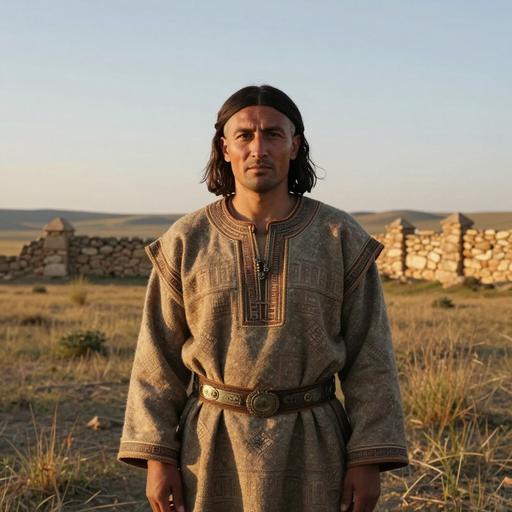
Portrait reconstruction of I3977
Ancient Individual

A man buried in Kazakhstan in the Late Bronze Age era

I3977
1190 BCE - 999 BCE
Male
Late Bronze Zevakinskiy
Kazakhstan
Scroll to begin
Chapter I

Identity

The biological and cultural markers that define this ancient individual

Sample ID

I3977

Date Range

1190 BCE - 999 BCE

Biological Sex

Male

mtDNA Haplogroup

U5b2b

Y-DNA Haplogroup

R-M478

Cultural Period

Late Bronze Zevakinskiy

Chapter II

Place

Where this individual was discovered

Country Kazakhstan
Locality Zevakinskiy stone fence
Coordinates 50.2249, 81.8368
Chapter III

Time

When this individual lived in the broader context of human history

I3977 1190 BCE - 999 BCE
Chapter IV

Story

The narrative of this ancient life

The Late Bronze Age Zevakinskiy phase of the Andronovo culture is a fascinating and complex segment of ancient Central Asian history. This era, which took place approximately from the 15th to the 9th centuries BCE, is a key period within the broader Andronovo cultural horizon, which is notable for its influence across a vast expanse of Eurasia, extending through parts of present-day Kazakhstan, Russia, and into the steppes of Central Asia.

  1. Geographical Context:

    • The Zevakinskiy phase is primarily associated with territories in what is now northeastern Kazakhstan. This region is characterized by its vast steppes, river valleys, and proximity to the forest-steppe belt, which provided a diverse ecology suitable for pastoralism, agriculture, and metallurgy.
  2. Cultural Characteristics:

    • The Andronovo culture is often identified by its distinctive pottery styles, which include geometrically incised or stamped designs. The Zevakinskiy phase witnessed the evolution of these ceramics, presenting a more refined and complex aesthetic.
    • Settlements from this period were typically small and semi-permanent, comprising circular or oval dwellings that were constructed with timber and earth. These structures reflect a semi-sedentary lifestyle that balanced between agriculture and nomadic pastoralism.
    • Burial practices during the Zevakinskiy phase are notable for their kurgan (burial mounds) systems. These included intricate grave goods, such as bronze tools, weapons, and ornaments, which indicate a stratified society with emerging social hierarchies.
  3. Economy and Subsistence:

    • The economy of the Zevakinskiy phase largely centered around a mixed subsistence strategy. Communities engaged in both agriculture — cultivating crops like wheat and barley — and animal husbandry, primarily herding cattle, sheep, and horses. The domestication and importance of the horse played a crucial role in mobility, warfare, and trade.
    • Metallurgy advanced significantly during this period, with bronze becoming a dominant material for tools and weapons. This advancement underscores the technological prowess of the Zevakinskiy people and their role in regional trade networks, where they exchanged metal goods and raw materials.
  4. Social Structure:

    • The social organization of Zevakinskiy communities is inferred to have been clan-based, with evidence suggesting a patriarchal framework. The presence of elaborate grave goods and the construction of substantial kurgans imply a degree of wealth differentiation and social stratification.
    • Ritual and religious elements are gleaned from both burial practices and the presence of ritual hearths and altars within residential sites. These indicate complex spiritual beliefs potentially centered around polytheism and ancestor worship.
  5. Interactions and Influence:

    • The Zevakinskiy phase is instrumental in understanding the diffusion of Indo-European languages, with the Andronovo culture often linked to early Indo-Iranian-speaking populations. This era reflects significant cultural interactions and exchanges across Eurasia, influencing and being influenced by neighboring cultures such as the Bactria-Margiana Archaeological Complex (BMAC) to the south.
    • Trade routes established during this period facilitated the exchange of ideas, goods, and technologies, setting the groundwork for the later Silk Road connections.

In summary, the Late Bronze Age Zevakinskiy phase of the Andronovo culture represents a crucial period of societal development characterized by advanced metallurgy, complex social structures, and significant intercultural interactions. Its legacy can be traced through the linguistic, technological, and cultural evolution of subsequent Central Asian and Indo-European societies.

Chapter V

Genetics

The genetic ancestry of this ancient individual

Ancient Genetic Admixture

This analysis compares the DNA profile of I3977 with ancient reference populations, showing the genetic composition in terms of prehistoric ancestral groups.

Western Steppe Pastoralists 34.8%
Ancient Asians 23.1%
European Hunter-Gatherers 22.7%
Neolithic Farmers 13.6%
Ancient Native Americans 5.8%

Modern Genetic Admixture

This analysis compares the DNA profile with present-day reference populations, showing what percentage of genetic makeup resembles modern populations from different regions.

Europe 57.1%
Eastern European 41.1%
Northwestern European 16.0%
English 11.1%
Finnish 3.5%
Scandinavian 1.5%
Asia 36.2%
Central Asian, Northern Indian & Pakistani 18.5%
Pakistan 15.1%
Central Asian 1.8%
Indian 1.6%
Northern Asian 9.2%
Siberian 9.2%
Northern West Asian 8.6%
Caucasian 8.6%
America 6.7%
America 6.7%
Native American 6.7%

Closest Modern Populations

These are the modern populations showing the closest statistical alignment to A man buried in Kazakhstan in the Late Bronze Age era, ranked by genetic distance. Lower distance values indicate closer statistical similarity.

1
Tatar Kazan
4.4191
2
Besermyan
4.8787
3
Tatar Mishar
6.2543
4
Udmurt
6.4647
5
Komi A
6.8799
6
Chuvash
7.2411
7
Tatar Lipka
7.4606
8
Russian Leshukonsky
8.5587
9
Saami Kola
8.7694
10
Tajik Tajikistan Hisor
9.6161
Chapter VI

Context

Other ancient individuals connected to this sample

Sources

References

Scientific publications and genetic data

Scientific Publication

The formation of human populations in South and Central Asia

Authors Narasimhan VM, Patterson N, Moorjani P
Abstract

By sequencing 523 ancient humans, we show that the primary source of ancestry in modern South Asians is a prehistoric genetic gradient between people related to early hunter-gatherers of Iran and Southeast Asia. After the Indus Valley Civilization's decline, its people mixed with individuals in the southeast to form one of the two main ancestral populations of South Asia, whose direct descendants live in southern India. Simultaneously, they mixed with descendants of Steppe pastoralists who, starting around 4000 years ago, spread via Central Asia to form the other main ancestral population. The Steppe ancestry in South Asia has the same profile as that in Bronze Age Eastern Europe, tracking a movement of people that affected both regions and that likely spread the distinctive features shared between Indo-Iranian and Balto-Slavic languages.

G25 Coordinates

The G25 coordinates for sample I3977 can be used for detailed admixture analysis in our G25 Studio tool.

I3977,0.10730254,0.0158279,0.04616846,0.0505056,-0.0204299,0.01142158,-0.0068288,-0.0080039,-0.01300474,-0.02484648,0.01006424,-0.00436784,0.00726192,-0.01812276,-0.0020436,-0.0090072,-0.01228356,-0.00189032,-0.01439056,-0.01524518,0.003982,0.00419816,-0.01355862,0.0091538,-0.0019401
Analyze in G25 Studio
Use code for 40% off Expires Feb 26