Menu
Store
Blog
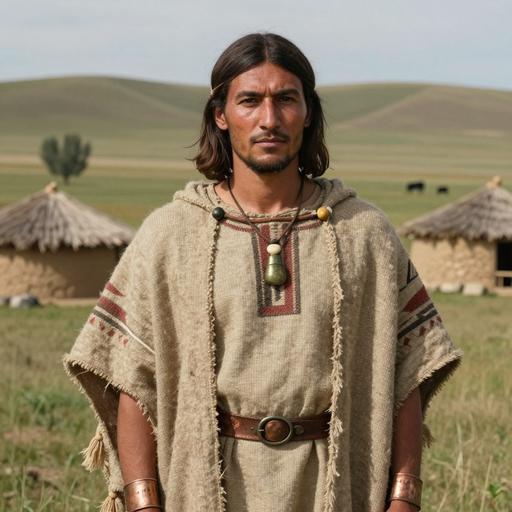
Portrait reconstruction of I4773
Ancient Individual

A man buried in Kazakhstan in the Middle Late Bronze Age era

I4773
1613 BCE - 1508 BCE
Male
Mid-Late Bronze Aktogai
Kazakhstan
Scroll to begin
Chapter I

Identity

The biological and cultural markers that define this ancient individual

Sample ID

I4773

Date Range

1613 BCE - 1508 BCE

Biological Sex

Male

mtDNA Haplogroup

U5a1a2a6

Y-DNA Haplogroup

R-YP4132

Cultural Period

Mid-Late Bronze Aktogai

Chapter II

Place

Where this individual was discovered

Country Kazakhstan
Locality Aktogai
Coordinates 46.9659, 80.0347
Chapter III

Time

When this individual lived in the broader context of human history

I4773 1613 BCE - 1508 BCE
Chapter IV

Story

The narrative of this ancient life

The Mid-Late Bronze Age Aktogai phase of the Andronovo culture, located in the vast steppes of present-day Kazakhstan, represents a significant period in the Eurasian Bronze Age, roughly spanning from 2000 to 1200 BCE. This era is characterized by its advanced metallurgy, dynamic social structures, and complex interactions with neighboring cultures across Central Asia.

Geographical Context

Kazakhstan's diverse landscape, featuring expansive steppes, mountains, and river systems, provided a conducive environment for the development of the Aktogai phase. The region's resources supported a semi-nomadic lifestyle, where communities engaged in both pastoralism and agriculture. The area around Aktogai was particularly fertile, allowing for settlement and resource exploitation.

Social Structure and Economy

The Aktogai phase is notable for its sophisticated social organization. Societies were tribal, with evidence suggesting a hierarchical structure that included chieftains and elite classes. These elites likely controlled trade, artisanal production, and resource distribution.

The economy was mixed, involving cattle, sheep, and horse herding alongside limited agriculture. The domestication of horses during this era revolutionized transportation and warfare, granting mobility and strategic advantages to these societies.

Settlement and Architecture

Settlements during the Aktogai phase were semi-permanent, reflecting the transitional nature between nomadic and settled lifestyles. They comprised timber and mud-brick structures, often arranged in circular compounds indicative of family or clan units.

Archaeological findings suggest the presence of fortified enclosures, which may have served defense purposes or as status symbols. These structures highlight a growing complexity in social organization and the need for protection against potential conflicts with rival groups or invading forces.

Metallurgy and Craftsmanship

The Aktogai phase is distinguished by its advanced metallurgy. The Andronovo people were skilled in bronze casting and metalwork, producing a variety of tools, weapons, and ornate jewelry. The presence of bronze axes, daggers, and spearheads suggests a culture proficient in both agriculture and warfare.

Artifacts such as intricate ceramic vessels and personal adornments reflect a high level of craftsmanship, as well as the cultural importance of aesthetic expression and ritualistic practices.

Cultural Practices and Beliefs

The spiritual life of the Aktogai phase included ancestor worship and belief in an afterlife, as evidenced by elaborate burial practices. Kurgans, or burial mounds, were constructed to commemorate important figures, containing grave goods that indicate the wealth and status of the deceased.

Ritual artifacts, such as ceremonial drinking vessels, imply that communal feasting and rituals were integral to social cohesion and the perpetuation of cultural traditions.

Interaction and Influence

The Aktogai phase was part of the broader Andronovo culture, which stretched across much of Central Asia. This connectivity facilitated trade and cultural exchange, as seen in the diffusion of technology, artistic motifs, and possibly language. The Aktogai people interacted with neighboring regions such as the Bactria-Margiana Archaeological Complex (BMAC) to the south and cultures in the Ural Mountains to the northwest.

Legacy

The Aktogai phase and Andronovo culture in general significantly impacted the cultural and genetic makeup of later cultures across Eurasia. The spread of Indo-Iranian languages, as well as the continued development of metalworking techniques, can trace their roots back to this pivotal era.

In summary, the Mid-Late Bronze Age Aktogai phase of the Andronovo culture in Kazakhstan was a dynamic period marked by advanced social organization, technological innovation, and cultural complexity, all of which influenced the trajectory of subsequent civilizations in the region.

Chapter V

Genetics

The genetic ancestry of this ancient individual

Ancient Genetic Admixture

This analysis compares the DNA profile of I4773 with ancient reference populations, showing the genetic composition in terms of prehistoric ancestral groups.

Western Steppe Pastoralists 39.4%
European Hunter-Gatherers 31.1%
Neolithic Farmers 24.4%
Ancient Asians 5.2%

Modern Genetic Admixture

This analysis compares the DNA profile with present-day reference populations, showing what percentage of genetic makeup resembles modern populations from different regions.

Europe 80.1%
Northwestern European 59.9%
English 24.8%
Finnish 15.8%
Scandinavian 11.3%
Northwestern European 8.0%
Eastern European 20.2%
Asia 18.9%
Northern West Asian 14.1%
Caucasian 11.7%
Cypriot 1.7%
Mesopotamian 0.7%
Central Asian, Northern Indian & Pakistani 4.8%
Indian 4.8%
America 0.8%
America 0.8%
Native American 0.8%

Closest Modern Populations

These are the modern populations showing the closest statistical alignment to A man buried in Kazakhstan in the Middle Late Bronze Age era, ranked by genetic distance. Lower distance values indicate closer statistical similarity.

1
Moksha
4.7096
2
Mordovian
5.0371
3
Finnish Southwest
5.0433
4
Erzya
5.1270
5
Russian Kostroma
5.2570
6
Moldovan O
5.4363
7
Finnish Central
5.4489
8
Russian Ryazan
5.4852
9
Swedish
5.5062
10
Russian Krasnoborsky
5.6565
Chapter VI

Context

Other ancient individuals connected to this sample

Sources

References

Scientific publications and genetic data

Scientific Publication

The formation of human populations in South and Central Asia

Authors Narasimhan VM, Patterson N, Moorjani P
Abstract

By sequencing 523 ancient humans, we show that the primary source of ancestry in modern South Asians is a prehistoric genetic gradient between people related to early hunter-gatherers of Iran and Southeast Asia. After the Indus Valley Civilization's decline, its people mixed with individuals in the southeast to form one of the two main ancestral populations of South Asia, whose direct descendants live in southern India. Simultaneously, they mixed with descendants of Steppe pastoralists who, starting around 4000 years ago, spread via Central Asia to form the other main ancestral population. The Steppe ancestry in South Asia has the same profile as that in Bronze Age Eastern Europe, tracking a movement of people that affected both regions and that likely spread the distinctive features shared between Indo-Iranian and Balto-Slavic languages.

G25 Coordinates

The G25 coordinates for sample I4773 can be used for detailed admixture analysis in our G25 Studio tool.

I4773,0.12303642,0.09314734,0.05036866,0.05735046,0.01416478,0.0215392,0.00567048,0.00778714,-0.00632334,-0.0198438,-0.00165864,-0.00268418,0.0002287,-0.00178398,0.00740704,-0.00442238,-0.01522338,0.00225266,-0.0017818,-0.00233104,0.00055122,0.00158792,0.00039224,0.00920682,0.00282154
Analyze in G25 Studio
Use code for 40% off Expires Feb 26