Menu
Store
Blog
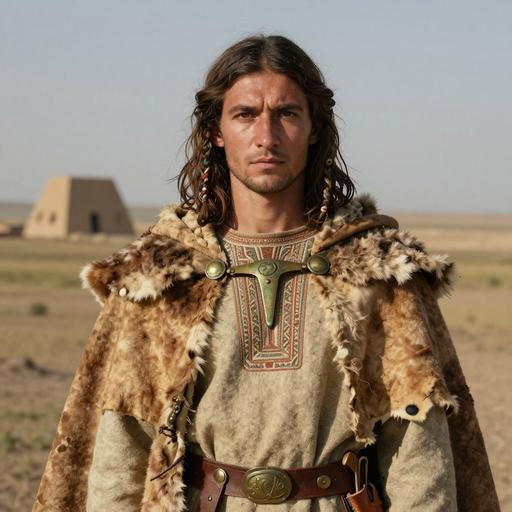
Portrait reconstruction of I4787
Ancient Individual

A man buried in Kazakhstan in the Middle Late Bronze Age era

I4787
1382 BCE - 1134 BCE
Male
Mid-Late Bronze Taldysay
Kazakhstan
Scroll to begin
Chapter I

Identity

The biological and cultural markers that define this ancient individual

Sample ID

I4787

Date Range

1382 BCE - 1134 BCE

Biological Sex

Male

mtDNA Haplogroup

H3g

Y-DNA Haplogroup

R-Z2124

Cultural Period

Mid-Late Bronze Taldysay

Chapter II

Place

Where this individual was discovered

Country Kazakhstan
Locality Aktobe. Koboda. Taldysay
Coordinates 48.2144, 67.0205
Chapter III

Time

When this individual lived in the broader context of human history

I4787 1382 BCE - 1134 BCE
Chapter IV

Story

The narrative of this ancient life

The Mid-Late Bronze Age Taldysay culture, part of the broader Andronovo cultural complex, represents a significant era in the prehistoric cultural developments of Central Asia, particularly within present-day Kazakhstan. This era, which dates approximately from 1500 to 1200 BCE, showcases a fascinating synthesis of technological, social, and cultural advancements. The Taldysay region provides key archaeological insights into the lifestyle and practices of this time.

Geographic and Environmental Context

The Taldysay culture is primarily situated in the steppes of Central Asia, a region characterized by vast grasslands and semi-arid conditions. This environment was conducive to both pastoralism and agriculture, which became the cornerstones of the economy. The presence of rivers and fertile plains also allowed for settlements to thrive and engage in varied subsistence practices.

Social Structure and Settlements

The society of the Taldysay culture was predominantly tribal, with evidence suggesting a relatively egalitarian social structure, though some distinctions based on status likely existed. Settlements typically comprised small villages that featured circular or semi-subterranean houses constructed from mud-brick or stone. The architectural designs reflect adaptiveness to climatic conditions and a focus on communal living.

Economy and Subsistence

The economy of the Taldysay people was a blend of agriculture and animal husbandry. They cultivated crops such as barley and wheat, which formed the staple diet. Animal husbandry was equally important, with cattle, sheep, and goats being raised for their meat, milk, and wool. This dual reliance on farming and pastoralism provided a stable economic base and supported population growth.

Material Culture

The Taldysay culture is renowned for its metallurgical skills, particularly in bronze-making, which is characteristic of the broader Andronovo culture. They produced weapons, tools, and ornaments from bronze, showcasing sophisticated craftsmanship. Pottery from this era is another key artifact, typically decorated with geometric patterns and exhibiting a high degree of skill and creativity.

Burial Practices and Spiritual Beliefs

Archaeological findings at Taldysay reveal elaborate burial practices indicating complex spiritual beliefs. Burials often included kurgans – large mounds that covered graves. These burial sites often contained goods such as pottery, tools, and personal ornaments, signifying beliefs in an afterlife. The presence of animal bones in graves suggests ritual significance and possibly sacrificial offerings.

Trade and Interactions

The Taldysay culture was not isolated; trade and interactions with neighboring cultures were likely. Their advanced metallurgical techniques may have been both influenced by and influential upon other cultures within the Andronovo complex and beyond. This interaction could have facilitated the exchange of goods, ideas, and technologies, enriching the cultural tapestry of the region.

Legacy and Cultural Impact

The Taldysay culture is an integral part of the Andronovo tradition, which significantly influenced the development of subsequent cultures in the region. Its legacy is observed in the diffusion of technological innovations, particularly bronze metallurgy, and social practices to other parts of Central Asia and even into parts of Eastern Europe and South Asia.

In conclusion, the Mid-Late Bronze Age Taldysay culture represents a dynamic and multifaceted period marked by technological prowess, complex social structures, and rich cultural expressions. This culture not only contributed to the historical narrative of Central Asia but also played a role in shaping the prehistoric cultural developments across a broader geographic expanse.

Chapter V

Genetics

The genetic ancestry of this ancient individual

Ancient Genetic Admixture

This analysis compares the DNA profile of I4787 with ancient reference populations, showing the genetic composition in terms of prehistoric ancestral groups.

Western Steppe Pastoralists 46.7%
European Hunter-Gatherers 31.6%
Neolithic Farmers 16.2%
Ancient Asians 5.5%

Modern Genetic Admixture

This analysis compares the DNA profile with present-day reference populations, showing what percentage of genetic makeup resembles modern populations from different regions.

Europe 77.6%
Northwestern European 49.9%
English 29.8%
Finnish 8.4%
Scandinavian 7.9%
Northwestern European 3.7%
Eastern European 27.7%
Asia 21.4%
Central Asian, Northern Indian & Pakistani 13.5%
Pakistan 13.5%
Northern West Asian 7.9%
Caucasian 7.9%
America 1.0%
America 1.0%
Native American 1.0%

Closest Modern Populations

These are the modern populations showing the closest statistical alignment to A man buried in Kazakhstan in the Middle Late Bronze Age era, ranked by genetic distance. Lower distance values indicate closer statistical similarity.

1
Moksha
5.7145
2
Mordovian
5.9339
3
Tatar Mishar
5.9407
4
Erzya
6.0532
5
Finnish Southwest
6.2580
6
Russian Kostroma
6.2707
7
Russian Krasnoborsky
6.4590
8
Finnish Central
6.5146
9
Afrikaner
6.6882
10
Moldovan O
6.7343
Chapter VI

Context

Other ancient individuals connected to this sample

Sources

References

Scientific publications and genetic data

Scientific Publication

The formation of human populations in South and Central Asia

Authors Narasimhan VM, Patterson N, Moorjani P
Abstract

By sequencing 523 ancient humans, we show that the primary source of ancestry in modern South Asians is a prehistoric genetic gradient between people related to early hunter-gatherers of Iran and Southeast Asia. After the Indus Valley Civilization's decline, its people mixed with individuals in the southeast to form one of the two main ancestral populations of South Asia, whose direct descendants live in southern India. Simultaneously, they mixed with descendants of Steppe pastoralists who, starting around 4000 years ago, spread via Central Asia to form the other main ancestral population. The Steppe ancestry in South Asia has the same profile as that in Bronze Age Eastern Europe, tracking a movement of people that affected both regions and that likely spread the distinctive features shared between Indo-Iranian and Balto-Slavic languages.

G25 Coordinates

The G25 coordinates for sample I4787 can be used for detailed admixture analysis in our G25 Studio tool.

I4787,0.1193275,0.08230746,0.04686232,0.05122016,0.00985342,0.0179625,0.00532848,0.00843024,-0.00590276,-0.0166409,0.00130958,-0.0023305,-0.00110324,-0.00773776,0.00768944,-0.00515466,-0.01689658,0.00093584,-0.00520624,-0.0083223,-0.0008312,0.00464926,-0.00684968,0.01077422,-0.00067701
Analyze in G25 Studio
Use code for 40% off Expires Feb 26