Menu
Store
Blog
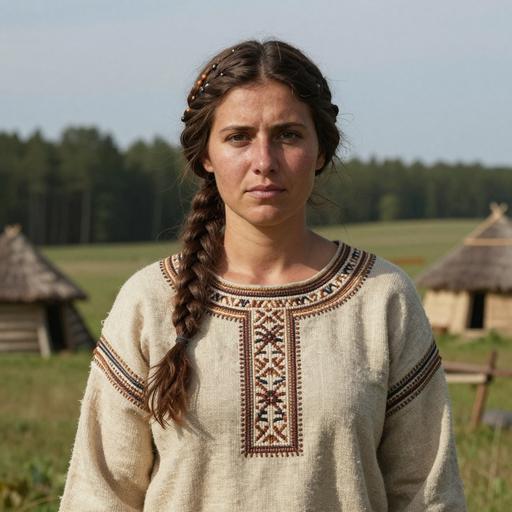
Portrait reconstruction of I6048
Ancient Individual

A woman buried in Russia in the Middle Late Bronze Age era

I6048
1732 BCE - 1542 BCE
Female
Mid-Late Bronze Priobrazhenka
Russia
Scroll to begin
Chapter I

Identity

The biological and cultural markers that define this ancient individual

Sample ID

I6048

Date Range

1732 BCE - 1542 BCE

Biological Sex

Female

mtDNA Haplogroup

H2a2a

Cultural Period

Mid-Late Bronze Priobrazhenka

Chapter II

Place

Where this individual was discovered

Country Russia
Locality Priobrazhenka 3
Coordinates 55.5100, 77.0500
Chapter III

Time

When this individual lived in the broader context of human history

I6048 1732 BCE - 1542 BCE
Chapter IV

Story

The narrative of this ancient life

The Mid-Late Bronze Age Priobrazhenka culture is a fascinating archaeological and historical phenomenon situated within the broader context of the Eurasian Steppe. This time period, approximately spanning from 2000 to 1200 BCE, is characterized by the dynamic interplay of emerging cultural identities, technological advancements, and complex social structures.

Geographical Context

The Priobrazhenka culture occupied the expansive and diverse terrain of the Eurasian Steppe, a vast stretch of grassland running from Eastern Europe through Central Asia. This geography facilitated trade, migration, and cultural exchanges between different societies. The steppe was not only a corridor for movement but also a challenging environment that dictated the lifestyle and survival strategies of its inhabitants.

Material Culture and Technology

Bronze metallurgy marks a significant technological development in this era. The Priobrazhenka culture is notable for its mastery in bronze tool and weapon production, including items such as spears, axes, and ornaments. These metal goods were likely central to both daily life and trade. Pottery from this period demonstrates sophisticated techniques and diverse styles, often serving as cultural markers that differentiate the Priobrazhenka from neighboring cultures.

Economy and Subsistence

Economically, the Priobrazhenka culture reflected a mixed system heavily dependent on pastoralism but also incorporating elements of agriculture. The domestication of horses played a crucial role, enabling more effective herding and enhancing mobility across the steppe. This mobility allowed for a seminomadic lifestyle, which was crucial for managing herds and accessing different grazing areas.

Social Organization

Socially, the Mid-Late Bronze Age steppe cultures were organized into complex tribal structures. There is evidence suggesting a stratified society, possibly led by warrior elites who controlled trade routes and resources. Burials from this period often include intricate grave goods, suggesting a level of wealth accumulation and social differentiation. The presence of kurgans, or burial mounds, is a testament to the society’s hierarchical nature and possibly ancestor worship or hero cults.

Cultural Interactions

The Priobrazhenka culture engaged in extensive interactions with neighboring cultures through trade and conflict. Evidence suggests contact with the Andronovo and Srubnaya cultures, among others, leading to shared technologies and cultural traits. These interactions were facilitated by the steppe’s role as a natural trade route, a fact that also contributed to the movement of ideas, language, and possibly genetics.

Religion and Beliefs

Religious practices and beliefs during the Mid-Late Bronze Age are inferred from burial practices and artifacts. The Priobrazhenka people likely held animistic and shamanistic beliefs, common in steppe cultures. The construction of kurgans indicates a belief in an afterlife, with burial goods serving as provisions or status symbols for the deceased in the next world.

Art and Symbolism

Art from the Priobrazhenka culture, though less well-documented than other aspects, reflects symbolic motifs possibly related to religion, identity, and power. These artifacts include decorated pottery, metalwork, and textiles, often displaying geometric patterns or stylized animal figures.

Legacy

The legacy of the Priobrazhenka culture is part of the broader tapestry of Eurasian history, contributing to the ethnogenesis of later groups in the region. The movement and interactions of these Bronze Age peoples set the stage for the subsequent Iron Age cultures and the eventual rise of more centralized political entities on the steppe.

In summary, the Mid-Late Bronze Age Priobrazhenka culture represents a dynamic interplay of technological advancement, social complexity, and cultural interaction within the challenging environment of the Eurasian Steppe. This period is a crucial chapter in understanding the formation of early Eurasian societies and their lasting impact on the history of the region.

Chapter V

Genetics

The genetic ancestry of this ancient individual

Ancient Genetic Admixture

This analysis compares the DNA profile of I6048 with ancient reference populations, showing the genetic composition in terms of prehistoric ancestral groups.

Western Steppe Pastoralists 33.5%
European Hunter-Gatherers 29.6%
Neolithic Farmers 26.2%
Ancient Native Americans 5.5%
Ancient Asians 5.3%

Modern Genetic Admixture

This analysis compares the DNA profile with present-day reference populations, showing what percentage of genetic makeup resembles modern populations from different regions.

Europe 90.7%
Northwestern European 75.4%
English 68.7%
Northwestern European 6.7%
Eastern European 15.3%
America 4.6%
America 4.6%
Native American 4.6%
Asia 2.9%
Central Asian, Northern Indian & Pakistani 2.9%
Pakistan 2.9%
Africa 1.8%
West African 1.8%
Senegambian & Guinean 1.8%

Closest Modern Populations

These are the modern populations showing the closest statistical alignment to A woman buried in Russia in the Middle Late Bronze Age era, ranked by genetic distance. Lower distance values indicate closer statistical similarity.

1
Mordovian
4.7660
2
Moksha
4.8273
3
Erzya
4.8672
4
Russian Kostroma
5.0639
5
Russian Krasnoborsky
5.1640
6
Finnish Central
5.4366
7
Ingrian
5.5048
8
Finnish Southwest
5.6843
9
Karelian
5.7367
10
Finnish Southeast
5.7516
Chapter VI

Context

Other ancient individuals connected to this sample

Sources

References

Scientific publications and genetic data

Scientific Publication

The formation of human populations in South and Central Asia

Authors Narasimhan VM, Patterson N, Moorjani P
Abstract

By sequencing 523 ancient humans, we show that the primary source of ancestry in modern South Asians is a prehistoric genetic gradient between people related to early hunter-gatherers of Iran and Southeast Asia. After the Indus Valley Civilization's decline, its people mixed with individuals in the southeast to form one of the two main ancestral populations of South Asia, whose direct descendants live in southern India. Simultaneously, they mixed with descendants of Steppe pastoralists who, starting around 4000 years ago, spread via Central Asia to form the other main ancestral population. The Steppe ancestry in South Asia has the same profile as that in Bronze Age Eastern Europe, tracking a movement of people that affected both regions and that likely spread the distinctive features shared between Indo-Iranian and Balto-Slavic languages.

G25 Coordinates

The G25 coordinates for sample I6048 can be used for detailed admixture analysis in our G25 Studio tool.

I6048,0.12195668,0.0774921,0.06684122,0.06609254,0.02137328,0.0116763,-0.01438972,-0.01518716,-0.00620632,-0.02193232,-0.00456338,-0.00383198,0.00541394,0.0085888,0.00195382,-0.0018808,-0.00298714,0.00129724,0.00113074,0.00283584,-0.00057086,0.00113812,-3.344E-05,0.00784004,-0.00200046
Analyze in G25 Studio
Use code for 40% off Expires Feb 26