Menu
Store
Blog
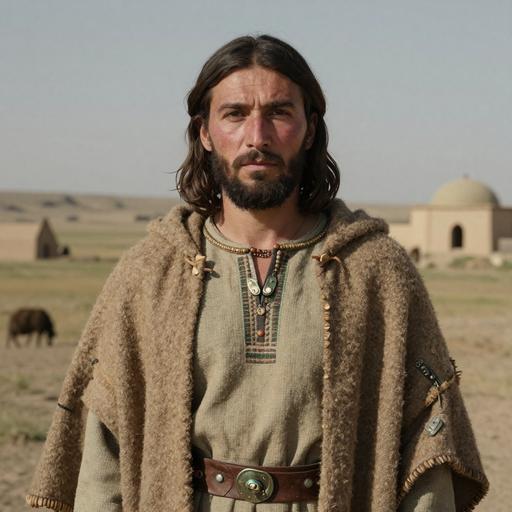
Portrait reconstruction of I6799
Ancient Individual

A man buried in Kazakhstan in the Middle Late Bronze Age era

I6799
1876 BCE - 1687 BCE
Male
Mid-Late Bronze Alakul Satan
Kazakhstan
Scroll to begin
Chapter I

Identity

The biological and cultural markers that define this ancient individual

Sample ID

I6799

Date Range

1876 BCE - 1687 BCE

Biological Sex

Male

mtDNA Haplogroup

T1a1

Y-DNA Haplogroup

R-Z2123

Cultural Period

Mid-Late Bronze Alakul Satan

Chapter II

Place

Where this individual was discovered

Country Kazakhstan
Locality Satan
Coordinates 49.1200, 75.8100
Chapter III

Time

When this individual lived in the broader context of human history

I6799 1876 BCE - 1687 BCE
Chapter IV

Story

The narrative of this ancient life

The Mid-Late Bronze Alakul Satan period is a fascinating and integral component of the broader Andronovo culture, which flourished across the Eurasian Steppe during the Bronze Age, particularly from around 1800 to 1400 BCE. This culture is notable for its significant contributions to the development of metallurgy, pastoralism, and its complex social structures. The Alakul Satan, a phase within the Andronovo culture, provides profound insights into the Bronze Age societies that existed in what is now Kazakhstan and parts of western Siberia.

Geographic and Environmental Context

The Alakul Satan period is primarily associated with regions in present-day northern and central Kazakhstan, extending into western Siberia. This area is characterized by vast steppes, semi-arid plains, and river valleys that provided rich pastures for livestock, as well as resources necessary for agriculture. The environment played a crucial role in shaping the economic and social structures of the Alakul Satan societies.

Economic Activities

Pastoralism and Agriculture: The people of the Alakul Satan period practiced a mixed economy with a strong emphasis on pastoralism. Herding of cattle, sheep, and horses formed the backbone of their subsistence strategy. Evidence suggests they practiced transhumance, moving herds between seasonal pastures. Agriculture complemented pastoral activities, with barley and millet being the primary crops cultivated.

Metallurgy: The Alakul Satan culture is renowned for advancements in metallurgy. They were skilled metalworkers, producing tools, weapons, and ornaments from bronze. The availability of tin and copper in the region facilitated the production and innovation in bronze technology.

Social Structure

The social organization during the Alakul Satan period was relatively complex. Archaeological evidence, including the structure of settlements and burial sites, suggests a stratified society with emerging social hierarchies.

Settlement Patterns: Villages during this period were semi-permanent, with evidence of mud-brick or wooden structures. Settlements were often strategically located near water sources for both human consumption and livestock needs, and their layout suggests coordinated planning.

Burial Practices: The Alakul Satan people practiced elaborate burial customs, which provide insights into their social structures and beliefs. Cemeteries contained kurgans, or burial mounds, with individual burials often accompanied by rich grave goods, including pottery, weapons, and jewelry, indicating a differentiation in social status.

Cultural and Artistic Expression

The artistic and cultural expressions of the Alakul Satan period are primarily discerned through their pottery and metalworks. Pottery from this era is characterized by well-crafted forms and intricate geometric patterns. These artifacts not only served utilitarian purposes but also held cultural significance.

Art and Ornamentation: Bronze ornaments and weaponry reflect a high degree of craftsmanship and aesthetic emphasis. These artifacts often featured motifs and designs indicative of the cultural values and symbolic beliefs of the time.

Interactions and Influence

The Alakul Satan phase was part of a broader network of cultural interactions across the Eurasian continent. This period saw increasing contacts with neighboring cultures, facilitated by trade and migration, which resulted in the exchange of technological innovations and cultural practices.

Cultural Exchange: Through trade routes, such as the early Silk Road corridors, the Alakul Satan culture connected with other regions. Evidence of imported materials and styles in artifacts signifies these interactions.

Influence on Successive Cultures: The technological and cultural advances of the Alakul Satan period laid the groundwork for subsequent societies in the region. Their developments in metallurgy and social organization notably influenced the later cultures in Central Asia.

Conclusion

The Mid-Late Bronze Alakul Satan period offers valuable insights into the complexity and adaptability of Bronze Age societies in the Eurasian steppe. Through their innovations in metallurgy, pastoral and agricultural strategies, and social organization, the Alakul Satan people played a crucial role in the history of Central Asian cultures and left a lasting legacy that continued to shape the region in the centuries to follow.

Chapter V

Genetics

The genetic ancestry of this ancient individual

Ancient Genetic Admixture

This analysis compares the DNA profile of I6799 with ancient reference populations, showing the genetic composition in terms of prehistoric ancestral groups.

Western Steppe Pastoralists 46.0%
European Hunter-Gatherers 28.3%
Neolithic Farmers 19.0%
Ancient Asians 6.7%

Modern Genetic Admixture

This analysis compares the DNA profile with present-day reference populations, showing what percentage of genetic makeup resembles modern populations from different regions.

Europe 89.1%
Northwestern European 55.2%
English 35.5%
Finnish 12.8%
Scandinavian 5.0%
Northwestern European 1.9%
Eastern European 33.9%
Asia 7.5%
Northern West Asian 7.5%
Caucasian 7.5%
America 2.6%
America 2.6%
Native American 2.6%
Africa 0.8%

Closest Modern Populations

These are the modern populations showing the closest statistical alignment to A man buried in Kazakhstan in the Middle Late Bronze Age era, ranked by genetic distance. Lower distance values indicate closer statistical similarity.

1
Moksha
3.9548
2
Mordovian
4.0546
3
Russian Kostroma
4.1003
4
Erzya
4.2065
5
Finnish Southwest
4.3176
6
Russian Krasnoborsky
4.3500
7
Finnish Central
4.5993
8
Finnish North
4.6837
9
Ingrian
4.9307
10
Karelian
5.1801
Chapter VI

Context

Other ancient individuals connected to this sample

Sources

References

Scientific publications and genetic data

Scientific Publication

The formation of human populations in South and Central Asia

Authors Narasimhan VM, Patterson N, Moorjani P
Abstract

By sequencing 523 ancient humans, we show that the primary source of ancestry in modern South Asians is a prehistoric genetic gradient between people related to early hunter-gatherers of Iran and Southeast Asia. After the Indus Valley Civilization's decline, its people mixed with individuals in the southeast to form one of the two main ancestral populations of South Asia, whose direct descendants live in southern India. Simultaneously, they mixed with descendants of Steppe pastoralists who, starting around 4000 years ago, spread via Central Asia to form the other main ancestral population. The Steppe ancestry in South Asia has the same profile as that in Bronze Age Eastern Europe, tracking a movement of people that affected both regions and that likely spread the distinctive features shared between Indo-Iranian and Balto-Slavic languages.

G25 Coordinates

The G25 coordinates for sample I6799 can be used for detailed admixture analysis in our G25 Studio tool.

I6799,0.12514918,0.08042458,0.0654789,0.06010388,0.01776744,0.01526636,0.00534652,0.00336616,-0.00648888,-0.021033,0.0019934,-0.00305856,0.00589532,0.00123772,0.00364692,-0.01281608,-0.01499974,-0.00020148,-0.00469006,-0.00454754,-0.00201972,0.0029414,-0.00479116,0.00410792,-0.00457741
Analyze in G25 Studio
Use code for 40% off Expires Feb 26