Menu
Currency
Main
Store
Blog

Loading Report

Preparing your ancestry journey

Connecting to ancient matches...

Preparing your report

Skip to main content
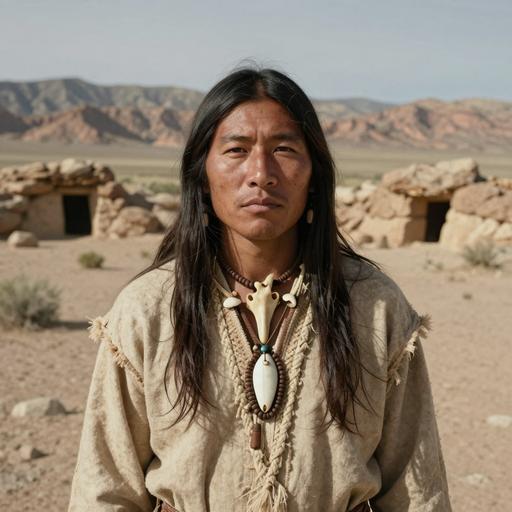
Portrait reconstruction of A man buried in USA in the Ancient North America era
Ancient Individual

A man buried in USA in the Ancient North America era

A man buried in USA during the Spirit Cave, Nevada, USA 11,000 Years Ago

A fragment of the ancient world, preserved across millennia in strands of DNA.

AHUR_2064
9229 BCE - 8816 BCE
Male
USA
Scroll to begin
Chapter I

Identity

The biological and cultural markers that define this ancient individual

Sample ID

AHUR_2064

Date Range

9229 BCE - 8816 BCE

Cultural Period

Spirit Cave, Nevada, USA 11,000 Years Ago

Biological Sex

Male

mtDNA Haplogroup

D1

Y-DNA Haplogroup

Q-M902

Social Role

Hunter (AI estimate, era-typical)

Chapter II

Place

Where this individual was discovered

Country USA
Locality Nevada. Spirit Cave
Chapter III

Time

When this individual lived in the broader context of human history

AHUR_2064 9229 BCE - 8816 BCE
Chapter IV

Story

The narrative of this ancient life

The Spirit Cave in Nevada, dated to approximately 11,000 years ago, offers a fascinating glimpse into the Paleo-Indian era and the lifestyles of the ancient inhabitants of North America. This period, generally characterized by hunter-gatherer societies, reveals much about the adaptation and survival strategies employed at the end of the Pleistocene epoch, when the last glacial period was receding and establishing the foundation for modern ecosystems.

Environmental Context

Around 11,000 years ago, the environment in what is now Nevada was significantly different from today. The end of the Ice Age was marked by a gradual warming trend, which led to the retreat of ice sheets and subsequent changes in flora and fauna. The Great Basin region, which includes the Spirit Cave, was characterized by a cooler and more humid climate than the arid conditions experienced today. This environment supported a diverse ecosystem that attracted both humans and wildlife.

The People

The inhabitants of the Spirit Cave were likely part of what is broadly termed the Paleo-Indians, among the earliest known peoples to occupy North America. These groups were highly mobile, with their movements often dictated by the availability of resources such as water, food, and materials for tool-making.

Subsistence and Tools

Spirit Cave dwellers relied heavily on hunting and gathering for subsistence. They hunted large game, such as now-extinct mammoths, mastodons, and ancient species of bison. Additionally, smaller game and a variety of plant materials likely supplemented their diet. Archaeological evidence suggests they used a range of tools made from stone, bone, and wood. These might include spear points, knives, scrapers, and sewing implements.

Social Structure and Living Arrangements

While specific details about the social structure of the Spirit Cave people remain elusive, it is reasonable to infer that their society was organized around familial or communal groups. These groups would have cooperated in hunting, gathering, and other survival activities. Shelters were likely temporary, constructed to provide protection against the elements but easily dismantled or abandoned as groups moved in search of new resources.

Cultural Practices and Artifacts

The artifacts discovered in Spirit Cave provide invaluable insights into the culture and daily life of these early inhabitants. The famous \Spirit Cave Mummy," for example, was found with intricately woven mats and textiles that showcase sophisticated techniques in weaving, indicating a level of craftsmanship and possibly social organization that allowed for the specialization of tasks. Other personal items found at the site, like moccasins and baskets, hint at a rich cultural life with attention to comfort and practicality.

Conclusion

In summary, the Spirit Cave and its Paleo-Indian inhabitants reflect a critical moment in the prehistory of North America—a time of environmental transition and human adaptation. The archaeological findings provide clear evidence of a people who mastered their challenging surroundings through ingenuity and cooperation, leaving behind a legacy that continues to intrigue and inform our understanding of human history. These early residents of Nevada were not only survivors of a changing world but were also innovators in their use of technology, social systems, and resource management."

Context

Related Samples

This individual exists within a broader network of ancient samples. No ancient genome stands alone.

Sample ID Culture/Period Date Location Action
Lovelock3 Lovelock Cave, Nevada, USA 600 Years Ago 1270 CE Lovelock Cave. Nevada. US, USA View
AHUR_2064 Spirit Cave, Nevada, USA 11,000 Years Ago 9229 BCE Nevada. Spirit Cave, USA View
Lovelock2 Lovelock Cave, Nevada, USA 1,850 Years Ago 26 CE Lovelock Cave. Nevada. US, USA View
Lovelock1 Lovelock Cave, Nevada, USA 1,850 Years Ago 49 BCE Lovelock Cave. Nevada. US, USA View
Lovelock4 Lovelock Cave, Nevada, USA 1,850 Years Ago 126 CE Lovelock Cave. Nevada. US, USA View
TrailCreek Trail Creek, Alaska, USA 9,000 Years Ago 7181 BCE Alaska. Trail Creek, USA View
AHUR770c Spirit Cave, Nevada, USA 11,000 Years Ago 9252 BCE Nevada. Spirit Cave, USA View
Andaman Great Andaman People 100BP 1800 CE Great Andaman Island, India View
A460 Western Archipelago Ayayema Culture, Chile 5,100 Years Ago 3364 BCE Ayayema Cave. Patagonia, Chile View
SA5832 Punta Santa Ana Site, Chile 7,300 Years Ago 5634 BCE Punta Santa Ana. Patagonia. Chile, Chile View
19651 Big Bar Site, Canada 5,700 Years Ago 3796 BCE Northwest, Canada View
Sumidouro5 Sumidouro Site, Brazil 10,100 Years Ago 8612 BCE Caverna do Sumidouro. Lagoa Santa. Brazil, Brazil View
Sumidouro6 Sumidouro Site, Brazil 10,100 Years Ago 8293 BCE Caverna do Sumidouro. Lagoa Santa. Brazil, Brazil View
Sumidouro4 Sumidouro Site, Brazil 10,100 Years Ago 8300 BCE Caverna do Sumidouro. Lagoa Santa. Brazil, Brazil View
Sumidouro7 Sumidouro Site, Brazil 10,100 Years Ago 8422 BCE Caverna do Sumidouro. Lagoa Santa. Brazil, Brazil View
Sumidouro8 Sumidouro Site, Brazil 10,100 Years Ago 8172 BCE Caverna do Sumidouro. Lagoa Santa. Brazil, Brazil View
Aconcagua Aconcagua Inca Culture 500 Years Ago 1400 CE Cerro Aconcagua. Mendoza Province, Argentina View
19651 3796 BCE Northwest, Canada View
SA5832 5634 BCE Punta Santa Ana. Patagonia. Chile, Chile View
A460 3364 BCE Ayayema Cave. Patagonia, Chile View
Aconcagua 1400 CE Cerro Aconcagua. Mendoza Province, Argentina View
AHUR_2064 9229 BCE Nevada. Spirit Cave, USA View
AHUR770c 9252 BCE Nevada. Spirit Cave, USA View
Andaman 1800 CE Great Andaman Island, India View
Lovelock1 49 BCE Lovelock Cave. Nevada. US, USA View
Lovelock2 26 CE Lovelock Cave. Nevada. US, USA View
Lovelock3 1270 CE Lovelock Cave. Nevada. US, USA View
Lovelock4 126 CE Lovelock Cave. Nevada. US, USA View
Sumidouro4 8300 BCE Caverna do Sumidouro. Lagoa Santa. Brazil, Brazil View
Sumidouro5 8612 BCE Caverna do Sumidouro. Lagoa Santa. Brazil, Brazil View
Sumidouro6 8293 BCE Caverna do Sumidouro. Lagoa Santa. Brazil, Brazil View
Sumidouro7 8422 BCE Caverna do Sumidouro. Lagoa Santa. Brazil, Brazil View
Sumidouro8 8172 BCE Caverna do Sumidouro. Lagoa Santa. Brazil, Brazil View
TrailCreek 7181 BCE Alaska. Trail Creek, USA View
Sample ID Culture/Period Date Location Action
AHUR_2064 Spirit Cave, Nevada, USA 11,000 Years Ago 9229 BCE Nevada. Spirit Cave, USA View
AHUR770c Spirit Cave, Nevada, USA 11,000 Years Ago 9252 BCE Nevada. Spirit Cave, USA View
Sources

References

Scientific publications and genetic data that inform this profile.

Scientific Publication

Early human dispersals within the Americas

Authors Moreno-Mayar JV, Vinner L, de Barros Damgaard P, de la Fuente C, Chan J et al.
Abstract

Studies of the peopling of the Americas have focused on the timing and number of initial migrations. Less attention has been paid to the subsequent spread of people within the Americas. We sequenced 15 ancient human genomes spanning from Alaska to Patagonia; six are ≥10,000 years old (up to ~18× coverage). All are most closely related to Native Americans, including those from an Ancient Beringian individual and two morphologically distinct "Paleoamericans." We found evidence of rapid dispersal and early diversification that included previously unknown groups as people moved south. This resulted in multiple independent, geographically uneven migrations, including one that provides clues of a Late Pleistocene Australasian genetic signal, as well as a later Mesoamerican-related expansion. These led to complex and dynamic population histories from North to South America.

Use code for 20% off Expires Jul 22