Menu
Currency
Main
Store
Blog

Loading Report

Preparing your ancestry journey

Connecting to ancient matches...

Preparing your report

Skip to main content
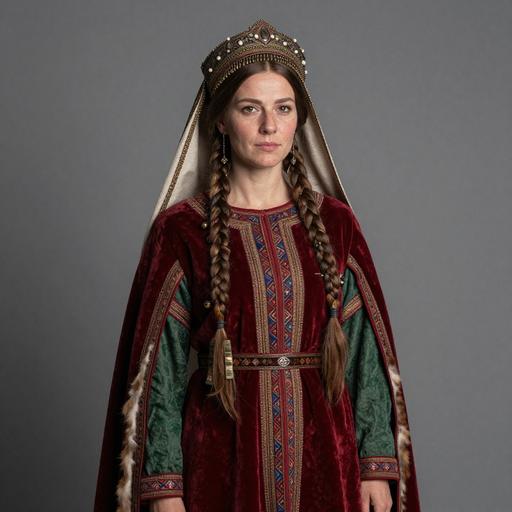
Portrait reconstruction of A woman buried in Russia in the Medieval era
Ancient Individual

A woman buried in Russia in the Medieval era

A woman buried in Russia during the Medieval Rus' (Kideksha)

A fragment of the ancient world, preserved across millennia in strands of DNA.

KED004
1400 CE - 1431 CE
Female
Russia
Scroll to begin
Chapter I

Identity

The biological and cultural markers that define this ancient individual

Sample ID

KED004

Date Range

1400 CE - 1431 CE

Cultural Period

Medieval Rus' (Kideksha)

Biological Sex

Female

mtDNA Haplogroup

Not available

Y-DNA Haplogroup

N/A (Female)

Chapter II

Place

Where this individual was discovered

Country Russia
Locality Kideksha (Vladimir Oblast, Suzdalsky District)
Coordinates 56.4429, 40.3847
Chapter III

Time

When this individual lived in the broader context of human history

KED004 1400 CE - 1431 CE
Chapter IV

Story

The narrative of this ancient life

Medieval Rus', particularly during the period when Kideksha was prominent, is a fascinating era that showcases the intricate tapestry of early Russian statehood, culture, and religious life. Kideksha, a historical settlement located near modern-day Suzdal in Russia, stands as an emblem of this era around the 12th century, reflecting the unique blend of influences that characterized Rus' society.

Historical Context

Kievan Rus', a loose federation of Slavic and Finno-Ugric peoples under the rule of the Varangians, reached its zenith before fragmenting into a number of smaller principalities. Kideksha is geographically situated in the Vladimir-Suzdal Principality, which emerged as a powerful and influential region during the decline of Kievan central power. Prince Yuri Dolgorukiy, notable for founding Moscow, constructed a church in Kideksha dedicated to Saints Boris and Gleb in 1152, signaling the area's importance.

Architecture and Art

Kideksha's architectural splendor is epitomized by the Church of Saints Boris and Gleb. This church is one of the earliest examples of white-stone architecture that would later dominate Russian ecclesiastical architecture. The transition from wooden to stone edifices marks technological and cultural advancements, emphasizing a desire for permanence and divine representation. The intricate stone carvings and frescoes within such structures reflect both Byzantine influences and native iconographic traditions, creating a distinctive Rus' aesthetic.

Religion

Religion in Medieval Rus' was a central aspect of life, heavily influenced by the Christianization of the region in the late 10th century under Prince Vladimir the Great. The adoption of Orthodox Christianity not only unified various Slavic tribes but also aligned Rus' more closely with Byzantium, culturally and politically. The Church of Saints Boris and Gleb in Kideksha underscores the importance of princely patronage in religious and cultural life, with saints Boris and Gleb themselves representing a paradigm of princely martyrdom and Christian virtue.

Society and Economy

Medieval Rus' society was predominantly agrarian, with the economy relying heavily on agriculture, including crop farming and animal husbandry. Kideksha, like other towns of its time, would have participated in local and long-distance trade networks, exchanging goods like furs, wax, honey, and through connections to the Silk Road, acquiring silk, spices, and other luxury items.

Social hierarchy was distinctly stratified, with boyars and princes at the top, followed by merchants, artisans, and peasants. This stratification was often reflected in settlement patterns, where fortified towns housed the elites, and surrounding lands were occupied by peasant communities.

Culture and Daily Life

Culturally, Medieval Rus' was a vibrant tapestry woven from Slavic, Norse, and Byzantine threads. Oral literature flourished in the forms of epic poetry (byliny) and folktales, indicative of both pagan and Christian traditions. Art, music, and dance were integral to community life, with festivities often aligning with both Christian holy days and remnants of pre-Christian customs.

Daily life in Kideksha, as in other towns, would have revolved around the agricultural calendar, religious observances, and the princely court's functions. Clothing styles reflected social status and were influenced by both native tradition and international trade, with wealthier individuals accessing dyes and materials like silk and brocade.

Conclusion

Kideksha during the Medieval Rus' period served as a microcosm of the broader cultural and political shifts occurring in Eastern Europe at the time. The combination of local traditions with external influences forged a unique identity that laid the foundations for the later Russian state. As a historical site, Kideksha today provides invaluable insights into the architectural, religious, and societal norms that defined an era of transition and cultural blossoming in Rus'.

Context

Related Samples

This individual exists within a broader network of ancient samples. No ancient genome stands alone.

Sample ID Culture/Period Date Location Action
BOL001_antiquity1240k Davydovskoye Archaeological Culture 239 CE Bolshoye-Davydovskoye-2 (Ivanovo Oblast, Gavrilovo-Posadsky District, Bolshoye Davydovskoye Village), Russia View
BOL002_antiquity1240k Davydovskoye Archaeological Culture 130 CE Bolshoye-Davydovskoye-2 (Ivanovo Oblast, Gavrilovo-Posadsky District, Bolshoye Davydovskoye Village), Russia View
BOL003_antiquity1240k Davydovskoye Archaeological Culture 237 CE Bolshoye-Davydovskoye-2 (Ivanovo Oblast, Gavrilovo-Posadsky District, Bolshoye Davydovskoye Village), Russia View
BOL004 Davydovskoye Archaeological Culture 212 CE Bolshoye-Davydovskoye-2 (Ivanovo Oblast, Gavrilovo-Posadsky District, Bolshoye Davydovskoye Village), Russia View
BOL005 Davydovskoye Archaeological Culture 130 CE Bolshoye-Davydovskoye-2 (Ivanovo Oblast, Gavrilovo-Posadsky District, Bolshoye Davydovskoye Village), Russia View
BOL006 Davydovskoye Archaeological Culture 130 CE Bolshoye-Davydovskoye-2 (Ivanovo Oblast, Gavrilovo-Posadsky District, Bolshoye Davydovskoye Village), Russia View
BOL007 Davydovskoye Archaeological Culture 261 CE Bolshoye-Davydovskoye-2 (Ivanovo Oblast, Gavrilovo-Posadsky District, Bolshoye Davydovskoye Village), Russia View
BOL008 Davydovskoye Archaeological Culture 235 CE Bolshoye-Davydovskoye-2 (Ivanovo Oblast, Gavrilovo-Posadsky District, Bolshoye Davydovskoye Village), Russia View
BOL009 Davydovskoye Archaeological Culture 240 CE Bolshoye-Davydovskoye-2 (Ivanovo Oblast, Gavrilovo-Posadsky District, Bolshoye Davydovskoye Village), Russia View
GOR001 Medieval Gorokhovets Culture 771 CE Puzhalova-gora (Vladimir Oblast, Gorokhovets municipality), Russia View
GOS001 Medieval Gorokhovets Culture 1047 CE Sretensky-monastery (Vladimir Oblast, Gorokhovetsky District), Russia View
GOS002 Medieval Gorokhovets Culture 1039 CE Sretensky-monastery (Vladimir Oblast, Gorokhovetsky District), Russia View
GOS003 Medieval Gorokhovets Culture 1021 CE Sretensky-monastery (Vladimir Oblast, Gorokhovetsky District), Russia View
KBL002 Modern Russia Kibol (1900 CE) 1665 CE Kibol-3 (Vladimir Oblast, Suzdalsky District), Russia View
KBL003 Modern Russia Kibol (1900 CE) 1645 CE Kibol-3 (Vladimir Oblast, Suzdalsky District), Russia View
KED001 Modern Russian (Kideksha) 1648 CE Kideksha (Vladimir Oblast, Suzdalsky District), Russia View
KED002 Modern Russian (Kideksha) 1661 CE Kideksha (Vladimir Oblast, Suzdalsky District), Russia View
KED003 Modern Russian (Kideksha) 1526 CE Kideksha (Vladimir Oblast, Suzdalsky District), Russia View
KED004 Medieval Rus' (Kideksha) 1400 CE Kideksha (Vladimir Oblast, Suzdalsky District), Russia View
KRS001 Medieval Krasnoe 1412 CE Krasnoe-3 (Vladimir Oblast, Suzdalsky District), Russia View
SHE001 Early Medieval Shekshovo 881 CE Shekshovo-9 (Ivanovo Oblast, Gavrilovo-Posadsky District, Sheksnovo Village), Russia View
SHE002 Early Medieval Shekshovo 993 CE Shekshovo-9 (Ivanovo Oblast, Gavrilovo-Posadsky District, Sheksnovo Village), Russia View
SHE003 Early Medieval Shekshovo 772 CE Shekshovo-9 (Ivanovo Oblast, Gavrilovo-Posadsky District, Sheksnovo Village), Russia View
SHE004 Early Medieval Shekshovo 888 CE Shekshovo-9 (Ivanovo Oblast, Gavrilovo-Posadsky District, Sheksnovo Village), Russia View
SHE005 Medieval Shekshovo Culture 992 CE Shekshovo-9 (Ivanovo Oblast, Gavrilovo-Posadsky District, Sheksnovo Village), Russia View
SHE006 Medieval Shekshovo Culture 986 CE Shekshovo-9 (Ivanovo Oblast, Gavrilovo-Posadsky District, Sheksnovo Village), Russia View
SHE007 Medieval Shekshovo Culture 1044 CE Shekshovo-9 (Ivanovo Oblast, Gavrilovo-Posadsky District, Sheksnovo Village), Russia View
SHE008 Medieval Shekshovo Culture 1303 CE Shekshovo-9 (Ivanovo Oblast, Gavrilovo-Posadsky District, Sheksnovo Village), Russia View
SHE009 Medieval Shekshovo Culture 1299 CE Shekshovo-9 (Ivanovo Oblast, Gavrilovo-Posadsky District, Sheksnovo Village), Russia View
SHK001 Medieval Shekshovo Culture 1166 CE Shekshovo-2 (Ivanovo Oblast, Gavrilovo-Posadsky District, Sheksnovo Village), Russia View
SHK002 Medieval Shekshovo Culture 1053 CE Shekshovo-2 (Ivanovo Oblast, Gavrilovo-Posadsky District, Sheksnovo Village), Russia View
Sample ID Culture/Period Date Location Action
KED004 Medieval Rus' (Kideksha) 1400 CE Kideksha (Vladimir Oblast, Suzdalsky District), Russia View
Sources

References

Scientific publications and genetic data that inform this profile.

Scientific Publication

Genetic admixture and language shift in the medieval Volga-Oka interfluve

Authors Peltola S, Majander K, Makarov N, Dobrovolskaya M, Nordqvist K et al.
Abstract

The Volga-Oka interfluve in northwestern Russia has an intriguing history of population influx and language shift during the Common Era. Today, most inhabitants of the region speak Russian, but until medieval times, northwestern Russia was inhabited by Uralic-speaking peoples.1,2,3 A gradual shift to Slavic languages started in the second half of the first millennium with the expansion of Slavic tribes, which led to the foundation of the Kievan Rus' state in the late 9th century CE. The medieval Rus' was multicultural and multilingual-historical records suggest that its northern regions comprised Slavic and Uralic peoples ruled by Scandinavian settlers.4,5,6 In the 10th-11th centuries, the introduction of Christianity and Cyrillic literature raised the prestige status of Slavic, driving a language shift from Uralic to Slavic.3 This eventually led to the disappearance of the Uralic languages from northwestern Russia. Here, we study a 1,500-year time transect of 30 ancient genomes and stable isotope values from the Suzdal region in the Volga-Oka interfluve. We describe a previously unsampled local Iron Age population and a gradual genetic turnover in the following centuries. Our time transect captures the population shift associated with the spread of Slavic languages and illustrates the ethnically mixed state of medieval Suzdal principality, eventually leading to the formation of the admixed but fully Slavic-speaking population that inhabits the area today. We also observe genetic outliers that highlight the importance of the Suzdal region in medieval times as a hub of long-reaching contacts via trade and warfare.