Menu
Currency
Main
Store
Blog

Loading Report

Preparing your ancestry journey

Connecting to ancient matches...

Preparing your report

Skip to main content
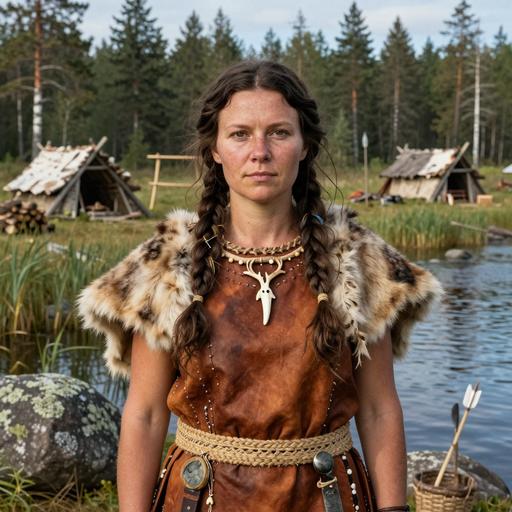
Portrait reconstruction of A woman buried in Russia in the Mesolithic era
Ancient Individual

A woman buried in Russia in the Mesolithic era

A woman buried in Russia during the Yuzhny Oleny Ostrov Culture

A fragment of the ancient world, preserved across millennia in strands of DNA.

UzOO77
5500 BCE - 5000 BCE
Female
Russia
Scroll to begin
Chapter I

Identity

The biological and cultural markers that define this ancient individual

Sample ID

UzOO77

Date Range

5500 BCE - 5000 BCE

Cultural Period

Yuzhny Oleny Ostrov Culture

Biological Sex

Female

mtDNA Haplogroup

R1b

Y-DNA Haplogroup

N/A (Female)

Chapter II

Place

Where this individual was discovered

Country Russia
Locality Yuzhny Oleniy Ostrov (Republic of Karelia, Medvezhyegorsky District, Velikaya Guba Village)
Coordinates 61.9377, 35.2609
Chapter III

Time

When this individual lived in the broader context of human history

UzOO77 5500 BCE - 5000 BCE
Chapter IV

Story

The narrative of this ancient life

The Yuzhny Oleny Ostrov culture represents a significant archaeological and historical enigma situated within the broader context of prehistoric Europe, specifically in the Pre-Baltic region. This culture dates back to the Mesolithic period, approximately 6,500 BCE to 5,500 BCE, and is primarily known through the detailed archaeological excavation of the burial ground on Yuzhny Oleny Ostrov (\Southern Deer Island") in Lake Onega in present-day northwestern Russia.

Geographic Context and Environment: The Yuzhny Oleny Ostrov culture thrived in an environment marked by post-glacial landscapes that included extensive woodlands, numerous rivers and lakes, and a cold climate transitioning towards the milder Holocene era. This geographical setting influenced their lifestyle, economy, and social structures, as the communities were nestled in a zone rich in deciduous and coniferous forests that provided ample resources for their subsistence strategies.

Subsistence and Economy: As a Mesolithic culture, the Yuzhny Oleny Ostrov people primarily relied on hunting, fishing, and gathering. Evidence suggests they hunted deer, elk, beaver, and a variety of birds, capitalizing on the abundant wildlife the forests and waterways offered. Fishing, supported by the proximity to freshwater resources, formed another pillar of their subsistence. The presence of fishhooks, nets, and other fishing implements in archaeological sites emphasizes their adeptness in exploiting aquatic resources. Plant gathering, though less documented, would have complemented their diet, including berries, nuts, and wild plants found in the forests.

Material Culture and Economy: The material culture of Yuzhny Oleny Ostrov includes a variety of stone tools, characterized by microlithic technology. These tools were fashioned from local raw materials, such as flint and quartz, and included blades, scrapers, and arrowheads, reflecting a highly skilled approach to tool-making. Additionally, evidence of bone and antler tools, such as harpoons and needles, suggest a diversified toolkit and reflect their expert craftsmanship in utilizing available natural resources.

Settlement Patterns: The settlement patterns of this culture indicate semi-permanent camps or villages strategically located near water bodies. These locations provided easy access to resources and facilitated transportation and communication. While the dwellings themselves have not survived, postholes and hearths suggest semi-subterranean structures that offered protection against the harsh climate.

Social Structure and Organization: The presence of a large burial site at Yuzhny Oleny Ostrov gives critical insights into the social and spiritual dimensions of this culture. Over 173 burials have been excavated, with rich grave goods accompanying many of the deceased. This suggests a stratified society with differential status and roles, possibly reflecting distinctions based on age, gender, or achievements. The burials also imply a belief system that valued the afterlife, with offerings that might have been made to accompany individuals into the next world.

Art and Symbolism: Artistic expressions in the Yuzhny Oleny Ostrov culture are evident in the form of personal adornments and decorations found in graves. Items such as pendants, beads, and intricately carved bone objects reflect both aesthetic sensibilities and possibly symbolic roles, serving as status symbols or spiritual talismans. Moreover, the craftsmanship and artistic presentation of these items indicate a developed cultural identity and shared values.

Spiritual and Ritual Practices: The extensive burial site, with its varying grave goods, points to complex ritual and spiritual beliefs. The inclusion of tools, ornaments, and food items in graves suggests practices oriented towards an afterlife or spiritual journey. The fact that some burials are richer than others implies a possible belief in an existence beyond death where one's earthly actions and status may have bearings.

Conclusion: The Yuzhny Oleny Ostrov culture exhibits typical features of a Mesolithic society but also reveals unique aspects shaped by its geographical setting, resource availability, and social complexities. While much about this culture remains to be discovered, especially regarding their symbolic and potentially proto-religious practices, they offer valuable insights into the transitional phases between hunter-gatherer ways of life and the advent of more settled and structured societies that would eventually lead to the Neolithic era in the region. Understanding this culture is crucial for grasping the broader prehistoric developments in the Pre-Baltic and Northern European contexts."

Context

Related Samples

This individual exists within a broader network of ancient samples. No ancient genome stands alone.

Sample ID Culture/Period Date Location Action
I0963 Hunter-Gatherer Russia 6000 BCE Archangelsk. Popovo, Russia View
Donkalnis1 Early to Middle Neolithic Narva Culture, Lithuania 5500 BCE Donkalnis, Lithuania View
Donkalnis4 Mesolithic Lithuania 5991 BCE Donkalnis, Lithuania View
Donkalnis6 Early to Middle Neolithic Narva Culture, Lithuania 4718 BCE Donkalnis, Lithuania View
Donkalnis7 Early to Middle Neolithic Narva Culture, Lithuania 5374 BCE Donkalnis, Lithuania View
Kivisaare3 Early to Middle Neolithic Narva Culture, Estonia 4776 BCE Kivisaare, Estonia View
Kivutkalns153 Bronze Age Latvia 796 BCE Kivutkalns, Latvia View
Kivutkalns164 Bronze Age Latvia 719 BCE Kivutkalns, Latvia View
Kivutkalns194 Bronze Age Latvia 407 BCE Kivutkalns, Latvia View
Kivutkalns19 Bronze Age Latvia 720 BCE Kivutkalns, Latvia View
Kivutkalns207 Bronze Age Latvia 787 BCE Kivutkalns, Latvia View
Kivutkalns209 Bronze Age Latvia 788 BCE Kivutkalns, Latvia View
Kivutkalns215 Bronze Age Latvia 758 BCE Kivutkalns, Latvia View
Kivutkalns222 Bronze Age Latvia 745 BCE Kivutkalns, Latvia View
Kivutkalns25 Bronze Age Latvia 799 BCE Kivutkalns, Latvia View
Kivutkalns42 Bronze Age Latvia 809 BCE Kivutkalns, Latvia View
Kretuonas1 Early to Middle Neolithic Narva Culture, Lithuania 4453 BCE Kretuonas 1B, Lithuania View
Kretuonas2 Early to Middle Neolithic Narva Culture, Lithuania 5500 BCE Kretuonas 1B, Lithuania View
Kretuonas4 Early to Middle Neolithic Narva Culture, Lithuania 5500 BCE Kretuonas 1B, Lithuania View
Kvarlov5164 Middle Neolithic Funnel Beaker Culture, Sweden 3945 BCE Kvärlöv. Saxtorp. Skåne, Sweden View
MotalaAA Hunter-Gatherer Motala, Sweden 5724 BCE Motala. Kanaljorden, Sweden View
Olsund_new Late Neolithic to Bronze Age Sweden 2573 BCE Ölsund. Hälsingland, Sweden View
Plinkaigalis241 Late Neolithic Lithuania 2861 BCE Plinkaigalis, Lithuania View
Plinkaigalis242 Late Neolithic Lithuania 3264 BCE Plinkaigalis, Lithuania View
Popovo2 Hunter-Gatherer Popovo, Russia 7500 BCE Popovo. Archangelsk, Russia View
Spiginas1 Early to Middle Neolithic Narva Culture, Lithuania 4442 BCE Spiginas, Lithuania View
Spiginas2 Late Neolithic Lithuania 2132 BCE Spiginas, Lithuania View
Spiginas4 Mesolithic Lithuania 6442 BCE Spiginas, Lithuania View
Tamula1 Middle Neolithic Comb Ceramic Culture 1, Estonia 3621 BCE Tamula, Estonia View
Tamula3 Middle Neolithic Comb Ceramic Culture 2, Estonia 3796 BCE Tamula, Estonia View
Turlojiske1932 Bronze Age Lithuania 1257 BCE Turlojiškė, Lithuania View
Turlojiske1 Bronze Age Lithuania 928 BCE Turlojiškė, Lithuania View
Turlojiske3 Bronze Age Lithuania 1015 BCE Turlojiškė, Lithuania View
Turlojiske5 Bronze Age Lithuania 2100 BCE Turlojiškė, Lithuania View
UzOO77_new Eastern Hunter-Gatherer, Russia 5500 BCE Yuzhnyy Oleni Ostrov. Karelia, Russia View
Veibri4 Early to Middle Neolithic Narva Culture, Estonia 4895 BCE Veibri, Estonia View
Gyvakarai1_10bp Late Neolithic Lithuania 2620 BCE Gyvakarai, Lithuania View
UzOO77 Yuzhny Oleny Ostrov Culture 5500 BCE Yuzhny Oleniy Ostrov (Republic of Karelia, Medvezhyegorsky District, Velikaya Guba Village), Russia View
Kretuonas2 5500 BCE Kretuonas 1B, Lithuania View
MA973 2575 BCE Kursi. Jõgeva, Estonia View
Gyvakarai1_10bp 2620 BCE Gyvakarai, Lithuania View
Sample ID Culture/Period Date Location Action
UzOO77 Yuzhny Oleny Ostrov Culture 5500 BCE Yuzhny Oleniy Ostrov (Republic of Karelia, Medvezhyegorsky District, Velikaya Guba Village), Russia View
UOO015 Yuzhny Oleny Ostrov Culture 6300 BCE Yuzhny Oleniy Ostrov (Republic of Karelia, Medvezhyegorsky District, Velikaya Guba Village), Russia View
UOO025 Yuzhny Oleny Ostrov Culture 6300 BCE Yuzhny Oleniy Ostrov (Republic of Karelia, Medvezhyegorsky District, Velikaya Guba Village), Russia View
UOO029 Yuzhny Oleny Ostrov Culture 6300 BCE Yuzhny Oleniy Ostrov (Republic of Karelia, Medvezhyegorsky District, Velikaya Guba Village), Russia View
UOO037 Yuzhny Oleny Ostrov Culture 6300 BCE Yuzhny Oleniy Ostrov (Republic of Karelia, Medvezhyegorsky District, Velikaya Guba Village), Russia View
UOO047 Yuzhny Oleny Ostrov Culture 6391 BCE Yuzhny Oleniy Ostrov (Republic of Karelia, Medvezhyegorsky District, Velikaya Guba Village), Russia View
UOO053 Yuzhny Oleny Ostrov Culture 6300 BCE Yuzhny Oleniy Ostrov (Republic of Karelia, Medvezhyegorsky District, Velikaya Guba Village), Russia View
UOO004 Yuzhny Oleny Ostrov Culture 6217 BCE Yuzhny Oleniy Ostrov (Republic of Karelia, Medvezhyegorsky District, Velikaya Guba Village), Russia View
UOO012 Yuzhny Oleny Ostrov Culture 6300 BCE Yuzhny Oleniy Ostrov (Republic of Karelia, Medvezhyegorsky District, Velikaya Guba Village), Russia View
UOO033 Yuzhny Oleny Ostrov Culture 6432 BCE Yuzhny Oleniy Ostrov (Republic of Karelia, Medvezhyegorsky District, Velikaya Guba Village), Russia View
UOO049 Yuzhny Oleny Ostrov Culture 6078 BCE Yuzhny Oleniy Ostrov (Republic of Karelia, Medvezhyegorsky District, Velikaya Guba Village), Russia View
UOO051 Yuzhny Oleny Ostrov Culture 6300 BCE Yuzhny Oleniy Ostrov (Republic of Karelia, Medvezhyegorsky District, Velikaya Guba Village), Russia View
UOO052 Yuzhny Oleny Ostrov Culture 6300 BCE Yuzhny Oleniy Ostrov (Republic of Karelia, Medvezhyegorsky District, Velikaya Guba Village), Russia View
UOO059 Yuzhny Oleny Ostrov Culture 6300 BCE Yuzhny Oleniy Ostrov (Republic of Karelia, Medvezhyegorsky District, Velikaya Guba Village), Russia View
UOO023 Yuzhny Oleny Ostrov Culture 6300 BCE Yuzhny Oleniy Ostrov (Republic of Karelia, Medvezhyegorsky District, Velikaya Guba Village), Russia View
UOO035 Yuzhny Oleny Ostrov Culture 6337 BCE Yuzhny Oleniy Ostrov (Republic of Karelia, Medvezhyegorsky District, Velikaya Guba Village), Russia View
Sources

References

Scientific publications and genetic data that inform this profile.

Scientific Publication

The genetic prehistory of the Baltic Sea region

Authors Mittnik A, Wang CC, Pfrengle S, Daubaras M, Zariņa G et al.
Abstract

While the series of events that shaped the transition between foraging societies and food producers are well described for Central and Southern Europe, genetic evidence from Northern Europe surrounding the Baltic Sea is still sparse. Here, we report genome-wide DNA data from 38 ancient North Europeans ranging from ~9500 to 2200 years before present. Our analysis provides genetic evidence that hunter-gatherers settled Scandinavia via two routes. We reveal that the first Scandinavian farmers derive their ancestry from Anatolia 1000 years earlier than previously demonstrated. The range of Mesolithic Western hunter-gatherers extended to the east of the Baltic Sea, where these populations persisted without gene-flow from Central European farmers during the Early and Middle Neolithic. The arrival of steppe pastoralists in the Late Neolithic introduced a major shift in economy and mediated the spread of a new ancestry associated with the Corded Ware Complex in Northern Europe.

Use code for 25% off Expires Jul 12