Menu
Currency
Main
Store
Blog

Loading Report

Preparing your ancestry journey

Connecting to ancient matches...

Preparing your report

Skip to main content
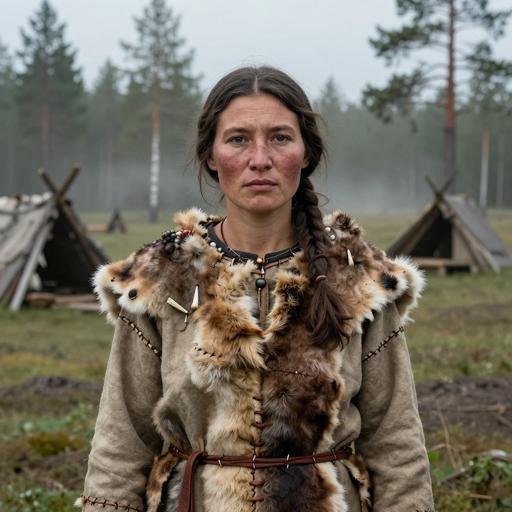
Portrait reconstruction of A woman buried in Russia in the Mesolithic era
Ancient Individual

A woman buried in Russia in the Mesolithic era

A woman buried in Russia during the Eastern Hunter-Gatherer, Russia

A fragment of the ancient world, preserved across millennia in strands of DNA.

UzOO77_new
5500 BCE - 5000 BCE
Female
Russia
Scroll to begin
Chapter I

Identity

The biological and cultural markers that define this ancient individual

Sample ID

UzOO77_new

Date Range

5500 BCE - 5000 BCE

Cultural Period

Eastern Hunter-Gatherer, Russia

Biological Sex

Female

mtDNA Haplogroup

R1b

Y-DNA Haplogroup

N/A (Female)

Chapter II

Place

Where this individual was discovered

Country Russia
Locality Yuzhnyy Oleni Ostrov. Karelia
Coordinates 62.0460, 35.3640
Chapter III

Time

When this individual lived in the broader context of human history

UzOO77_new 5500 BCE - 5000 BCE
Chapter IV

Story

The narrative of this ancient life

The Eastern Hunter-Gatherers (EHG) represent a fascinating period in prehistoric human history, specifically within the context of the Mesolithic and Neolithic periods of Eastern Europe, with a significant focus on what is now modern-day Russia. This group forms an integral part of the broader Circumpolar Culture, which encompasses the various hunter-gatherer societies that inhabited the northern latitudes around the Arctic Circle.

Geographic Distribution

The EHG communities primarily occupied the expanses of Eastern Europe, stretching into parts of Russia, particularly around the Volga River Basin, the Ural Mountains, and extending towards western Siberia. These areas are characterized by vast forests, steppe zones, and numerous rivers and waterways, which played a crucial role in the sustenance of these communities.

Chronological Framework

The EHG are predominantly associated with the Mesolithic period, transitioning into the early Neolithic, approximately between 10,000 BCE and 3,000 BCE. This era is marked by significant climatic changes following the last Ice Age, leading to the development of more temperate environments that supported diverse ecosystems.

Lifestyle and Economy

  • Subsistence Strategy: EHG societies were primarily hunter-gatherers, relying on hunting, fishing, and foraging. Large game such as elk, moose, and reindeer were common targets, while the numerous rivers and lakes offered rich fishing opportunities. Seasonally available plant resources were also an important part of their diet.

  • Tools and Technology: The EHG developed a variety of tools made from stone, bone, and antler. These tools include spearheads, arrowheads, scrapers, and awls, which exhibit sophisticated knapping techniques. The Mesolithic also saw the advent of microliths, small stone blades that could be hafted onto wooden shafts to create composite tools.

  • Housing and Settlements: Settlements were typically temporary and mobile, reflecting their subsistence strategies. These consisted of simple structures made from available natural materials such as wood, hide, and bone. In regions closer to water sources, semi-permanent camps were established.

Social and Cultural Aspects

  • Community Structure: EHG societies were likely organized in small, kin-based groups or bands. Social structures would have been relatively egalitarian, typical of hunter-gatherer groups, with shared responsibilities in hunting and gathering.

  • Spiritual and Ritualistic Practices: While concrete evidence is sparse, the EHG likely had complex spiritual beliefs tied to nature and animals, similar to other circumpolar and shamanistic traditions. Burial sites from this period suggest ritualistic practices, with some graves containing grave goods that indicate beliefs in an afterlife or spiritual journey.

  • Art and Symbolism: There is evidence of artistic expression in EHG communities, including petroglyphs and carved figurines. These artworks often depict animals, human figures, and abstract symbols, hinting at a rich cultural and symbolic life.

Genetic Legacy

Recent genetic studies have provided more insight into the EHG and their role in prehistoric migrations. The EHG exhibit a genetic profile that contributed significantly to the ancestry of later European populations, particularly through interactions with other hunter-gatherer groups and early agrarian societies.

Interaction with Other Cultures

The EHG were part of a broader network of hunter-gatherer communities across Eurasia. They interacted with Western Hunter-Gatherers (WHG) and later with incoming Early European Farmers (EEF), contributing to the genetic and cultural mosaic of prehistoric Europe. This era of interaction likely involved trade, cultural exchange, and occasional conflict.

Climate and Environment

The transition from the Pleistocene to the Holocene era brought about climatic shifts that influenced EHG life. A warming climate led to the retreat of glaciers and the establishment of boreal forests, creating new opportunities and challenges for these societies. The adaptation to these changing conditions was a hallmark of EHG resilience and innovation.

In summary, the Eastern Hunter-Gatherers of Russia represent a key cultural and historical phase in the broader narrative of human prehistory, exemplifying the adaptability and resourcefulness of early human societies in the face of dynamic environmental changes. Their legacy persists in the genetic and cultural heritage of contemporary populations across Europe and Asia.

Context

Related Samples

This individual exists within a broader network of ancient samples. No ancient genome stands alone.

Sample ID Culture/Period Date Location Action
I0963 Hunter-Gatherer Russia 6000 BCE Archangelsk. Popovo, Russia View
Donkalnis1 Early to Middle Neolithic Narva Culture, Lithuania 5500 BCE Donkalnis, Lithuania View
Donkalnis4 Mesolithic Lithuania 5991 BCE Donkalnis, Lithuania View
Donkalnis6 Early to Middle Neolithic Narva Culture, Lithuania 4718 BCE Donkalnis, Lithuania View
Donkalnis7 Early to Middle Neolithic Narva Culture, Lithuania 5374 BCE Donkalnis, Lithuania View
Kivisaare3 Early to Middle Neolithic Narva Culture, Estonia 4776 BCE Kivisaare, Estonia View
Kivutkalns153 Bronze Age Latvia 796 BCE Kivutkalns, Latvia View
Kivutkalns164 Bronze Age Latvia 719 BCE Kivutkalns, Latvia View
Kivutkalns194 Bronze Age Latvia 407 BCE Kivutkalns, Latvia View
Kivutkalns19 Bronze Age Latvia 720 BCE Kivutkalns, Latvia View
Kivutkalns207 Bronze Age Latvia 787 BCE Kivutkalns, Latvia View
Kivutkalns209 Bronze Age Latvia 788 BCE Kivutkalns, Latvia View
Kivutkalns215 Bronze Age Latvia 758 BCE Kivutkalns, Latvia View
Kivutkalns222 Bronze Age Latvia 745 BCE Kivutkalns, Latvia View
Kivutkalns25 Bronze Age Latvia 799 BCE Kivutkalns, Latvia View
Kivutkalns42 Bronze Age Latvia 809 BCE Kivutkalns, Latvia View
Kretuonas1 Early to Middle Neolithic Narva Culture, Lithuania 4453 BCE Kretuonas 1B, Lithuania View
Kretuonas2 Early to Middle Neolithic Narva Culture, Lithuania 5500 BCE Kretuonas 1B, Lithuania View
Kretuonas4 Early to Middle Neolithic Narva Culture, Lithuania 5500 BCE Kretuonas 1B, Lithuania View
Kvarlov5164 Middle Neolithic Funnel Beaker Culture, Sweden 3945 BCE Kvärlöv. Saxtorp. Skåne, Sweden View
MotalaAA Hunter-Gatherer Motala, Sweden 5724 BCE Motala. Kanaljorden, Sweden View
Olsund_new Late Neolithic to Bronze Age Sweden 2573 BCE Ölsund. Hälsingland, Sweden View
Plinkaigalis241 Late Neolithic Lithuania 2861 BCE Plinkaigalis, Lithuania View
Plinkaigalis242 Late Neolithic Lithuania 3264 BCE Plinkaigalis, Lithuania View
Popovo2 Hunter-Gatherer Popovo, Russia 7500 BCE Popovo. Archangelsk, Russia View
Spiginas1 Early to Middle Neolithic Narva Culture, Lithuania 4442 BCE Spiginas, Lithuania View
Spiginas2 Late Neolithic Lithuania 2132 BCE Spiginas, Lithuania View
Spiginas4 Mesolithic Lithuania 6442 BCE Spiginas, Lithuania View
Tamula1 Middle Neolithic Comb Ceramic Culture 1, Estonia 3621 BCE Tamula, Estonia View
Tamula3 Middle Neolithic Comb Ceramic Culture 2, Estonia 3796 BCE Tamula, Estonia View
Turlojiske1932 Bronze Age Lithuania 1257 BCE Turlojiškė, Lithuania View
Turlojiske1 Bronze Age Lithuania 928 BCE Turlojiškė, Lithuania View
Turlojiske3 Bronze Age Lithuania 1015 BCE Turlojiškė, Lithuania View
Turlojiske5 Bronze Age Lithuania 2100 BCE Turlojiškė, Lithuania View
UzOO77_new Eastern Hunter-Gatherer, Russia 5500 BCE Yuzhnyy Oleni Ostrov. Karelia, Russia View
Veibri4 Early to Middle Neolithic Narva Culture, Estonia 4895 BCE Veibri, Estonia View
Gyvakarai1_10bp Late Neolithic Lithuania 2620 BCE Gyvakarai, Lithuania View
UzOO77 Yuzhny Oleny Ostrov Culture 5500 BCE Yuzhny Oleniy Ostrov (Republic of Karelia, Medvezhyegorsky District, Velikaya Guba Village), Russia View
Kretuonas2 5500 BCE Kretuonas 1B, Lithuania View
MA973 2575 BCE Kursi. Jõgeva, Estonia View
Gyvakarai1_10bp 2620 BCE Gyvakarai, Lithuania View
Sample ID Culture/Period Date Location Action
UzOO77_new Eastern Hunter-Gatherer, Russia 5500 BCE Yuzhnyy Oleni Ostrov. Karelia, Russia View
Sources

References

Scientific publications and genetic data that inform this profile.

Scientific Publication

The genetic prehistory of the Baltic Sea region

Authors Mittnik A, Wang CC, Pfrengle S, Daubaras M, Zariņa G et al.
Abstract

While the series of events that shaped the transition between foraging societies and food producers are well described for Central and Southern Europe, genetic evidence from Northern Europe surrounding the Baltic Sea is still sparse. Here, we report genome-wide DNA data from 38 ancient North Europeans ranging from ~9500 to 2200 years before present. Our analysis provides genetic evidence that hunter-gatherers settled Scandinavia via two routes. We reveal that the first Scandinavian farmers derive their ancestry from Anatolia 1000 years earlier than previously demonstrated. The range of Mesolithic Western hunter-gatherers extended to the east of the Baltic Sea, where these populations persisted without gene-flow from Central European farmers during the Early and Middle Neolithic. The arrival of steppe pastoralists in the Late Neolithic introduced a major shift in economy and mediated the spread of a new ancestry associated with the Corded Ware Complex in Northern Europe.

Use code for 25% off Expires Jul 12