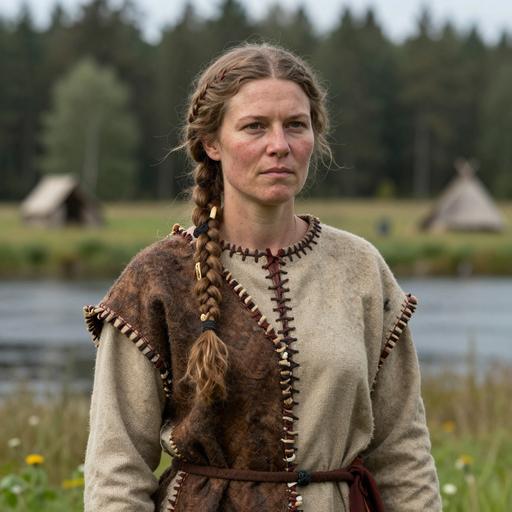
A woman buried in Sweden in the Mesolithic era

Download PDF creates a visual, rasterized copy. Use Print for selectable text and better assistive-technology support.

Loading Report

Preparing your ancestry journey

Preparing the available report content...

Your report will open automatically.

Skip to main content
Reference library / Sample profile

A woman buried in Sweden in the Mesolithic era

Explore the recorded context, genetic comparisons and research behind this reference sample.

SwedenHunter-Gatherer Motala, Sweden

A reference profile describes this sample. It does not establish a personal or family relationship.

AI portrait reconstruction for A woman buried in Sweden in the Mesolithic era
AI-generated artistic reconstruction, not a photograph of the individual.
Record

Sample details

Recorded details and available lineage markers.

Individual

Mesolithic individual, Sweden

Sample ID: MotalaAA

Date Range

5724 BCE - 5563 BCE

Cultural Period

Hunter-Gatherer Motala, Sweden

Biological Sex

Female

mtDNA Haplogroup

Not available

Y-DNA Haplogroup

Not available

Social Role

Hunter (AI estimate, era-typical)

Geography

Location

Where this individual was discovered

Country Sweden
Locality Motala. Kanaljorden
Coordinates 58.5350, 15.0460
Chronology

Date range

When this individual lived in the broader context of human history

Mesolithic individual, Sweden 5724 BCE - 5563 BCE
Context

Historical context

Background information associated with the reference record.

The Hunter-Gatherer culture of Motala, Sweden, is an intriguing chapter of human prehistory, positioned within the broader context of the Western European Hunter-Gatherers (WEHG) during the Mesolithic period. This era, which spanned from approximately 10,000 to 5,000 BCE, marks a critical transitional phase as humans adapted to post-glacial environments across Europe.

Geography and Environment

Motala is situated in south-central Sweden, an area characterized by a landscape of lakes, rivers, and dense forests. During the Mesolithic period, this region was undergoing significant ecological transformation due to the retreat of the ice sheets from the last Ice Age. The climate was warming, which allowed for the spread of deciduous forests interspersed with conifers, creating a richly diverse environment. Waterways were abundant, providing a lifeline for the communities that thrived there.

Subsistence and Economy

The Western European Hunter-Gatherers, including those from Motala, were highly adapted to their landscapes. Their economy was based on a mix of hunting, fishing, and foraging, which ensured a varied diet. The presence of lakes and rivers meant that fishing was an essential component of their subsistence strategy. Evidence, such as fishing implements and remains of fish species like pike and perch, suggests that they had sophisticated methods for catching fish.

Hunting supplemented their diet, with evidence of red deer, wild boar, and elk being prevalent game. These communities used tools like arrows and spears, crafted with microlithic technology, indicating advanced hunting techniques. Gathering played a crucial role as well, with nuts, berries, and wild plants providing nutritional balance.

Social Structure and Settlement Patterns

The Hunter-Gatherers of Motala lived in semi-permanent settlements, often near water sources. Archaeological findings suggest small, kin-based groups, which were flexible and mobile to adapt to the seasonal availability of resources. The social structure was likely egalitarian, with shared responsibilities for hunting, gathering, and processing food, although some division of labor based on age and gender might have existed.

Their dwellings were constructed to provide shelter from the harsh Scandinavian weather, using materials like wood and animal hides. The architecture likely consisted of simple, yet functional design, optimized for their nomadic lifestyle.

Tools and Technology

The technology of the Motala inhabitants was marked by a high degree of sophistication, particularly in the domain of lithic tools. They utilized local flint and stone to create an array of tools that typified the Mesolithic toolkit—microliths, scrapers, blades, and burins. These tools were essential for their survival, utilized in hunting, processing food, and crafting other implements.

Bone and antler were also significant materials. Artifacts such as bone fishhooks, harpoons, and needles have been discovered, demonstrating their skill in working with organic materials.

Art and Spirituality

While there is limited direct evidence of art from this specific region, parallels with other Mesolithic cultures suggest that symbolic expression was an integral part of their lives. This could have included body ornamentation with ochre, creating carvings, or engaging in ritualistic practices. Artifacts from other hunter-gatherer sites include decorated objects, which hint at a complex spiritual life potentially involving animistic beliefs or ancestor worship.

Burial Practices

One of the most striking aspects of the Motala hunter-gatherers was their mortuary practices, underscoring complex social and spiritual dimensions. Excavations in the region have revealed burials that include a variety of grave goods, such as red ochre, stone tools, and animal teeth pendants, suggesting a belief in an afterlife or the importance of items in death as in life.

In conclusion, the Hunter-Gatherer culture of Motala represents a community deeply intertwined with its natural environment, exhibiting adaptations that reflect both survival needs and evolving cultural practices. Their lifestyle, characterized by mobility, a diverse subsistence strategy, and intricate social structures, offers fascinating insights into the resilience and adaptability of human societies during the Mesolithic period.

Analysis

Genetic comparisons

These comparisons show genetic similarity, not identity or origin. The populations listed are those whose genomes show statistical alignment to this ancient individual.

Similarity reflects shared history, not shared identity. These are analytical comparisons, not claims about who this person was.

Modern Genetic Admixture

This analysis compares the DNA profile with present-day reference populations, showing statistical similarity to modern reference populations from different regions. The excavation site records where this individual was found, not a fixed modern genetic identity.

Europe 99.9%
Eastern European 99.9%

Closest Modern Populations

These are the modern populations showing the closest statistical alignment to A woman buried in Sweden in the Mesolithic era, ranked by genetic distance. Lower distance values indicate closer statistical similarity. Cross-region similarity can reflect shared ancestry, population movement, continuity, or later admixture.

1
Russian Tver
1.7794
2
Russian Kostroma
1.9936
3
Russian Yaroslavl
2.0310
4
Russian Ryazan
2.2404
5
Russian Kursk
2.2484
6
Moksha
2.2947
7
Mordovian
2.5710
8
Russian Orel
2.6495
9
Russian Kaluga
2.6502
10
Erzya
2.6630
Context

Related Samples

This individual exists within a broader network of ancient samples. No ancient genome stands alone.

Individual Culture/Period Date Location Action
Circumpolar Cultures individual, Russia Hunter-Gatherer Russia 6000 BCE Archangelsk. Popovo, Russia View
EMN Narva-o individual, Lithuania Early to Middle Neolithic Narva Culture, Lithuania 5500 BCE Donkalnis, Lithuania View
Mesolithic individual, Lithuania Mesolithic Lithuania 5991 BCE Donkalnis, Lithuania View
EMN Narva individual, Lithuania Early to Middle Neolithic Narva Culture, Lithuania 4718 BCE Donkalnis, Lithuania View
EMN Narva individual, Lithuania Early to Middle Neolithic Narva Culture, Lithuania 5374 BCE Donkalnis, Lithuania View
EMN Narva individual, Estonia Early to Middle Neolithic Narva Culture, Estonia 4776 BCE Kivisaare, Estonia View
LBA Flat Graves individual, Latvia Bronze Age Latvia 796 BCE Kivutkalns, Latvia View
LBA Flat Graves individual, Latvia Bronze Age Latvia 719 BCE Kivutkalns, Latvia View
Baltic individual, Latvia Bronze Age Latvia 407 BCE Kivutkalns, Latvia View
LBA Flat Graves individual, Latvia Bronze Age Latvia 720 BCE Kivutkalns, Latvia View
LBA Flat Graves individual, Latvia Bronze Age Latvia 787 BCE Kivutkalns, Latvia View
LBA Flat Graves individual, Latvia Bronze Age Latvia 788 BCE Kivutkalns, Latvia View
LBA Flat Graves individual, Latvia Bronze Age Latvia 758 BCE Kivutkalns, Latvia View
LBA Flat Graves individual, Latvia Bronze Age Latvia 745 BCE Kivutkalns, Latvia View
LBA Flat Graves individual, Latvia Bronze Age Latvia 799 BCE Kivutkalns, Latvia View
LBA Flat Graves individual, Latvia Bronze Age Latvia 809 BCE Kivutkalns, Latvia View
EMN Narva individual, Lithuania Early to Middle Neolithic Narva Culture, Lithuania 4453 BCE Kretuonas 1B, Lithuania View
European Hunter-Gatherers individual, Lithuania Early to Middle Neolithic Narva Culture, Lithuania 5500 BCE Kretuonas 1B, Lithuania View
EMN Narva individual, Lithuania Early to Middle Neolithic Narva Culture, Lithuania 5500 BCE Kretuonas 1B, Lithuania View
MN individual, Sweden Middle Neolithic Funnel Beaker Culture, Sweden 3945 BCE Kvärlöv. Saxtorp. Skåne, Sweden View
Mesolithic individual, Sweden Hunter-Gatherer Motala, Sweden 5724 BCE Motala. Kanaljorden, Sweden View
LN EBA individual, Sweden Late Neolithic to Bronze Age Sweden 2573 BCE Ölsund. Hälsingland, Sweden View
LN individual, Lithuania Late Neolithic Lithuania 2861 BCE Plinkaigalis, Lithuania View
LN individual, Lithuania Late Neolithic Lithuania 3264 BCE Plinkaigalis, Lithuania View
Arkhangelsk Mesolithic individual, Russia Hunter-Gatherer Popovo, Russia 7500 BCE Popovo. Archangelsk, Russia View
EMN individual, Lithuania Early to Middle Neolithic Narva Culture, Lithuania 4442 BCE Spiginas, Lithuania View
LN individual, Lithuania Late Neolithic Lithuania 2132 BCE Spiginas, Lithuania View
Middle Mesolithic individual, Lithuania Mesolithic Lithuania 6442 BCE Spiginas, Lithuania View
MN-1 individual, Estonia Middle Neolithic Comb Ceramic Culture 1, Estonia 3621 BCE Tamula, Estonia View
MN-2 individual, Estonia Middle Neolithic Comb Ceramic Culture 2, Estonia 3796 BCE Tamula, Estonia View
LBA individual, Lithuania Bronze Age Lithuania 1257 BCE Turlojiškė, Lithuania View
LBA individual, Lithuania Bronze Age Lithuania 928 BCE Turlojiškė, Lithuania View
LBA individual, Lithuania Bronze Age Lithuania 1015 BCE Turlojiškė, Lithuania View
LBA individual, Lithuania Bronze Age Lithuania 2100 BCE Turlojiškė, Lithuania View
Circumpolar Cultures individual, Russia Eastern Hunter-Gatherer, Russia 5500 BCE Yuzhnyy Oleni Ostrov. Karelia, Russia View
EMN Narva individual, Estonia Early to Middle Neolithic Narva Culture, Estonia 4895 BCE Veibri, Estonia View
Indo-European individual, Lithuania Late Neolithic Lithuania 2620 BCE Gyvakarai, Lithuania View
Karelia Mesolithic individual, Russia Yuzhny Oleny Ostrov Culture 5500 BCE Yuzhny Oleniy Ostrov (Republic of Karelia, Medvezhyegorsky District, Velikaya Guba Village), Russia View
Baltic Emn individual, Lithuania 5500 BCE Kretuonas 1B, Lithuania View
Baltic Ln individual, Estonia 2575 BCE Kursi. Jõgeva, Estonia View
Baltic Ln individual, Lithuania 2620 BCE Gyvakarai, Lithuania View
Page 1
Individual Culture/Period Date Location Action
Mesolithic HG individual, Sweden Hunter-Gatherer Motala, Sweden 5966 BCE Motala. Kanaljorden, Sweden View
Mesolithic HG individual, Sweden Hunter-Gatherer Motala, Sweden 5721 BCE Motala. Kanaljorden, Sweden View
Mesolithic HG individual, Sweden Hunter-Gatherer Motala, Sweden 5967 BCE Motala. Kanaljorden, Sweden View
Mesolithic HG individual, Sweden Hunter-Gatherer Motala, Sweden 5715 BCE Motala. Kanaljorden, Sweden View
Mesolithic HG individual, Sweden Hunter-Gatherer Motala, Sweden 5885 BCE Motala. Kanaljorden, Sweden View
Western European Hunter-Gatherers individual, Sweden Hunter-Gatherer Motala, Sweden 5722 BCE Motala. Kanaljorden, Sweden View
Mesolithic individual, Sweden Hunter-Gatherer Motala, Sweden 5724 BCE Motala. Kanaljorden, Sweden View
Page 1
Sources

References

Scientific publications and genetic data that inform this profile.

G25 Coordinates

These coordinates represent a position in genetic space, a tool for comparison, not a conclusion. You can use these to perform custom admixture analysis in G25 Studio.

MotalaAA,0.1325793,0.09975218,0.07869902,0.07152588,0.03069958,0.02635742,0.01175264,0.01502316,-0.00185552,-0.02800786,-0.00351012,-0.0080636,0.02035496,0.01861674,-0.01163868,0.00072134,-0.00290982,-0.00151908,9.404E-05,-0.001895,0.00017734,-0.00073728,0.00268756,-0.00072614,-0.00364265
Continue in G25 Studio
Use code for 30% off • Expires Nov 16