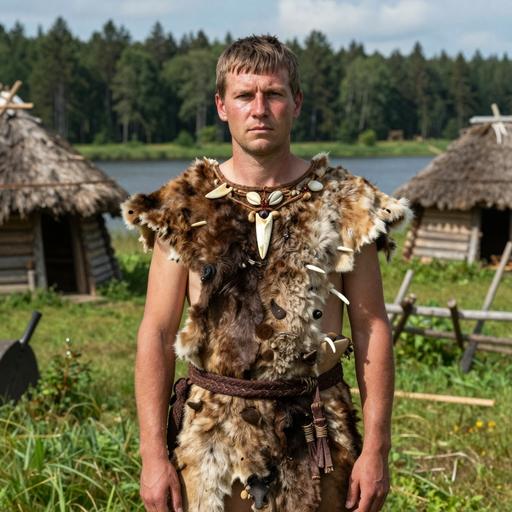
A man buried in Lithuania in the era

Download PDF creates a visual, rasterized copy. Use Print for selectable text and better assistive-technology support.

Loading Report

Preparing your ancestry journey

Preparing the available report content...

Your report will open automatically.

Skip to main content
Reference library / Sample profile

A man buried in Lithuania in the era

Explore the recorded context, genetic comparisons and research behind this reference sample.

LithuaniaEarly Middle Neolithic Baltic

A reference profile describes this sample. It does not establish a personal or family relationship.

AI portrait reconstruction for A man buried in Lithuania in the  era
AI-generated artistic reconstruction, not a photograph of the individual.
Record

Sample details

Recorded details and available lineage markers.

Individual

Baltic Emn individual, Lithuania

Sample ID: Kretuonas2

Date Range

5500 BCE - 2900 BCE

Cultural Period

Early Middle Neolithic Baltic

Biological Sex

Male

mtDNA Haplogroup

U5b2b

Y-DNA Haplogroup

I-FT384996

Social Role

Farmer (AI estimate, era-typical)

Geography

Location

Where this individual was discovered

Country Lithuania
Locality Kretuonas 1B

A location map is not available for this record.

Chronology

Date range

When this individual lived in the broader context of human history

Baltic Emn individual, Lithuania 5500 BCE - 2900 BCE
Context

Historical context

Background information associated with the reference record.

Between about 5500 and 4500 BCE, Early Middle Neolithic communities in the Baltic region practiced food production while still relying on locally available environments. Their archaeological record highlights pottery styles, settlement traces, and toolkits that support a village-based economy.

Region & Environment

The Baltic’s mixture of coasts, lakes, rivers, and forested interiors shaped daily subsistence. Seasonal availability of resources would have affected hunting, fishing, gathering, and how intensively farming could be pursued in different micro-regions.

Historical Context

This era falls within the Neolithic development of farming societies in northern Europe. Communities adopted domestic plants and animals and integrated them with local strategies, producing a flexible subsistence base rather than an exclusively agricultural economy.

Populations & Lifeways

People likely lived in semi-permanent settlements or repeated occupation zones. Household labor included cultivation, herding, food processing, and craft production such as pottery making. Mobility may have remained relevant for fishing, hunting, or exploiting particular landscapes.

Archaeology & Material Culture

Archaeological signatures include ceramics with regionally distinctive decorative traditions, reflecting both learning within communities and differences between groups. Stone tools for cutting and scraping, as well as woodworking-related implements, are important for understanding daily tasks. Settlement patterns and domestic debris provide evidence of long-term or repeated habitation.

Culture & Society

Ceramic style and settlement practices indicate that Neolithic communities were part of broader cultural networks. At the same time, variations in decoration and artifact combinations suggest local identities and selective adoption of technologies and practices.

Legacy & Transition

Over time, these Neolithic foundations—settlement routines, pottery traditions, and mixed subsistence practices—helped structure later developments in the Middle and Late Neolithic Baltic. Shifts into subsequent periods are visible in changing artifact styles and evolving settlement organization.

Analysis

Genetic comparisons

These comparisons show genetic similarity, not identity or origin. The populations listed are those whose genomes show statistical alignment to this ancient individual.

Similarity reflects shared history, not shared identity. These are analytical comparisons, not claims about who this person was.

Modern Genetic Admixture

This analysis compares the DNA profile with present-day reference populations, showing statistical similarity to modern reference populations from different regions. The excavation site records where this individual was found, not a fixed modern genetic identity.

Europe 100.0%
Northwestern European 100.0%
Northwestern European 65.7%
English 34.3%

Closest Modern Populations

These are the modern populations showing the closest statistical alignment to A man buried in Lithuania in the era, ranked by genetic distance. Lower distance values indicate closer statistical similarity. Cross-region similarity can reflect shared ancestry, population movement, continuity, or later admixture.

1
Estonian
2.2887
2
Russian Pskov
3.0601
3
Polish Kashubian
3.1715
4
Russian Kaluga
3.3441
5
Lithuanian PA
3.3570
6
Lithuanian VA
3.4119
7
Lithuanian VZ
3.4380
8
Belarusian
3.5105
9
Russian Yaroslavl
3.5282
10
Russian Tver
3.5508
Context

Related Samples

This individual exists within a broader network of ancient samples. No ancient genome stands alone.

Individual Culture/Period Date Location Action
Circumpolar Cultures individual, Russia Hunter-Gatherer Russia 6000 BCE Archangelsk. Popovo, Russia View
EMN Narva-o individual, Lithuania Early to Middle Neolithic Narva Culture, Lithuania 5500 BCE Donkalnis, Lithuania View
Mesolithic individual, Lithuania Mesolithic Lithuania 5991 BCE Donkalnis, Lithuania View
EMN Narva individual, Lithuania Early to Middle Neolithic Narva Culture, Lithuania 4718 BCE Donkalnis, Lithuania View
EMN Narva individual, Lithuania Early to Middle Neolithic Narva Culture, Lithuania 5374 BCE Donkalnis, Lithuania View
EMN Narva individual, Estonia Early to Middle Neolithic Narva Culture, Estonia 4776 BCE Kivisaare, Estonia View
LBA Flat Graves individual, Latvia Bronze Age Latvia 796 BCE Kivutkalns, Latvia View
LBA Flat Graves individual, Latvia Bronze Age Latvia 719 BCE Kivutkalns, Latvia View
Baltic individual, Latvia Bronze Age Latvia 407 BCE Kivutkalns, Latvia View
LBA Flat Graves individual, Latvia Bronze Age Latvia 720 BCE Kivutkalns, Latvia View
LBA Flat Graves individual, Latvia Bronze Age Latvia 787 BCE Kivutkalns, Latvia View
LBA Flat Graves individual, Latvia Bronze Age Latvia 788 BCE Kivutkalns, Latvia View
LBA Flat Graves individual, Latvia Bronze Age Latvia 758 BCE Kivutkalns, Latvia View
LBA Flat Graves individual, Latvia Bronze Age Latvia 745 BCE Kivutkalns, Latvia View
LBA Flat Graves individual, Latvia Bronze Age Latvia 799 BCE Kivutkalns, Latvia View
LBA Flat Graves individual, Latvia Bronze Age Latvia 809 BCE Kivutkalns, Latvia View
EMN Narva individual, Lithuania Early to Middle Neolithic Narva Culture, Lithuania 4453 BCE Kretuonas 1B, Lithuania View
European Hunter-Gatherers individual, Lithuania Early to Middle Neolithic Narva Culture, Lithuania 5500 BCE Kretuonas 1B, Lithuania View
EMN Narva individual, Lithuania Early to Middle Neolithic Narva Culture, Lithuania 5500 BCE Kretuonas 1B, Lithuania View
MN individual, Sweden Middle Neolithic Funnel Beaker Culture, Sweden 3945 BCE Kvärlöv. Saxtorp. Skåne, Sweden View
Mesolithic individual, Sweden Hunter-Gatherer Motala, Sweden 5724 BCE Motala. Kanaljorden, Sweden View
LN EBA individual, Sweden Late Neolithic to Bronze Age Sweden 2573 BCE Ölsund. Hälsingland, Sweden View
LN individual, Lithuania Late Neolithic Lithuania 2861 BCE Plinkaigalis, Lithuania View
LN individual, Lithuania Late Neolithic Lithuania 3264 BCE Plinkaigalis, Lithuania View
Arkhangelsk Mesolithic individual, Russia Hunter-Gatherer Popovo, Russia 7500 BCE Popovo. Archangelsk, Russia View
EMN individual, Lithuania Early to Middle Neolithic Narva Culture, Lithuania 4442 BCE Spiginas, Lithuania View
LN individual, Lithuania Late Neolithic Lithuania 2132 BCE Spiginas, Lithuania View
Middle Mesolithic individual, Lithuania Mesolithic Lithuania 6442 BCE Spiginas, Lithuania View
MN-1 individual, Estonia Middle Neolithic Comb Ceramic Culture 1, Estonia 3621 BCE Tamula, Estonia View
MN-2 individual, Estonia Middle Neolithic Comb Ceramic Culture 2, Estonia 3796 BCE Tamula, Estonia View
LBA individual, Lithuania Bronze Age Lithuania 1257 BCE Turlojiškė, Lithuania View
LBA individual, Lithuania Bronze Age Lithuania 928 BCE Turlojiškė, Lithuania View
LBA individual, Lithuania Bronze Age Lithuania 1015 BCE Turlojiškė, Lithuania View
LBA individual, Lithuania Bronze Age Lithuania 2100 BCE Turlojiškė, Lithuania View
Circumpolar Cultures individual, Russia Eastern Hunter-Gatherer, Russia 5500 BCE Yuzhnyy Oleni Ostrov. Karelia, Russia View
EMN Narva individual, Estonia Early to Middle Neolithic Narva Culture, Estonia 4895 BCE Veibri, Estonia View
Indo-European individual, Lithuania Late Neolithic Lithuania 2620 BCE Gyvakarai, Lithuania View
Karelia Mesolithic individual, Russia Yuzhny Oleny Ostrov Culture 5500 BCE Yuzhny Oleniy Ostrov (Republic of Karelia, Medvezhyegorsky District, Velikaya Guba Village), Russia View
Baltic Emn individual, Lithuania 5500 BCE Kretuonas 1B, Lithuania View
Baltic Ln individual, Estonia 2575 BCE Kursi. Jõgeva, Estonia View
Baltic Ln individual, Lithuania 2620 BCE Gyvakarai, Lithuania View
Page 1
Individual Culture/Period Date Location Action
Baltic Emn individual, Lithuania 5500 BCE Kretuonas 1B, Lithuania View
Page 1
Sources

References

Scientific publications and genetic data that inform this profile.

G25 Coordinates

These coordinates represent a position in genetic space, a tool for comparison, not a conclusion. You can use these to perform custom admixture analysis in G25 Studio.

Kretuonas2,0.13173326,0.11988636,0.0875973,0.07563408,0.04095208,0.03299918,0.00805028,0.01643874,-0.0008095,-0.03014726,0.0005341,-0.00620166,0.01238644,0.01304144,0.00184956,0.00096538,0.00097148,-0.00258238,0.00480284,0.00117024,0.00339026,-0.00454736,-0.00440446,0.00882376,0.0016909
Continue in G25 Studio
Use code for 30% off • Expires Nov 16