Menu
Store
Blog
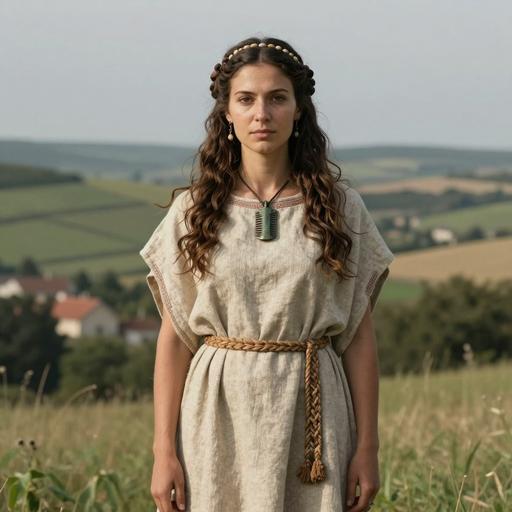
Portrait reconstruction of I20751
Ancient Individual

A woman buried in Hungary in the Late Bronze Age era

I20751
1500 BCE - 1000 BCE
Female
Late Bronze Age Hungary
Hungary
Scroll to begin
Chapter I

Identity

The biological and cultural markers that define this ancient individual

Sample ID

I20751

Date Range

1500 BCE - 1000 BCE

Biological Sex

Female

mtDNA Haplogroup

Not available

Cultural Period

Late Bronze Age Hungary

Chapter II

Place

Where this individual was discovered

Country Hungary
Locality Besenyszög Berek-ér partja. Köröm-Kápolnadomb
Coordinates 47.2094, 20.2631
Chapter III

Time

When this individual lived in the broader context of human history

I20751 1500 BCE - 1000 BCE
Chapter IV

Story

The narrative of this ancient life

The Late Bronze Age in Hungary, encompassing approximately 1300 to 800 BCE, is recognized for being a significant period marked by the Urnfield Culture. This era is characterized by several distinguishing cultural, economic, and societal features deeply intertwined with the broader developments across Central Europe at the time. Below is an in-depth exploration of this culture and era.

Geographic Setting

Territory: The Urnfield Culture in Hungary was part of a more extensive cultural complex that spread across Central and Eastern Europe. In Hungary, this culture was predominant in the Upper Danube River Basin, which provided fertile land for agriculture and a corridor for trade and movement.

Cultural Characteristics

Burial Practices: The Urnfield Culture is primarily characterized by its unique burial practices, where cremated remains were interred in urns – hence the name 'Urnfield'. These urns were placed in cemeteries, which often contained hundreds of burials. This shift from inhumation to cremation marks a significant departure from earlier burial traditions. The use of urns sometimes adorned with intricate patterns or motifs reflects a spiritual or ritualistic sophistication, hinting at beliefs about the afterlife.

Material Culture: Artifacts from this period include a variety of pottery that was often highly decorated with geometric designs. Metalwork, especially in bronze, was advanced, with finds including tools, weapons, and ornaments like fibulae, pins, and decorative inlays. Bronze swords, axes, and spearheads were particularly notable, indicating the importance of warfare or status in society.

Architecture and Settlements: Settlements of the Urnfield Culture were typically fortified, often situated on hills or other defensible locations, signaling the potential for conflict or social stratification. These communities relied on both agriculture and animal husbandry, with evidence of crop production including barley, wheat, and millet and the raising of cattle, pigs, and sheep.

Social Structure

Society: The Urnfield Culture likely had a hierarchy, though it was not as rigidly structured as later Iron Age societies. The wealth of burial goods and the complexity of the settlements suggest a degree of social differentiation. Leaders or elites might have emerged due to their control over resources or their roles as warriors or religious figures.

Trade and Economy: The location within the Danube River Basin facilitated trade, both within the region and with distant cultures. The exchange likely included raw materials such as tin and copper necessary for bronze production and various finished goods, promoting economic complexity and cultural exchange.

Technological and Economic Developments

Metalworking: The period saw significant advancements in metallurgy, notably in the production and distribution of bronze items. Workshops would have been centers of technological innovation, critical for the local economy and trade networks.

Agriculture: Agricultural practices became more sophisticated with the use of tools like bronze sickles, which increased efficiency in farming. The agricultural surplus might have supported larger populations, leading to the growth of settlements and increased social stratification.

Artistic and Intellectual Life

Art and Symbolism: The decorative motifs found on pottery and metal goods indicate a rich symbolic culture. These designs may have conveyed identity, social status, or spiritual beliefs.

Religion and Spirituality: While specific details about religious beliefs are scant, the care taken in burial practices suggests a well-developed spiritual life. The reverence shown to the cremated dead indicates beliefs in an afterlife or the significance of ancestors.

Conclusion

The Late Bronze Age in Hungary, characterized by the Urnfield Culture, was a period of significant transformation and development. It laid critical groundwork for subsequent cultural and technological advancements during the Iron Age. This era is a testament to the adaptability and innovation of ancient communities in response to shifting environmental and social contexts. Through their advancements in metallurgy, agriculture, and social organization, the people of the Urnfield Culture left a lasting legacy in the cultural tapestry of Central Europe.

Chapter V

Genetics

The genetic ancestry of this ancient individual

Ancient Genetic Admixture

This analysis compares the DNA profile of I20751 with ancient reference populations, showing the genetic composition in terms of prehistoric ancestral groups.

European Hunter-Gatherers 36.6%
Neolithic Farmers 33.4%
Western Steppe Pastoralists 30.0%

Modern Genetic Admixture

This analysis compares the DNA profile with present-day reference populations, showing what percentage of genetic makeup resembles modern populations from different regions.

Europe 98.9%
Northwestern European 49.2%
English 20.3%
Scandinavian 17.5%
Northwestern European 8.8%
Finnish 2.6%
Southern European 46.8%
Balkan 17.2%
Iberian 14.0%
Italian 11.9%
Sardinian 3.8%
Eastern European 2.8%
Asia 1.1%
Northern West Asian 1.1%
Cypriot 1.1%

Closest Modern Populations

These are the modern populations showing the closest statistical alignment to A woman buried in Hungary in the Late Bronze Age era, ranked by genetic distance. Lower distance values indicate closer statistical similarity.

1
Belgianc
1.7356
2
French Nord
1.7897
3
French Alsace
1.8855
4
French Occitanie
2.0789
5
Swiss German
2.0830
6
French Paris
2.0895
7
Belgianb
2.1996
8
Belgiana
2.2547
9
French Pas De Calais
2.3448
10
French Auvergne
2.3755
Chapter VI

Context

Other ancient individuals connected to this sample

Sources

References

Scientific publications and genetic data

Scientific Publication

A minimally destructive protocol for DNA extraction from ancient teeth

Authors Harney É, Cheronet O, Fernandes DM
Abstract

Ancient DNA sampling methods-although optimized for efficient DNA extraction-are destructive, relying on drilling or cutting and powdering (parts of) bones and teeth. As the field of ancient DNA has grown, so have concerns about the impact of destructive sampling of the skeletal remains from which ancient DNA is obtained. Due to a particularly high concentration of endogenous DNA, the cementum of tooth roots is often targeted for ancient DNA sampling, but destructive sampling methods of the cementum often result in the loss of at least one entire root. Here, we present a minimally destructive method for extracting ancient DNA from dental cementum present on the surface of tooth roots. This method does not require destructive drilling or grinding, and, following extraction, the tooth remains safe to handle and suitable for most morphological studies, as well as other biochemical studies, such as radiocarbon dating. We extracted and sequenced ancient DNA from 30 teeth (and nine corresponding petrous bones) using this minimally destructive extraction method in addition to a typical tooth sampling method. We find that the minimally destructive method can provide ancient DNA that is of comparable quality to extracts produced from teeth that have undergone destructive sampling processes. Further, we find that a rigorous cleaning of the tooth surface combining diluted bleach and UV light irradiation seems sufficient to minimize external contaminants usually removed through the physical removal of a superficial layer when sampling through regular powdering methods.

G25 Coordinates

The G25 coordinates for sample I20751 can be used for detailed admixture analysis in our G25 Studio tool.

I20751,0.1270333,0.13599184,0.05806672,0.02566234,0.04665262,0.00948534,0.00062896,0.00779306,0.01580206,0.01584532,-0.00375078,0.00340022,-0.01128884,-0.00589348,0.00706842,0.00098572,-0.00654788,0.00159386,0.0005592,-0.0024059,0.00142118,0.00181642,-0.00453964,0.00210674,0.0030073
Analyze in G25 Studio
Use code for 40% off Expires Feb 27