Menu
Store
Blog
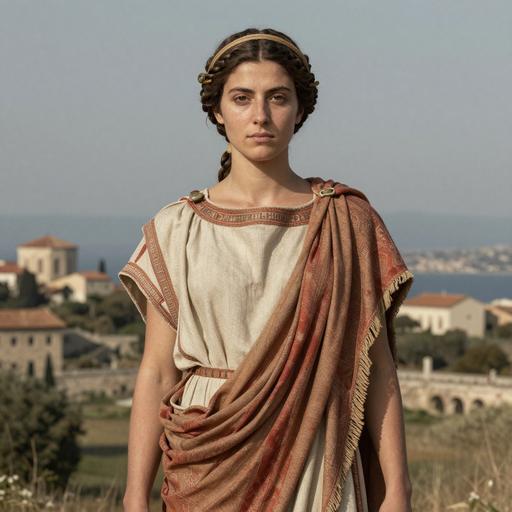
Portrait reconstruction of R475
Ancient Individual

A woman buried in Italy in the Iron Age era

R475
700 BCE - 600 BCE
Female
Iron Age Roman Republic
Italy
Scroll to begin
Chapter I

Identity

The biological and cultural markers that define this ancient individual

Sample ID

R475

Date Range

700 BCE - 600 BCE

Biological Sex

Female

mtDNA Haplogroup

T2b32

Cultural Period

Iron Age Roman Republic

Chapter II

Place

Where this individual was discovered

Country Italy
Locality Civitavecchia
Coordinates 42.0889, 11.7656
Chapter III

Time

When this individual lived in the broader context of human history

R475 700 BCE - 600 BCE
Chapter IV

Story

The narrative of this ancient life

The Iron Age Roman Republic, a pivotal era in Roman civilization, is traditionally dated from 509 BC, following the overthrow of the Roman monarchy, to 27 BC, when Augustus assumed power, leading to the establishment of the Roman Empire. This period marked significant developments in political structures, military conquests, social organization, and culture in Rome, laying the foundation for its expansion from a small city-state to a formidable republic controlling vast territories.

Political Structure

The Roman Republic's political system was characterized by a complex group of institutions, reflecting a balance of power between different societal classes. The key features of this setup included:

  1. Consuls: The Republic was led by two consuls, elected annually, who shared supreme civil and military authority. This system ensured a check on individual power and facilitated a rotation of leadership.

  2. Senate: Comprising mostly patricians, the Roman Senate held significant influence over foreign and financial policies, providing stability and continuity. Senators served for life, and their decisions often guided the consuls.

  3. Assemblies: The Roman Republic also had several citizen assemblies, which were critical in electing magistrates and passing legislation. This allowed for a measure of democratic participation, though largely dominated by the patrician class.

  4. Tribunes: Established to represent the plebeians, the Tribunes had the power to veto legislative actions and protect plebeian interests, reflecting societal struggles and the eventual political inclusion of different social classes.

Military Expansion

The Republic's era witnessed a period of aggressive military expansion, which was instrumental in shaping Rome's power:

  1. Conquest of Italy: The early Republic focused on unifying the Italian Peninsula, subduing local tribes and city-states through alliances and wars, notably against the Etruscans, Samnites, and Greek colonies.

  2. Punic Wars: Rome engaged in a series of conflicts with Carthage, known as the Punic Wars, which were crucial in establishing Rome as a Mediterranean powerhouse. The defeat of Hannibal and later Carthage itself allowed Rome to dominate North Africa, Spain, and other territories.

  3. Hellenistic Conquest: With victories over major Hellenistic kingdoms, notably in Greece and Asia Minor, Rome extended its influence, spreading its control over the Eastern Mediterranean.

Society and Economy

The Roman Republic fostered a diverse and evolving societal structure:

  1. Social Classes: Roman society was initially divided into patricians (aristocratic families) and plebeians (commoners). Over time, social mobility increased, and a new class of equestrians emerged, gaining wealth and political influence.

  2. Slavery: Slaves were an integral part of the economy, sourced mainly through conquests, which significantly influenced agricultural and domestic sectors.

  3. Economy: As Rome expanded, it established trade networks, integrating various economies under its dominion. Rome benefited from agricultural surpluses, especially grain from Sicily and North Africa. The annexation of territories brought wealth that funded infrastructure and military needs.

Culture and Religion

The cultural landscape of the Roman Republic was rich and transformative:

  1. Religion: Roman religion was polytheistic, adopting and adapting gods from conquered regions. The integration of Greek deities and rituals was particularly influential, leading to a synthesis of mythologies.

  2. Architecture and Engineering: Romans excelled in architectural innovations, epitomized by the development of aqueducts, bridges, and roads, which facilitated military and economic activities.

  3. Latin Literature: This era saw the beginnings of Roman literature, with authors such as Plautus and Terence in theater and later poets and historians like Lucretius, Catullus, and Sallust, who contributed to the Latin literary tradition.

  4. Philosophy and Law: Roman engagement with Greek philosophy enriched intellectual life, while advancements in Roman law during this time laid a foundation that would heavily influence Western legal systems.

The Iron Age Roman Republic was a foundational period that shaped the trajectory of Rome and had lasting impacts on Western civilization. Through a blend of political, military, and cultural transformations, the Republic laid the groundwork for the subsequent Roman Empire, which would further expand Rome’s legacy.

Chapter V

Genetics

The genetic ancestry of this ancient individual

Ancient Genetic Admixture

This analysis compares the DNA profile of R475 with ancient reference populations, showing the genetic composition in terms of prehistoric ancestral groups.

Neolithic Farmers 50.3%
European Hunter-Gatherers 31.6%
Western Steppe Pastoralists 11.8%
Ancient Africans 4.2%
Ancient Asians 2.2%

Modern Genetic Admixture

This analysis compares the DNA profile with present-day reference populations, showing what percentage of genetic makeup resembles modern populations from different regions.

Europe 68.5%
Southern European 67.9%
Italian 23.3%
Iberian 22.0%
Sardinian 12.7%
Balkan 9.8%
Northwestern European 0.5%
Africa 23.4%
North African 21.8%
North African 17.6%
Egyptian 4.2%
Northern East African 1.6%
Ethiopian 1.6%
Asia 7.9%
Arab, Egyptian & Levantine 6.4%
Arabian 6.1%
Northern West Asian 1.5%
Cypriot 1.5%

Closest Modern Populations

These are the modern populations showing the closest statistical alignment to A woman buried in Italy in the Iron Age era, ranked by genetic distance. Lower distance values indicate closer statistical similarity.

1
Belmonte Jew
3.6639
2
Sicilian West
4.9685
3
Maltese
5.3307
4
Spanish Canarias
5.3820
5
French Corsica
5.5798
6
Italian Lazio
5.7019
7
Sicilian East
5.7185
8
Turkish Sabbatean
5.8429
9
Ashkenazi Germany
5.9665
10
Italian Jew
6.0024
Chapter VI

Context

Other ancient individuals connected to this sample

Sources

References

Scientific publications and genetic data

Scientific Publication

Ancient Rome: A genetic crossroads of Europe and the Mediterranean

Authors Antonio ML, Gao Z, Moots HM
Abstract

Ancient Rome was the capital of an empire of ~70 million inhabitants, but little is known about the genetics of ancient Romans. Here we present 127 genomes from 29 archaeological sites in and around Rome, spanning the past 12,000 years. We observe two major prehistoric ancestry transitions: one with the introduction of farming and another prior to the Iron Age. By the founding of Rome, the genetic composition of the region approximated that of modern Mediterranean populations. During the Imperial period, Rome's population received net immigration from the Near East, followed by an increase in genetic contributions from Europe. These ancestry shifts mirrored the geopolitical affiliations of Rome and were accompanied by marked interindividual diversity, reflecting gene flow from across the Mediterranean, Europe, and North Africa.

G25 Coordinates

The G25 coordinates for sample R475 can be used for detailed admixture analysis in our G25 Studio tool.

R475,0.08574458,0.14902058,0.01010792,-0.04732936,0.03873392,-0.02243194,-0.00267808,0.00288466,0.04250252,0.03774344,-0.00093414,0.00461206,-0.00428372,-0.0091476,-0.00312082,0.00428322,0.0007845,0.0014663,0.00159196,-0.0008265,0.00423586,0.00608124,-0.0082997,-0.0110166,-0.00061205
Analyze in G25 Studio
Use code for 40% off Expires Feb 26