Introduction
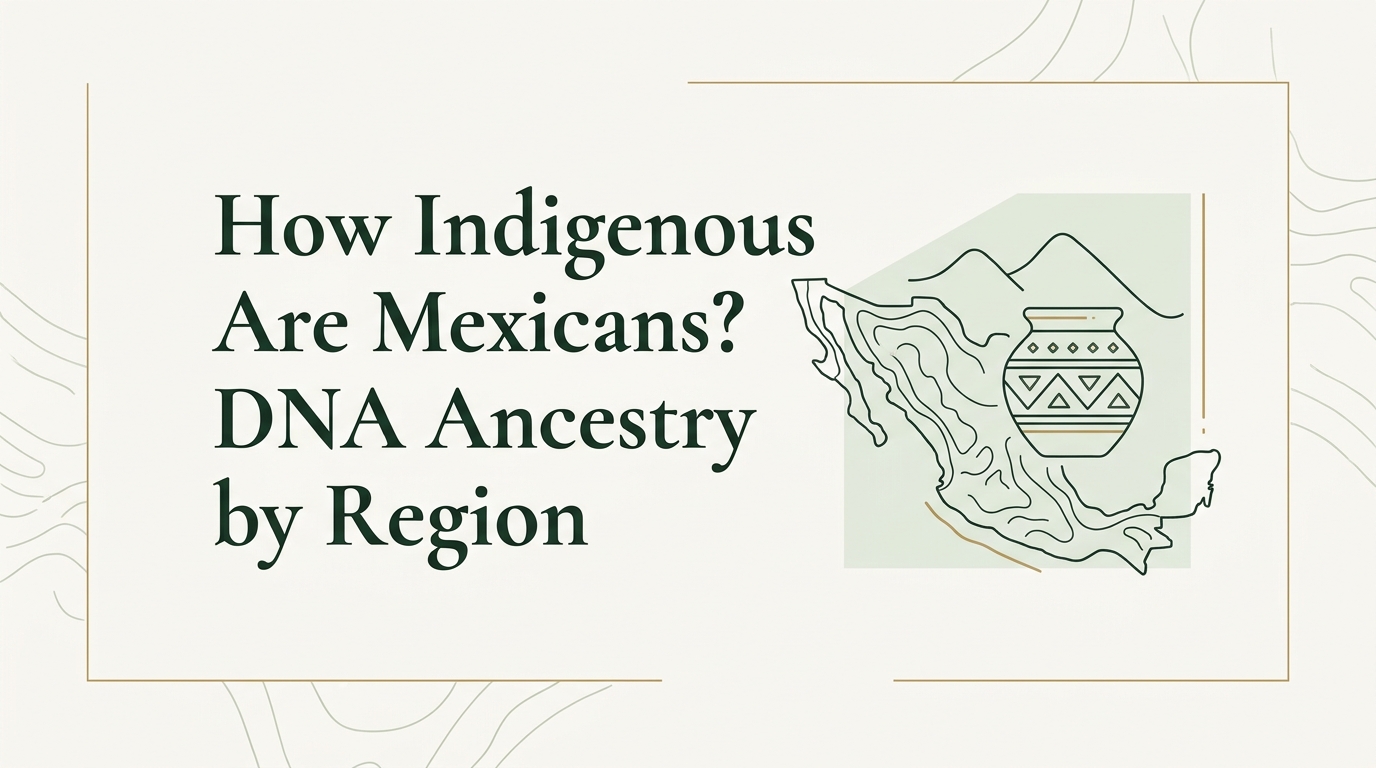
Mexico is often described as a mestizo nation, yet no single percentage can capture the genetic history of more than 130 million people across a country with vast geographic, cultural, and linguistic diversity. A person from Sonora, Mexico City, Oaxaca, Veracruz, or the Yucatan Peninsula may show different patterns of Indigenous, European, African, and, in smaller amounts, East Asian genetic similarity.
Genome-wide DNA studies now make it possible to examine these patterns in far greater detail than older family narratives or broad national labels allow. The overall picture is clear: Indigenous ancestry is a major part of Mexican population genetics, but its average level and its likely regional sources vary substantially across the country.
This article reviews what large-scale genetic studies, the Mexican Biobank, uniparental markers, and ancient DNA research indicate about Mexican ancestry. These findings describe statistical patterns in sampled populations, not a test of any individual's identity, community membership, or cultural belonging.
Key Discoveries / Main Points
Indigenous ancestry is substantial in Mexican mestizo population samples. A major 2009 genome-wide survey estimated an average of 55.2% Indigenous-related ancestry, 41.8% European-related ancestry, and 1.8% African-related ancestry across six sampled states.
Regional variation is more informative than a national average. The same survey ranged from about 36% Indigenous-related ancestry in Sonora to 66% in Guerrero, while later nationwide sampling identified particularly high average Indigenous ancestry in Oaxaca and lower averages in northern states.
Maternal and paternal lineages show a pronounced sex-biased history. About 92.9% of mitochondrial DNA lineages in one mestizo sample were Indigenous-associated, whereas European-associated Y chromosome lineages made up about 64.9% of paternal lines.
Local Indigenous populations matter in ancestry analysis. Genetic studies show that Indigenous ancestry in mestizo populations tends to resemble nearby peoples, such as Nahua-related ancestry in central Mexico, Zapotec-related ancestry in the south, and Maya-related ancestry in the Yucatan Peninsula.
Ancient DNA supports long-term regional continuity in several areas. Genomes from ancient individuals at Chichen Itza show close genetic relationships to present-day Maya populations, while research in central and northern Mexico also identifies local continuity across major environmental and historical changes.
What This Means for Your DNA
For someone exploring Mexican DNA ancestry, a result such as Indigenous Americas, Native American, Iberian, Spanish, West African, or East Asian is best understood as a similarity estimate based on a company's reference panels. It does not directly assign a person to a specific historic people, language group, or present-day Indigenous community. Reference datasets differ between testing companies, so percentages can shift as databases and analytical methods improve.
Regional family history can help make broad ancestry results more meaningful. A Mexican tester with roots in Oaxaca may, on average, be more likely to show strong genetic affinity to southern Mexican Indigenous reference groups than a tester whose recent ancestry is from the northern border states. Likewise, a person with ancestry from the Yucatan Peninsula may receive a distinctly Maya-associated signal, while central Mexican ancestry may overlap more strongly with Nahua-related reference populations.
Haplogroups add another layer, but they answer a narrower question. A mitochondrial DNA haplogroup follows one direct maternal line, and a Y-DNA haplogroup follows one direct paternal line in people who have a Y chromosome. Because each represents only one ancestral path among many, they can reveal the unequal maternal and paternal contributions to Mexico's colonial-era population history, but they should not be treated as a complete summary of a person's ancestry.
Historical and Archaeological Context
Mexico's genetic landscape began long before Spanish colonization. Mesoamerica supported numerous large agricultural societies, while northern regions were home to populations with different settlement histories and lower population densities. This pre-colonial geography helps explain why modern ancestry averages often form a broad north-to-south gradient: regions with dense Indigenous populations before 1519 generally retained a larger Indigenous genetic contribution in later mestizo populations.
The conquest of the Mexica Empire between 1519 and 1521 was followed by devastating epidemics, including smallpox and later cocoliztli outbreaks. Indigenous population losses were enormous in central Mexico, yet they did not erase regional genetic continuity. The colonial population emerged through interactions among Indigenous peoples, Europeans, and Africans brought to New Spain, especially through Veracruz. These processes were not uniform, and their effects differed sharply among regions.
Other migration routes also left smaller but detectable signals. The Manila galleon connected Acapulco and Manila from 1565 to 1815, contributing to Asian migration into New Spain. Recent Mexican Biobank analyses detected East Asian ancestry at low state-level averages, with the highest reported average in Guerrero. Veracruz and the Costa Chica also reflect the enduring genetic and cultural history of Afro-Mexican communities. Mexico's ancestry is therefore not a simple two-way mixture, but a regional mosaic shaped by many populations and historical periods.
The Science Behind It
Genome-wide ancestry studies examine hundreds of thousands of genetic markers distributed across the autosomal chromosomes. Researchers compare patterns in study participants with reference datasets representing Indigenous Mexican, European, African, East Asian, and other populations. Statistical methods then estimate the proportions of a genome that most closely resemble those references. These are population-level models, and their precision depends on the quality, size, and geographic coverage of the reference samples.
The first large Mexican genome-wide survey sampled 300 mestizo participants from six states. Subsequent research expanded the scope: a 2014 study included more than 1,000 individuals from 20 Indigenous and 11 mestizo populations, highlighting substantial genetic differentiation among Indigenous communities. The Mexican Biobank later genotyped 6,057 people from all 32 states and 898 localities, providing the broadest national view to date. Its sampling included many rural participants and Indigenous-language speakers, an important strength, although no study can perfectly represent every Mexican locality or social group.
Population genetic measures also reveal why a generic Indigenous Americas label has limits. The 2014 research reported a high level of differentiation between some Indigenous groups, including the Seri and Lacandon Maya. Long runs of homozygosity in some smaller, more isolated communities reflect historical population size and marriage patterns, not a measure of cultural authenticity or biological worth. Ancient DNA offers a separate line of evidence by comparing genomes from archaeological remains with living populations, but similarity across time should be interpreted as continuity in populations, not as proof that any modern individual descends from a particular ancient person.
In Simple Terms: DNA ancestry tools compare your genetic patterns with reference groups. They can show that parts of your DNA are more similar to people from certain regions, but they cannot determine your culture, legal identity, or exact ancestral village from a percentage alone.
Why It Matters
Mexican population genetics challenges both overly simple narratives: the idea that all Mexicans have the same balanced Spanish and Indigenous mixture, and the idea that one genetic result can define who is Indigenous. The evidence instead points to deep local ancestry, extensive diversity among Indigenous peoples, and a colonial history in which maternal and paternal lines often followed different paths.
As more ancient DNA and carefully sampled modern genomes become available, ancestry models should become more regionally specific. For family historians, the most useful approach combines DNA results with documented relatives, places of origin, historical records, and an awareness that genetic ancestry is only one part of a family's story.
References / Further Reading
- Silva-Zolezzi et al. (2009), genome-wide ancestry survey of Mexican mestizo populations.
- Moreno-Estrada et al. (2014), genetic structure among Indigenous and mestizo populations in Mexico.
- Sohail, Moreno-Estrada et al. (2023), Mexican Biobank population genetics study in Nature.
- Martinez-Cortes et al. (2012, 2013), Y chromosome and mitochondrial DNA lineages in Mexican mestizo populations.
- Rodriguez-Rodriguez et al. (2022), ancient DNA research on Mexico.
- Barberena-Jonas et al. (2026), follow-up analysis of Mexican Biobank genomes.
- INEGI, 2020 Population and Housing Census.