Introduction
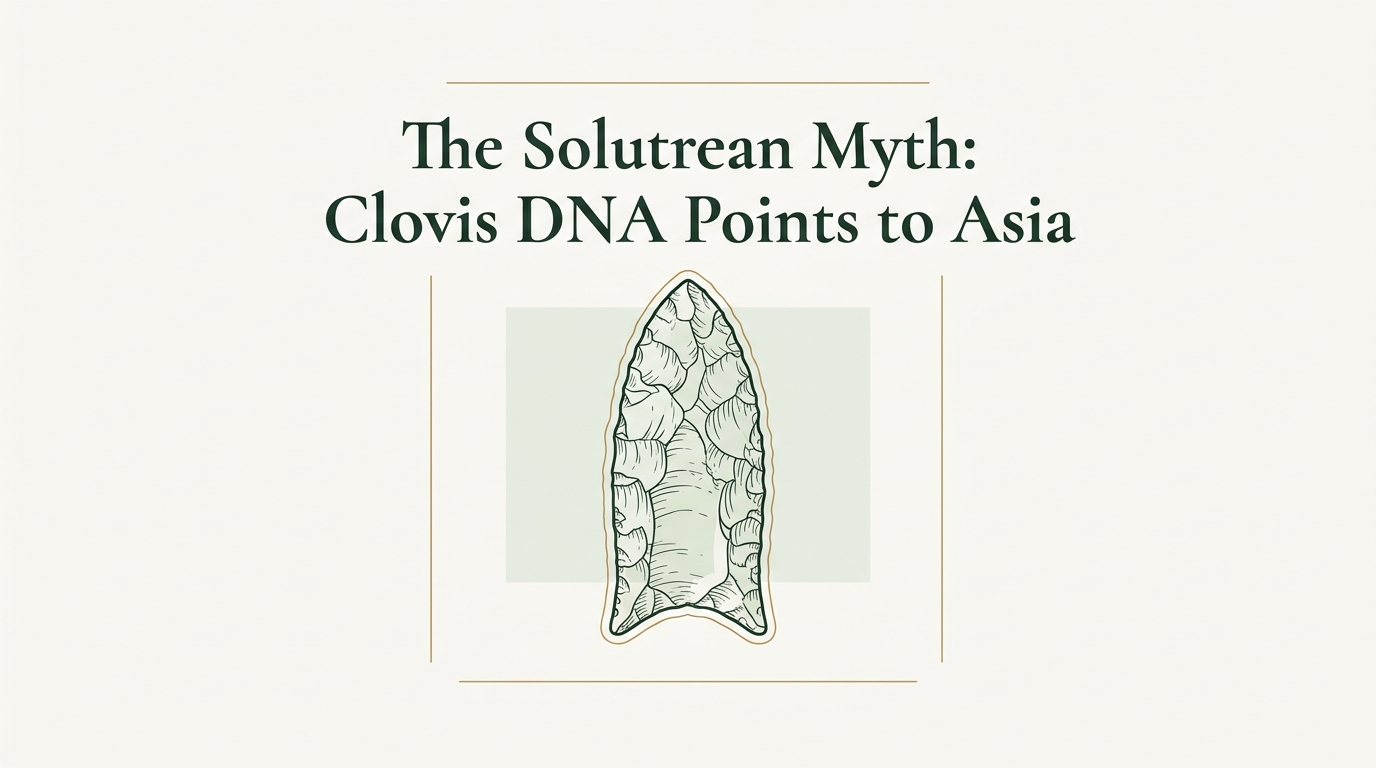
Could Ice Age Europeans have crossed the North Atlantic along sea ice and founded the Clovis culture? The Solutrean hypothesis has long captured public attention because it offers a dramatic alternative account of the first Americans. It proposes that hunter-gatherers from Ice Age France and Iberia traveled west and contributed directly to North America's Clovis people.
Archaeology once left considerable room for debate. Some researchers noted technical similarities between finely made Solutrean stone points in western Europe and Clovis points in North America. Ancient DNA now allows a more direct test: if Clovis people descended in part from Solutreans, their genomes should retain a measurable Solutrean-related signal.
The available evidence tells a different story. The genome of the Anzick child from Montana, the only known Clovis burial, fits within the ancestry of Native American populations. When compared with a real Solutrean genome from southern Spain, its deeper ancestry is explained far better by populations from ancient Siberia. This distinction matters not only for American prehistory, but also for how DNA ancestry results are interpreted.
Key Discoveries / Main Points
Clovis DNA from the Anzick child, dated to about 12,600 years ago, belongs to a population directly ancestral to many Indigenous peoples of the Americas, not to Ice Age Europeans.
The Anzick genome carries Native American-associated uniparental lineages: mitochondrial haplogroup D4h3a and a branch of Y-chromosome haplogroup Q, both consistent with an Asian-derived founding population.
A 24,000-year-old Siberian individual from Mal'ta explains substantially more of the deep ancestry signal in early American genomes than a 23,000-year-old Solutrean individual from Malalmuerzo, Spain.
In Global25-based comparisons, adding Mal'ta-related ancestry improved the model fit for the Anzick genome by 93 units, versus 32 units when adding the Spanish Solutrean genome. Similar results appear across early genomes from Alaska, Nevada, Washington, and Brazil.
Models seeking a Clovis-specific European contribution find little or no extra Solutrean-related ancestry. Values near 0 to 1 percent compared with several early American populations are consistent with statistical noise and shared deep population history, not evidence of a trans-Atlantic migration.
What This Means for Your DNA
For people exploring DNA ancestry, this research highlights an important principle: a shared genetic signal does not automatically identify a recent migration route or a direct ancestral population. Native Americans and Europeans can share some genetic variants without the first Americans having come from Europe. In this case, the connection is better explained by deep population relationships in Eurasia, especially through ancient Siberian groups.
Consumer ancestry tests estimate genetic similarity to present-day or ancient reference panels. They do not read a literal map of every journey made by an ancestor. If an analysis detects broad northern Eurasian, Siberian, or Ancient North Eurasian-related similarity, that result reflects complex population genetics shaped by ancient mixtures, isolation, and genetic drift. It should not be interpreted as proof that a person has a specific Solutrean ancestor.
Haplogroups provide another useful but limited perspective. Maternal mitochondrial DNA and paternal Y-DNA trace only one lineage each among thousands of genealogical ancestors. The Anzick child's D4h3a mitochondrial lineage and Q Y-chromosome lineage support the wider Native American genetic pattern, but ancestry is best understood by combining these markers with autosomal DNA, archaeological dates, and well-contextualized ancient DNA.
Historical and Archaeological Context
The Solutrean culture flourished in what is now France and Iberia roughly 22,000 to 17,000 years ago, during the Last Glacial Maximum. Its craftspeople made sophisticated bifacial, leaf-shaped stone points. Clovis technology emerged much later in North America, approximately 13,050 to 12,750 years ago, a gap of around 4,000 years even when using the later end of the Solutrean chronology.
Proponents of the hypothesis emphasized overshot flaking, a method in which a flake travels across a stone tool's face, as well as proposed early finds from the Atlantic coast of North America. Yet technological resemblance alone cannot establish population descent. Clovis points also have distinctive fluting, a channel flake removed from the base, that is not a Solutrean feature. Archaeologists also question the age or archaeological context of some proposed pre-Clovis Atlantic artifacts. Independent invention, or convergence, is common when skilled toolmakers work with similar materials and practical requirements.
The broader timeline also weakens a Clovis-first or European-first account. Human footprints at White Sands, New Mexico, date to roughly 23,000 to 21,000 years ago, well before the Clovis period. Meanwhile, the Anzick burial in Montana connects Clovis-era people genetically to later and living Native American populations. Across the Americas, ancient DNA supports a history rooted in migrations from northeast Asia and Siberia, followed by diversification within the Americas.
The Science Behind It
The central genetic puzzle involves Ancient North Eurasian ancestry. The Mal'ta child, buried near Lake Baikal in Siberia around 24,000 years ago, belonged to a population related to groups that later contributed ancestry both westward into parts of Europe and eastward into the ancestors of Native Americans. Published estimates indicate that Native American ancestral populations received about 14 to 38 percent of their ancestry from a Mal'ta-related source. This shared heritage can make Native American and European populations appear genetically connected in some comparisons, without requiring an Atlantic crossing.
The analysis described here used Global25, a system that compares genomes using coordinates derived from principal component analysis. Distance measures can show broad genetic affinities, while mixture models test whether adding a potential source population improves the statistical fit for a target genome. The Anzick child is distant from all ancient source groups in absolute terms, partly because Indigenous American populations experienced long isolation and substantial genetic drift. Therefore, the informative comparison is not simply which ancient sample is closest, but which proposed source improves a model more effectively.
When an East Asian hunter-gatherer source from Devil's Gate in the Russian Far East was used as a starting point, the Mal'ta genome consistently improved fits for early American individuals much more than the Solutrean genome did. Adding the Spanish Solutrean sample can provide a small improvement because European and Mal'ta-related groups share older ancestry. But it does not outperform the Siberian explanation. A further test compared Anzick with other Native American genomes while allowing both Mal'ta and Solutrean sources. It found virtually no robust Clovis-specific Solutrean contribution.
In Simple Terms: DNA can reveal whether two ancient groups are likely to share population history. The Clovis child has a small amount of genetic similarity that Europeans and Siberians also share, but the pattern points to Siberia as the main source. It is like recognizing that two distant cousins share a grandparent, not concluding that one moved into the other's home.
Why It Matters
The Solutrean question demonstrates how ancient DNA can move a debate beyond suggestive visual similarities in artifacts. Stone tools remain essential evidence for human behavior, innovation, and adaptation, but genomes provide an independent record of biological population history. Together, archaeology and genetics support a peopling of the Americas connected to northeast Asia and Siberia, followed by long-term population history within the Western Hemisphere.
More ancient DNA from Ice Age Siberia, Beringia, coastal regions, and the Americas will refine this picture. Every newly sequenced individual is still only one person, not an entire culture. Even so, the direct comparison between the Anzick and Malalmuerzo genomes makes the key conclusion clear: current population genetics evidence does not support a meaningful Solutrean contribution to Clovis ancestry.
References / Further Reading
- Rasmussen, M. and colleagues (2014), genome study of the Anzick Clovis child.
- Raghavan, M. and colleagues (2014), genome study of the Mal'ta child and Ancient North Eurasian ancestry.
- Posth, C. and colleagues (2023), ancient genome research including the Solutrean individual from Malalmuerzo, Spain.
- Stanford, D. and Bradley, B. (2012), Across Atlantic Ice.
- Waters, M. R. and colleagues (2020), chronology of Clovis archaeology.
- Research on White Sands human footprints, initially published in 2021 and further confirmed in 2025.